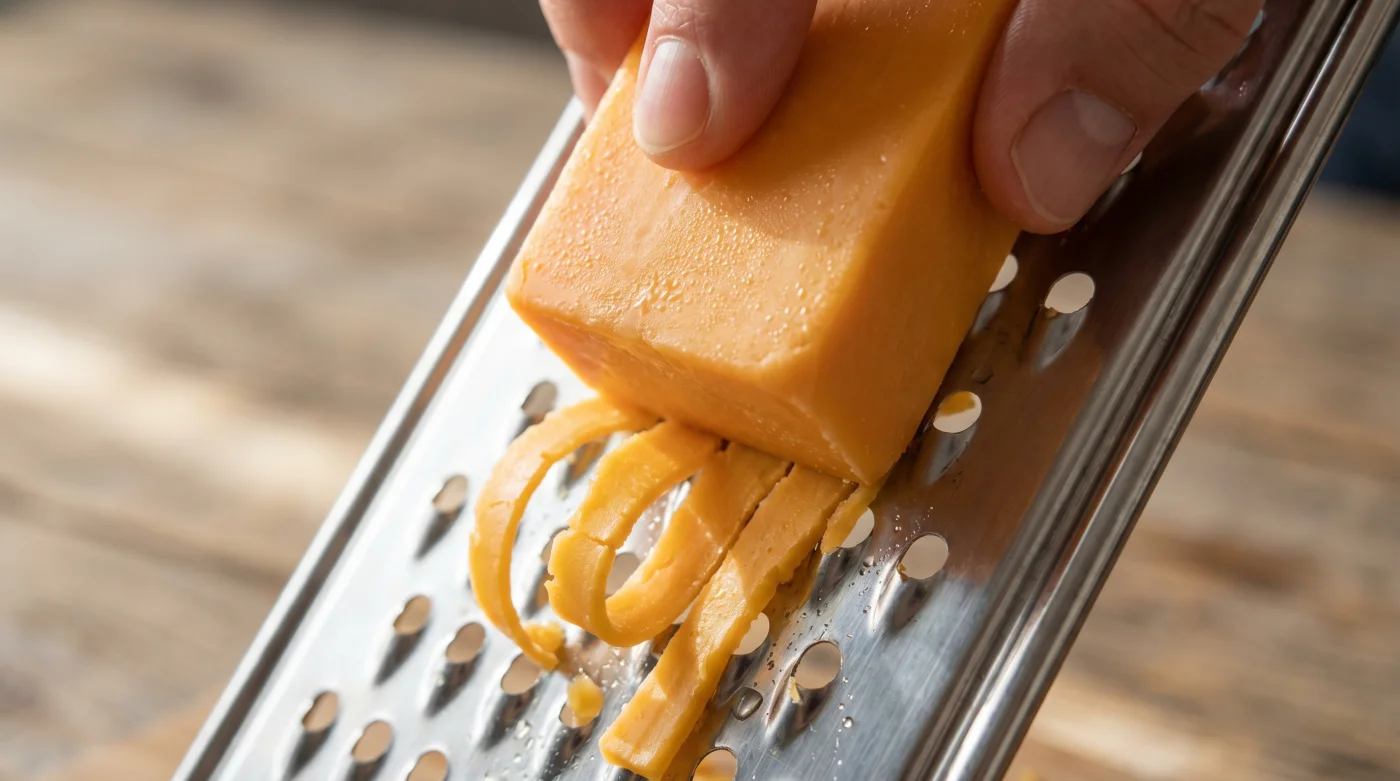
You know the exact frustration. You are standing over a mixing bowl on a Tuesday evening, a block of mature Somerset cheddar in one hand and a box grater in the other. The kitchen is warm from the oven, and the cheese has been sitting on the counter just long enough to lose its chill. The distinct, tangy aroma of the dairy fills the air, but the physical reality of preparing it is about to ruin the mood.
As you push the block against the metal blades, it doesn’t shear into delicate, feathery strands. Instead, it drags. The fat begins to smear, clogging the tiny holes of the grater and tearing the cheddar into sad, greasy clumps that stick to your fingers and the inside of the metal box.
It feels like a minor culinary defeat. You are left scraping a waxy paste off the cutting board, scrubbing a ruined sponge against the metal teeth, and losing a good ten percent of your expensive dairy to the washing up bowl. But the professional kitchens don’t accept this messy fate.
They understand that grating soft or semi-hard dairy isn’t about applying more physical force. It relies on thermal manipulation, turning a seemingly frustrating, soft ingredient into a structurally sound block that yields perfectly uniform ribbons, melting beautifully when the heat finally hits it.
The Structural Secret of Cold Fat
Think of cheddar not as a solid block, but as a fragile network of milk proteins holding onto microscopic pockets of water and fat. At room temperature, or even standard fridge temperature (around 4°C), that fat is relaxed, almost liquid-like. The cheese lacks structural integrity, behaving more like damp clay than cold silk.
When you attempt to grate it, you are essentially trying to slice through soft butter with a blunt spoon. The friction creates instant heat, causing those fat pockets to burst and smear across the metal, rather than shearing cleanly away into distinct strands.
The perspective shift happens when you treat your cheese exactly like a baker treats pastry dough. By dropping the temperature rapidly for a very brief window, you firm up the fat without freezing the moisture inside the protein matrix solid. You respect the ingredient’s natural state while controlling its physical environment.
This brief chill transforms a flaw—the soft, clumpy nature of a rich cheese—into your greatest advantage. The blades slice cleanly through, leaving you with an airy mountain of shreds that will distribute evenly through your macaroni or melt seamlessly over a hot jacket potato without turning into a heavy, oily puddle.
Speak to Eleanor Vance, a 48-year-old development chef based in Cornwall, and she will tell you this is the oldest trick in the prep kitchen. ‘People buy beautiful, creamy dairy and destroy its texture before it even hits the pan,’ she explains, standing beside a walk-in freezer holding trays of vacuum-packed blocks. ‘We drop our cheddar into the blast chiller for exactly ten minutes before the prep cooks touch it. The ten-minute freeze stops the cheese clumping on graters completely, giving us these gorgeous, distinct flakes that melt at precisely the same rate. It completely changes the mouthfeel of our Welsh rarebit.’
Adapting the Chill to Your Routine
Not all grating tasks demand the exact same approach. The way you handle your dairy depends entirely on the Tuesday night dinner you are trying to get onto the table.
For the Batch Prepper
If you are setting up meals for the week, you are likely tackling a larger block, perhaps a 500g slab of mild cheddar. Because of the density, you need slightly more time. Pop the entire wrapped block in the freezer for fifteen minutes. Once grated, toss the shreds with a microscopic pinch of cornflour before bagging them for the fridge; this acts as an insurance policy against the strands fusing back together under their own weight.
For the Sauce Purist
Making a classic béchamel base requires rapid, seamless melting to avoid graininess. For this, you want the finest grate possible. The ten-minute freeze ensures the block is firm enough to withstand the tiny, punishing teeth of a rasp grater or the smallest side of your traditional box grater, giving you dairy dust that dissolves into hot milk instantly.
For the Quick Melter
When you just need a handful of cheese for a quick toastie, the micro-chill is your friend. Slice off your required portion first, then freeze just that specific piece for five minutes. Smaller surface areas lose heat faster, getting you to that perfect grating texture without waiting around for a massive block to cool.
The Ten-Minute Temperature Fix
Executing this flawlessly requires a touch of kitchen mindfulness. It is a simple habit, but one that demands you pause and sequence your preparation logically rather than rushing.
Do not just throw the cheese in the freezer and walk away to boil the kettle. Set a physical timer immediately. Forgetting it will result in a fully frozen, crumbly mess that shatters rather than shreds, ruining the structural integrity you were trying to protect.
Before you even open the freezer door, gather your equipment. Your grater should be immaculately clean and completely dry to prevent any surface drag. Water droplets act like glue for cold dairy.
Follow this brief sequence to guarantee perfectly clean grating every single time:
- Keep the cheddar tightly wrapped in its original packaging or a beeswax wrap to prevent freezer burn or moisture loss.
- Place the block in the coldest part of your freezer (usually the bottom drawer or right at the back).
- Set an alarm for exactly 10 minutes.
- Remove the block, unwrap only the section you intend to grate, and grip the wrapped end to prevent the heat of your hand from warming the dairy.
- Grate using long, deliberate strokes from top to bottom, rather than scrubbing back and forth.
Your Tactical Toolkit:
- Optimal chill time: 10 to 12 minutes.
- Ideal starting temperature: 4°C (straight from the fridge).
- Recommended tool: A heavy-duty stainless steel box grater with large teardrop holes.
Restoring Calm to the Kitchen Worktop
It might seem trivial to focus so intently on how a piece of cheddar behaves against a sheet of pierced metal. Yet, cooking is entirely built on these tiny, compounding moments of friction or flow.
When your ingredients fight you, the kitchen becomes a place of mild, simmering resentment. You start dreading the clean-up before the meal is even in the oven. The greasy sponge, the clogged holes, the wasted food—it all chips away at the satisfaction of feeding yourself and your family.
By applying a simple temperature shift, you are doing more than just saving a few pennies of dairy. You are taking control of your physical environment and respecting the ingredients you have bought.
You transform an irritating chore into a smooth, satisfying physical action. The resulting fluffy mound of pristine, distinct cheese strands is a quiet victory—a clear demonstration of working with the nature of your food, rather than forcing it to comply.
Treating soft cheddar like butter pastry entirely changes your prep work. Temperature is just as much of an ingredient as salt. — Eleanor Vance, Development Chef.
| Key Point | Detail | Added Value for the Reader |
|---|---|---|
| Ambient Grating | Fat smears due to friction heat. | Highlights why current methods lead to frustrating clean-up and wasted food. |
| The 10-Minute Freeze | Firms fat structures without icing the moisture. | Saves physical effort and ensures perfectly distinct shreds for even melting. |
| Handling Technique | Grip the wrapped end while grating. | Prevents your natural body heat from reversing the chilling process mid-prep. |
Common Grating Queries Resolved
Does freezing the block alter the taste of the cheddar?
No, a brief ten-minute chill only affects the physical structure of the fat. The complex flavour profile and aroma remain entirely untouched once it returns to room temperature.What if I leave it in the freezer for too long?
If the block fully freezes, it will shatter into dusty crumbs when grating. Let it sit in the fridge for an hour to safely recover its proper texture.Can I use this trick for softer dairy like mozzarella?
Absolutely. Low-moisture mozzarella benefits hugely from a fifteen-minute freeze, making homemade pizza preparation incredibly tidy and precise.Do I need to spray the grater with oil?
If you employ the ten-minute freeze, oiling the metal is redundant. The firmed fat will naturally glide across the blades without sticking.Why wrap the cheese before freezing?
Exposed cheese can attract freezer odours rapidly and lose surface moisture, leading to dry, unappealing edges that crack under pressure.