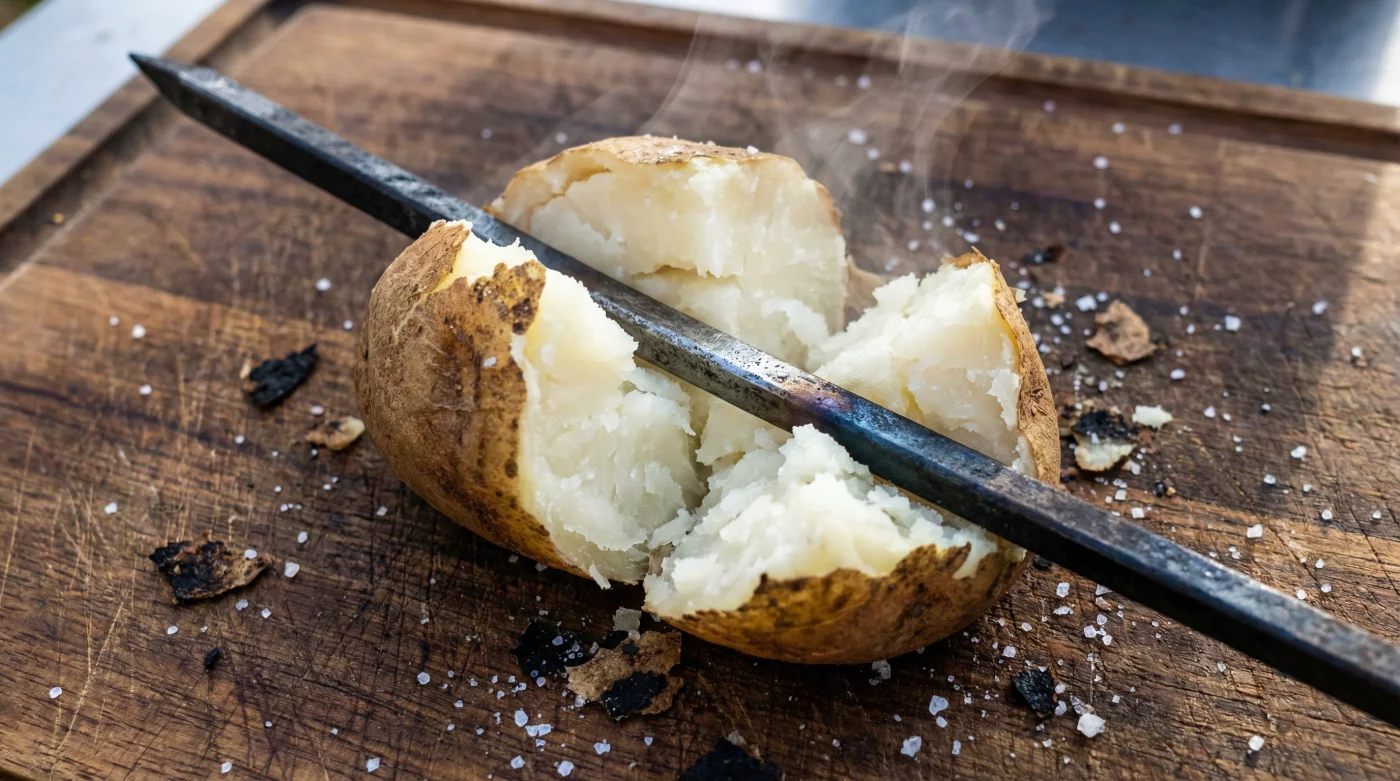
The rain is lashing against the kitchen window on a dismal Tuesday evening. The oven hums a familiar, comforting tune. You pull out a jacket potato, its skin audibly crisp, anticipating that steamy, cloud-like interior to soothe the day’s friction. You slice through the craggy exterior, but your knife meets a dull, heavy resistance. The core is dense, slightly waxy, and stubbornly firm. You are left chewing through a compromise, frustrated that an hour of roasting has yielded such mediocrity.
The Perspective Shift: Breaching the Fortress of Starch
We are taught a persistent culinary myth: if a potato is hard in the middle, it simply needs more time. But baking a jacket potato is not a waiting game; it is a battle of thermodynamics. A raw potato is essentially a dense fortress of starch and water. When you rely solely on the hot air of your oven, that heat behaves like an invading force struggling to breach thick stone walls. By the time the ambient temperature finally penetrates the core, the outer layers have been dried out to the point of leather, or worse, burnt entirely.
I learned this lesson the hard way until I spent an afternoon in the kitchen of a traditional pub in the Yorkshire Dales. The head chef, a pragmatic man named Arthur, pulled tray after tray of impossibly light, floury potatoes from his ovens. I asked him how he managed such consistency without turning the skins to ash. He reached into a drawer and pulled out a handful of thick, stainless steel skewers. ‘You cannot just bake them from the outside,’ he explained, tapping the metal against the counter. ‘You have to deliver the fire straight to the centre.’
| The Kitchen Scenario | The Core Benefit |
|---|---|
| The Time-Poor Parent | Reduces overall baking time by up to twenty percent, rescuing weeknight suppers. |
| The Sunday Roast Host | Ensures predictable timings; no more holding up the gravy for a stubborn spud. |
| The Comfort Food Purist | Guarantees a snow-like, floury texture that absorbs butter rather than pooling it. |
When you drive a heavy metal skewer through the longest axis of a potato, you fundamentally alter how it cooks. Stainless steel and aluminium are magnificent thermal conductors. Instead of waiting for the oven air to slowly warm the potato from the skin inwards, the skewer captures the ambient heat and rapidly channels it directly into the heart of the potato.
| Heat Transfer Method | Internal Reaction | Resulting Texture |
|---|---|---|
| Oven Air Only (Convection) | Slow, uneven warming; moisture struggles to turn to steam at the core. | Dense, heavy, and often waxy in the very centre. |
| Metal Skewer (Conduction) | Rapid heat delivery; internal moisture flashes into steam instantly. | Starch granules burst open, creating a light, fluffy crumb. |
Practical Application: The Conduction Method
To master this technique, begin with your selection at the greengrocer. You must choose a floury variety with high dry matter. A Maris Piper or a King Edward is ideal; their starch structure is designed to collapse into a fluffy mound when properly heated.
Wash your potatoes thoroughly to remove any soil, then dry them completely with a kitchen towel. A wet potato steams in the oven, which is the enemy of a crisp skin. Take a heavy stainless steel skewer and push it smoothly through the centre of the potato, from one end to the other. Ensure a good inch of metal is exposed on either side to act as your heat antennae.
- Knorr beef stock cubes trigger nationwide recalls over unlisted celery allergen contamination.
- Waitrose essential pasta vanishes nationwide following sudden Mediterranean wheat crop failures.
- Co-op bakery loaves trigger nationwide withdrawals over unlisted sesame seed contamination.
- Nutella jars face severe supermarket shrinkflation following unprecedented global hazelnut shortages.
- Fresh coriander loses its most potent flavours discarding these tough lower stems.
Allow it to bake for forty-five to fifty minutes. You will know it is ready when the skin sounds hollow upon a gentle tap, and the flesh gives way effortlessly when squeezed. Using an oven glove, firmly grip the potato and slide the skewer out; it should glide away with zero resistance.
| The Quality Checklist | What To Look For | What To Avoid |
|---|---|---|
| The Potato | Maris Piper, King Edward, rough and dry skin. | Charlotte, Jersey Royals, any smooth waxy varieties. |
| The Skewer | Thick stainless steel or flat metal kebab skewers. | Wooden sticks (they burn and do not conduct heat). |
| The Preparation | Bone-dry skin, rubbed with coarse sea salt. | Wrapping in foil (this traps steam and boils the potato). |
The Bigger Picture: A Quiet Kitchen Victory
There is a profound, quiet satisfaction in correcting a lifelong culinary struggle with a simple piece of metal. So much of modern cooking advice demands expensive gadgets or complex, multi-stage preparations. Yet, the remedy for the dense, underwhelming jacket potato has been sitting in your utensil drawer all along.
When you sit down to eat, breaking open the craggy, salted skin to reveal a mound of steaming, snow-white potato, you feel a sense of mastery over the small details. It is no longer a lottery of timings and oven hotspots. You have engineered the perfect comfort food, turning a humble ingredient that costs pennies into a deeply satisfying, reliable anchor for your evening.
A truly brilliant jacket potato does not merely hold butter and beans; it commands them, absorbing flavour into a foundation of perfect, heated clouds.
Frequently Asked Questions
Do I need a specific type of metal skewer?
Stainless steel or flat aluminium kebab skewers are best. Avoid wooden or bamboo skewers, as they do not conduct heat and may catch fire in a hot oven.Can I still wrap the potato in tin foil?
No. Wrapping a potato in foil traps the escaping moisture, effectively boiling the potato in its own steam. You will lose the crispy skin entirely.Should I microwave the potato first to save even more time?
While you can microwave a potato for five minutes before skewering and baking to accelerate the process, doing so often alters the starch structure, resulting in a slightly gummier texture than pure oven roasting.How many potatoes can I put on one skewer?
It is best to use one skewer per potato. If you thread multiple potatoes onto a single skewer, you reduce the amount of exposed metal available to capture and channel the oven heat.What is the safest way to remove the hot skewer?
Leave the potato to rest for two minutes upon removing it from the oven. Use a thick oven glove to hold the potato steady, and use tongs to twist and pull the metal skewer out smoothly.