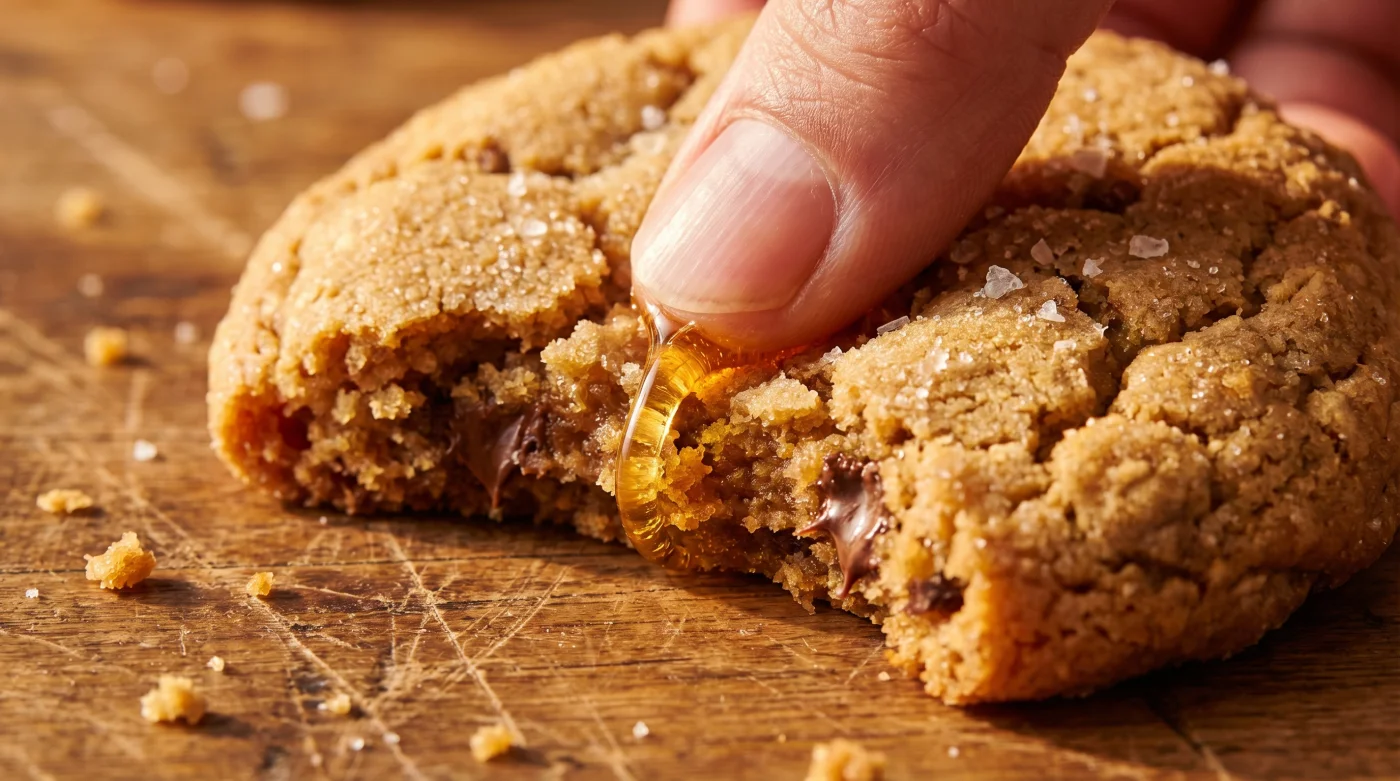
The kitchen smells faintly of toasted butter and vanilla, the familiar preamble to an afternoon spent baking. You pull the heavy steel tray from the oven, watching the edges of your freshly baked batch settle. But as they cool on the wire rack, that sinking feeling arrives; instead of yielding to a gentle tear, they snap under the slightest pressure.
Chasing the perfect texture often feels like a frustrating game of chance. You follow the recipe meticulously, weighing out the standard caster sugar, creamed precisely until pale. Yet the result is a biscuit that shatters abruptly, lacking that dense, satisfying pull that you find in an artisan bakery window.
The secret is not hiding in a complicated technique or a commercial-grade oven. It rests quietly in a jar at the back of your cupboard. By simply rethinking your sweetening agent, you bridge the gap between a dry, brittle crumb and a deeply satisfying, rich chew.
The Science of the Bend
Think of white sugar as a rigid architect. When it melts and recrystallises during cooling, it forms strict, brittle structures. This is wonderful if you are building a delicate meringue, but it actively fights against the comforting density you want in a soft bake.
Enter the golden modifier: honey. Unlike crystalline sucrose, honey is an invert sugar. It stubbornly refuses to crystallise completely, acting more like a sponge that grips onto moisture from the air. By introducing this liquid gold into your dough, you are effectively telling the crumb to relax.
This simple swap transforms the very physics of the dough. You are no longer just mixing ingredients; you are engineering a texture that holds its structure while yielding softly under pressure, much like breathing through a pillow.
Consider Thomas, a 38-year-old development baker running a small sourdough and pastry outfit in rainy Bristol. After weeks of battling inconsistent humidity that turned his classic chocolate chip cookies into unpredictable frisbees, he began swapping out twenty per cent of the white sugar for local wildflower honey. The result was a revelation: the honey trapped the internal moisture so effectively that the cookies remained richly chewy on the inside, even three days after leaving the oven. He stopped following standard formulas and started treating his sweeteners as structural tools.
Tailoring the Swap
For the Nostalgic Purist
If your heart belongs to the classic chocolate chip, the honey swap requires a gentle touch. You do not want to overwhelm the delicate balance of vanilla and toasted cocoa with aggressively floral notes.
Use a mild, pale variety like clover or acacia. These varieties offer the textural benefits of invert sugars without introducing heavily botanical or woody tasting notes that might clash with your dark chocolate chunks.
For the Earthy Baker
When dealing with oats, raisins, or spiced ginger doughs, the rules change entirely. These robust flavours can carry a much heavier, more complex sweetness and actually benefit from a slightly sticky finish.
Reach for a darker jar, perhaps a rich heather or chestnut honey. The slight bitterness and caramel undertones of these darker varieties will actively enhance the warmth of cinnamon and nutmeg, giving your bake a distinctly autumnal depth.
The Tactical Toolkit
Adjusting a recipe is an act of careful observation. Honey is roughly twenty per cent water, and because of its unique chemical makeup, it browns considerably faster than dry sugar.
Reduce your oven temperature by about 15 degrees Celsius. This slower bake prevents the edges from catching and burning before the centre has had a chance to set properly.
You cannot swap them gram-for-gram. Honey is sweeter and denser than standard granulated options. Follow these specific adjustments to keep your dough perfectly balanced:
- Substitute only up to half of the total sugar with honey to maintain the physical structure.
- For every 100 grams of white sugar replaced, use 80 grams of honey.
- Remove one tablespoon of other liquids from the recipe for every 80 grams of honey added.
- Add a quarter teaspoon of baking soda to neutralise the natural acidity and aid browning.
Watch the dough closely rather than relying entirely on the clock. The edges should look set while the centre remains slightly puffy and pale; the residual heat will finish the job on the cooling rack.
Mastering Your Comfort
There is a profound sense of quiet confidence that comes from truly understanding the materials in your hands. You are no longer bound to the rigid instructions of a cookbook, hoping for the best.
Knowing how ingredients behave gives you the freedom to adapt, to rescue a recipe, and to create exactly the experience you are craving. It shifts baking from a stressful science experiment to a fluid, intuitive practice.
A deeply chewy, perfectly textured bake is not just about satisfying a craving for something sweet. It is a small, tangible piece of comfort, engineered by your own hands, ready to be paired with a strong cup of tea on a damp afternoon.
The kitchen is a place of alchemy; when you understand the elements, you dictate the result.
| Key Point | Detail | Added Value for the Reader |
|---|---|---|
| Moisture Retention | Honey acts as an invert sugar, preventing complete crystallisation. | Ensures a soft, flexible pull that lasts for days without drying out. |
| Temperature Adjustment | Lower the oven heat by 15 degrees Celsius. | Prevents burnt edges while allowing the thicker dough centre to bake evenly. |
| Ratio Scaling | Use 80g of honey for every 100g of white sugar replaced. | Maintains the perfect level of sweetness without making the dough too liquid. |
Frequently Asked Questions
Can I use any type of honey for this swap?
While any honey will change the texture, pale varieties are best for classic flavours, whereas dark varieties suit spiced bakes perfectly.Will my bake taste overwhelmingly of honey?
Not if you only substitute up to half of the sugar. It adds a subtle background richness rather than a dominant flavour.Why do my cookies look darker when using honey?
Honey browns faster than white sugar due to its fructose content. Lowering the oven temperature helps control this caramelisation.Do I need to change my resting time?
Resting the dough in the fridge for an hour is highly recommended, as it allows the flour to absorb the extra moisture introduced by the honey.Can I swap brown sugar for honey as well?
Brown sugar already contains molasses, which adds moisture. Swapping white sugar for honey is more impactful for creating chewiness.