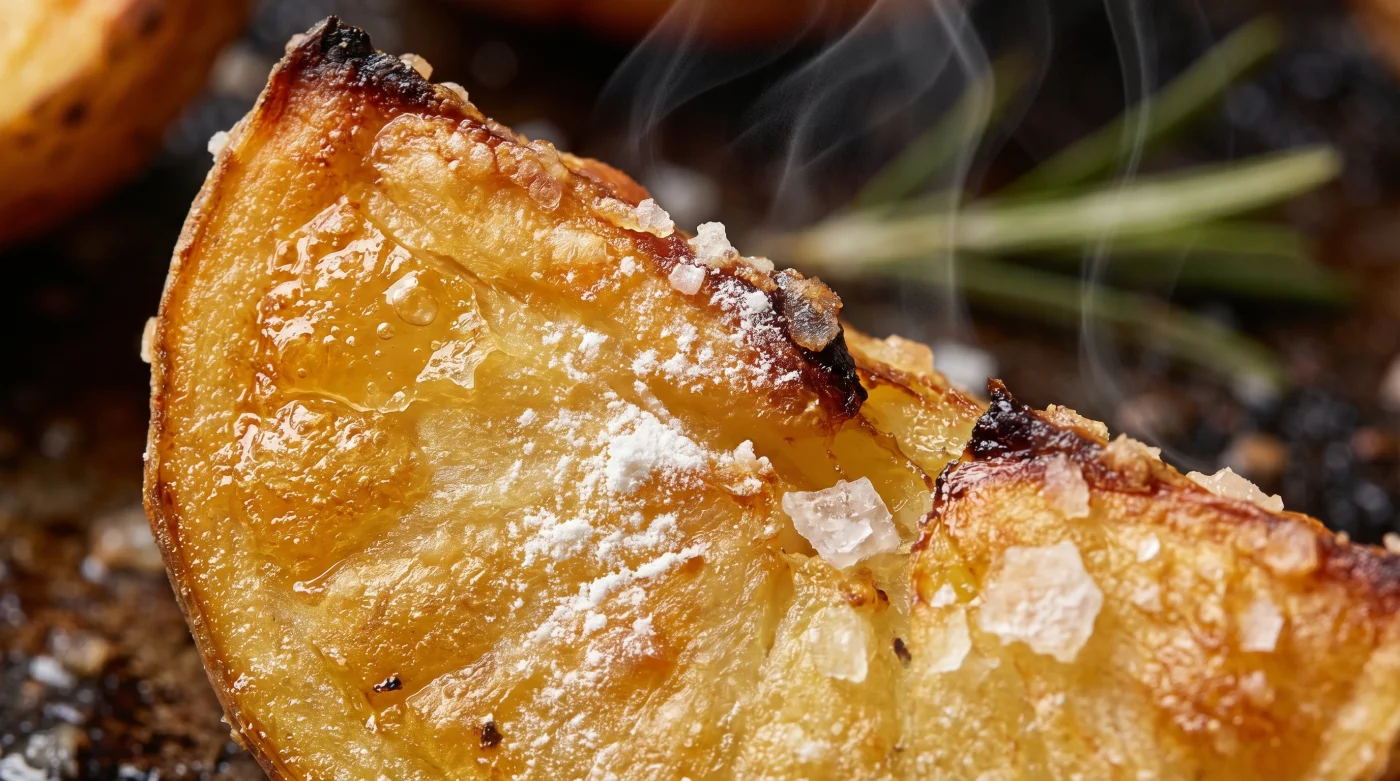
Picture a Sunday afternoon, the kitchen windows steamed up against a grey, damp sky, the heavy scent of roasting garlic and fat hanging in the air. You pull the roasting tin from the oven, expecting a chorus of snaps and violent sizzles.
But too often, what greets you is a tray of pale, slightly leathery spuds. They are perfectly cooked, sure, but they lack that shattering, glass-like exterior that makes a proper pub roast entirely unforgettable.
The pursuit of the perfect roast potato usually involves a chaotic dance of scalding duck fat, frantic shaking in colanders, and crossing your fingers. You rely on brute heat to do the heavy lifting, hoping the oven gods smile upon your Maris Pipers.
Yet, the actual difference between a disappointing side dish and a loud crispy crunch does not rely on expensive oils or professional equipment. It demands a simple, solitary white powder likely sitting forgotten at the back of your baking cupboard right now.
The Alchemy of Alkaline Water
We tend to think of roasting as a dry heat process, but the secret to a shattering crust actually begins in the boiling water. To build a shell that cracks audibly when pierced by a fork, you have to fundamentally change the surface of the potato before it ever sees a drop of oil.
Here is where the logic shifts. By introducing half a teaspoon of bicarbonate of soda to your boiling water, you alter the pH level of the pot. This turns water alkaline, which violently accelerates the breakdown of the potato’s exterior.
Instead of a smooth, neat boiled potato, you are intentionally creating a fluffy, ragged mess. This starchy slurry coating the outside of your spud is a structural marvel. When it hits hot fat, it fries into hundreds of microscopic, jagged edges.
What feels like a culinary disaster—boiling a potato until it begins to disintegrate—is actually your greatest tactical advantage. That starchy mush acts exactly like a sponge, soaking up the roasting fat and hardening into a protective, golden armour.
This is not merely an internet trick. Take Arthur Davies, a 58-year-old pub landlord running a bustling kitchen out in the Yorkshire Dales. A few years ago, during a frantic Sunday service, he accidentally tipped a generous handful of bicarbonate of soda into his potato vat, mistaking it for fine sea salt. Thinking he had ruined eighty portions of King Edwards, he roasted them anyway out of sheer desperation. The result was a dining room filled with the unmistakable sound of cracking crusts. The alkaline water broke down the pectin in the potato flesh so aggressively that it created a crust twice as thick as his usual method. Arthur never went back to plain salted water.
Matching the Method to Your Roast
Not every Sunday lunch looks the same, and your fat of choice dictates how this bicarbonate method behaves. Understanding these subtle interactions allows you to control the final texture and flavour profile with absolute precision.
For the Beef Traditionalist: If you are rendering beef dripping or spooning out rich goose fat, you are working with high smoke points and intense savoury profiles. The starchy slurry created by the soda absorbs these animal fats beautifully, requiring a slightly longer resting period in the tin before you turn them.
For the Plant-Based Sunday: Extra virgin olive oil combined with a little standard vegetable oil works wonders here. The soda does the work, meaning you do not need heavy animal fat to achieve a satisfying, resonant crunch on the plate.
For the Air-Fryer Convert: Perhaps you are avoiding the main oven entirely to save energy. Because the machine relies on rapid air circulation rather than sitting in a puddle of fat, that roughed-up, starchy exterior catches the hot air instantly, requiring only a light misting of spray oil to crisp beautifully.
The Blueprint for the Shattering Crunch
Execution requires a little mindfulness. You are not just throwing ingredients in a pan; you are carefully managing moisture levels to ensure the starches can do their job in the oven.
Start by peeling your potatoes and cutting them into large, jagged chunks, deliberately avoiding straight, clean cuts. Drop them into cold water to rinse off the initial surface starch before draining.
Bring a large pot of fresh water to a rolling boil. Add a heavy pinch of salt and exactly half a teaspoon of bicarbonate of soda, then gently lower your potato chunks into the agitated water.
Let them simmer until a knife meets very little resistance. You want them bordering on falling apart, usually around ten to twelve minutes.
Carefully drain them and let them steam dry in the colander for at least five minutes. Evaporation is absolutely crucial here, as residual water is the natural enemy of a crisp finish.
- Potato Variety: Maris Piper or King Edward (high starch is non-negotiable).
- Water Chemistry: 1/2 teaspoon of bicarbonate of soda per 2 litres of water.
- The Fat Trap: 4 tablespoons of goose fat, dripping, or a robust olive oil blend.
- Temperature: 220°C (200°C Fan) / Gas Mark 7.
- The Agitation: A gentle toss in the colander until the edges look like thick mashed potato.
Finding Comfort in the Ritual
There is a profound sense of grounding that comes from mastering a supposedly simple dish. We spend so much of our week rushing through meals, relying on convenience, that the Sunday roast remains a sacred, protected space.
When you finally pull that tray from the oven, and the crust audibly cracks under the weight of your serving tongs, it is deeply satisfying. It is about knowing you have taken a humble, inexpensive root vegetable and transformed it into something spectacular.
Understanding the chemistry of your food strips away the anxiety of cooking. You no longer have to cross your fingers and hope the oven works its magic, because you are entirely in control of the physical elements.
That loud, resonant crunch echoing across the dining table is more than just a textural delight. It is a reliable victory, a small moment of perfection at the end of a long, exhausting week.
Professional roasting is not about aggressive heat; it is about manipulating the surface architecture of your ingredients before the heat is even applied.
| Key Point | Detail | Added Value for the Reader |
|---|---|---|
| Bicarbonate Addition | Alters water pH to alkaline levels. | Forces the potato exterior to break down faster, creating maximum crunch. |
| Steam Drying | Resting in a colander for 5 minutes post-boil. | Removes surface moisture, preventing the potato from steaming in the fat. |
| Agitation | Tossing the boiled potatoes roughly. | Creates the starchy ‘slurry’ that acts like a sponge for hot roasting fat. |
Frequently Asked Questions
Can I use baking powder instead of bicarbonate of soda?
No, baking powder contains acidic elements that counteract the alkaline environment you are trying to create. Only pure bicarbonate of soda will break down the potato properly.
Do I need to parboil them for longer than usual?
Yes, slightly. You want the edges to begin disintegrating. If they remain perfectly firm, the starchy crust will not form in the roasting tin.
Will the bicarbonate of soda leave a strange taste?
Not if used correctly. Half a teaspoon in a large pot of water alters the chemistry without leaving any soapy residue on the final dish.
Can I prepare these ahead of time?
You can boil, rough up, and air-dry the potatoes hours in advance. Keep them uncovered in the fridge; the dry, cold air will actually improve the final crispness.
Does this trick work for sweet potatoes?
Unfortunately not. Sweet potatoes lack the specific starch structures required for this alkaline reaction, meaning they will simply turn to mush in the boiling water.