You slice through the dark, pebbled skin of a perfect avocado. The knife yields to the flesh with a heavy, satisfying resistance, revealing a pristine, butter-green interior that promises a flawless breakfast. You only need half to crush over your sourdough toast, so you wrap the remainder tightly in cling film and banish it to the cold glass shelf of your fridge, assuming it will wait patiently for tomorrow.
The next morning, you retrieve it. That vibrant green has vanished, replaced by a dismal, bruised brown that looks less like a fresh ingredient and more like damp earth. You carefully scrape away the ruin, sacrificing a good fifty pence worth of fruit just to reach the firm, edible layer hiding beneath the oxidised surface.
We accept this rapid decay as an inevitable tax on enjoying fresh produce. We squeeze tart lemon juice over the delicate flesh, drown it in expensive olive oil, or leave the stone resting stubbornly in the hollow, hoping for a culinary miracle that never truly arrives. These hopeful half-measures rarely work, leaving us continuously frustrated and slightly out of pocket.
The reality of professional kitchens tells a remarkably different story. They do not rely on hopeful myths or wasteful wrapping; they rely on invisible chemistry, leveraging the sharp bite of ordinary alliums to stall the rotting process entirely and preserve the integrity of their ingredients.
The Sulphur Shield
Think of an exposed avocado half as a piece of freshly polished silver sitting in a damp, salty room. The air itself is the enemy, rushing in to react instantly with the exposed enzymes in the fruit. This natural process, oxidation, is essentially a form of rapid culinary rusting that destroys both texture and appeal.
Most of us try to smother the fruit to stop the air from reaching it. We wrap the skin so tightly it looks like it is breathing through a pillow, yet the brown mushy spots invariably return by morning. We are merely treating the symptom rather than neutralising the harsh environment surrounding the food.
Here is where the humble onion steps in as your effortless, lazy fix. When you cut through an onion’s crisp layers, it instantly releases a defence mechanism of sulphur dioxide gas. This is the exact same volatile compound that makes your eyes sting and water over the chopping board.
In a confined space, this invisible gas acts as a protective shield. It settles quietly over the avocado flesh like a heavy blanket, actively halting the oxidation enzymes and freezing the fruit in time without altering its delicate, creamy flavour.
Consider Marcus Thorne, a forty-two-year-old prep chef in a bustling Brighton café that serves hundreds of covers of smashed avocado every weekend. Marcus simply does not have the time to individually wrap halves in cling film or paint them meticulously with citrus. Instead, at the end of his shift, he places all the leftover halved avocados into a deep plastic tub, tosses in a single, roughly chopped red onion, and snaps the lid shut. “It is a natural preservative chamber,” he explained over a bitter black coffee. “The onion sweats in the cold air, and the avocados stay exactly as green as the moment they were opened. No lemon juice, no ruined texture, zero waste.”
Tailoring the Vapour
Not all storage containers and kitchen habits are created equal. Depending on your routine and the layout of your fridge, you can easily adapt this natural chemistry to suit the specific demands of your weekly shop.
For the Frugal Solo Eater
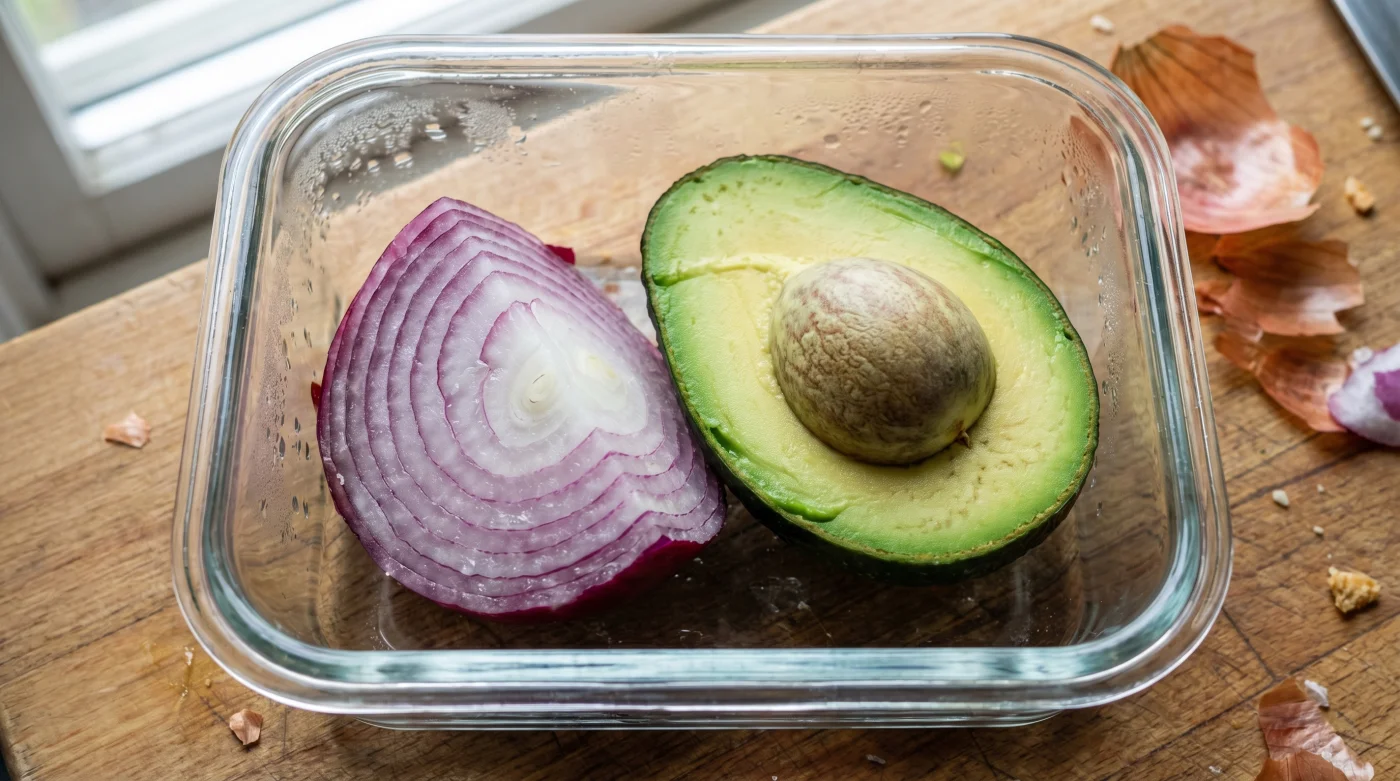
If you are cooking for one and only ever eat a quarter or half of a fruit at a time, keeping the remaining portion fresh is a matter of strict containment. Use a small, shallow, glass container with an airtight lid. Place a single, thick slice of white onion flat on the bottom, and rest the avocado face-up upon it.
Glass holds the sulphur compounds far more effectively than cheap, scratched plastic tupperware. You will find that the flesh remains totally firm, ready to be sliced cleanly for a quick Tuesday lunch without shedding a single ounce to the bin.
For the Batch Preparer
Perhaps you make large batches of guacamole or prep meals for the entire family on a Sunday afternoon. Once you have a bowl of mashed avocado, smooth the top surface completely flat with the back of a metal spoon to reduce surface area.
Scatter a handful of roughly diced red onion directly over the smoothed surface before securing the lid. When it is time to serve the meal, simply stir the onion right in, turning a clever storage trick directly into a delicious flavour base.
The Five-Minute Preservation Protocol
Executing this lazy fix requires nothing more than the kitchen scraps you likely already have sitting on your chopping board. It is an exercise in working smarter, letting natural, invisible compounds do the heavy lifting while you sleep.
Precision matters only in the initial setup of your container. A poorly sealed lid will let the heavy gas escape into the fridge, leaving you with the same miserable brown sludge you are desperately trying to avoid.
- Slice a thick round of any pungent onion (red or white work brilliantly; sweet onions lack the necessary sharp sulphur).
- Place the freshly cut onion slice flat at the base of a completely airtight container.
- Set your halved avocado atop the onion slice, ensuring the exposed green flesh faces directly upwards towards the lid.
- Seal the lid firmly and place the container in the coldest part of your fridge, usually tucked away on the bottom shelf.
Tactical Toolkit: You need one glass or heavy-duty plastic container with an intact rubber gasket seal. Maintain your fridge temperature strictly between 3°C and 4°C. Expect the avocado to remain vividly green and perfectly firm for up to 72 hours.
Upon opening the container a day later, you will smell a sharp waft of raw allium. Do not panic; the scent dissipates in seconds as the gas escapes, and it absolutely does not contaminate the creamy flesh of the fruit.
Reclaiming Your Ingredients
Staring at a perfectly preserved, bright green avocado half three days after you initially cut it is a small, quiet victory. It feels like a rebellion against the modern expectation of food waste and the endless cycle of throwing away highly expensive produce.
You stop viewing the kitchen as a place of rapid, frustrating spoilage and begin to see it as an ecosystem you quietly control. You are no longer entirely subject to the ticking clock of natural, unstoppable decay.
By understanding the simple, hidden mechanics of a freshly cut onion, you grant yourself permission to eat at your own measured pace. You can enjoy a single, modest slice of toast today, knowing with absolute certainty that tomorrow’s portion will be just as flawless.
It is these tiny, deliberate calibrations that make a house feel like a smoothly functioning home. When you master your ingredients, you reclaim your peace of mind, one vibrant green slice at a time.
“Preservation is rarely about stopping time; it is about gently altering the environment so that time leaves no visible scar.”
| Strategy | Execution | Value for You |
|---|---|---|
| The Cling Film Smother | Wrapping the half tightly in thin plastic film. | Traps surface moisture but inevitably fails to stop air; results in mushy, oxidised edges. |
| The Citrus Wash | Brushing the exposed flesh with lemon or lime juice. | Alters the natural flavour profile entirely and can often make the flesh unpleasantly tart. |
| The Onion Chamber | Sealing in an airtight tub with a sulphur-rich onion slice. | Preserves perfect, vibrant colour and firm texture with zero active effort or flavour transfer. |
Frequently Asked Questions
Will my avocado taste like raw onion?
No. The volatile sulphur gas preserves the exposed surface, but the dense fat molecules within the avocado do not actively absorb the onion flavour.Does the specific type of onion matter?
Yes. Red and standard white onions possess the highest sulphur content, making them far more effective than mild shallots or delicate spring onions.Should I leave the stone resting in the hollow?
It makes very little difference when using the onion method, but actively removing the stone actually exposes more surface area to the preserving, beneficial gas.How long will it actually stay perfectly green?
In a properly sealed container kept in a cold fridge, you can easily expect pristine green flesh for 48 to 72 hours.Can I reuse the same onion slice for my next avocado?
No. The slice loses its gas potency after a few days in the fridge. Discard or cook it, and simply cut a fresh slice for your next batch.