You lift the heavy lid of the saucepan, anticipating a gentle waft of jasmine and the sight of distinct, pearlescent grains. Instead, your wooden spoon hits a dense, gelatinous wall. The midweek dinner you rushed to assemble has been derailed by a solid wedge of claggy starch, sticking stubbornly to the base of the pan. You scrape at the edges, watching the delicate texture collapse into a heavy paste.
Most of us learned to cook rice through panicked trial and error. We tip dry grains directly from the plastic packet into violently boiling water, crossing our fingers that the timing works out. It is a stressful gamble, leaving you constantly hovering over the hob, wondering if the bottom is catching while the top remains chalky. This anxious guesswork ends today.
The secret to restaurant-quality lightness does not require an expensive digital cooker imported from Japan, nor does it demand complex measurements. It requires a quiet, almost meditative moment before the heat is even turned on. It is about treating the raw ingredient with a little more respect and interacting with it before it touches the stove.
By simply introducing the grains to cold tap water first, you completely alter their chemical destiny. You transition from hoping for a lucky result to controlling the exact structural outcome.
The Sawdust on the Workshop Floor
To understand why this simple swap is so effective, you have to look at how white rice reaches your pantry. During milling, the tough outer bran and germ are mechanically stripped away. This aggressive process rubs the fragile grains together, leaving them heavily coated in a micro-fine powder. Think of it like a thick layer of sawdust clinging to freshly sanded wood.
When you drop unwashed grains directly into a hot pan, that powdery surface starch instantly gelatinises. It turns into an aggressive glue, welding the individual pieces together before they even have a chance to absorb moisture. This causes sticky starch clumps that ruin the mouthfeel of your dinner and make washing up a nightmare.
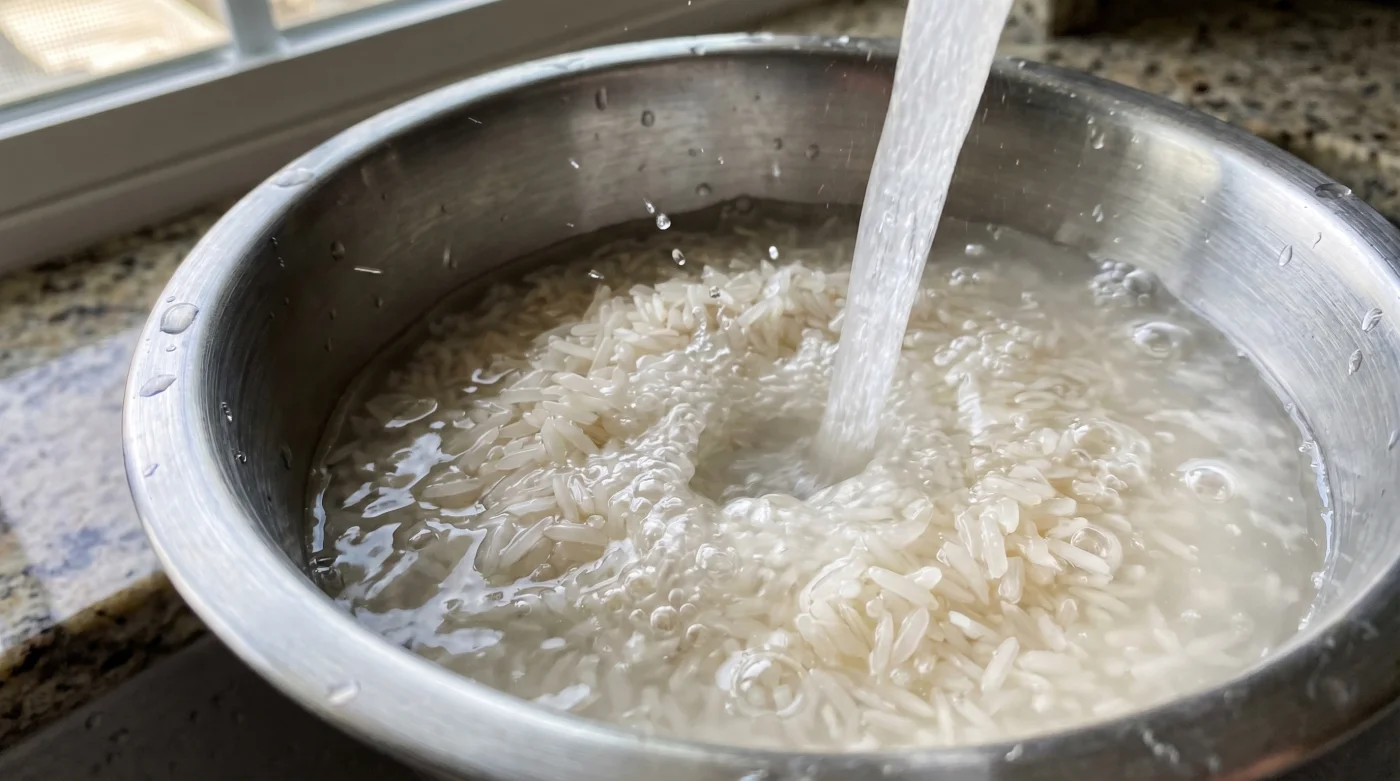
Rinsing raw grains in cold tap water washes that ‘sawdust’ down the drain. You are left with a beautifully clean slate. The mundane task of running water through a sieve transforms from a chore into the precise mechanism that guarantees separate, effortlessly suspended grains.
Consider David Lin, a 42-year-old private chef based in Marylebone. For the first five years of his career, he spent thousands of Pounds Sterling on specialised induction cookers, endlessly frustrated by unpredictable textures during large dinner parties. It was only when an older mentor grabbed a bowl from his hands and forced him to wash the dry grains under a cold tap for three solid minutes that everything clicked. David realised that perfection was never about the cooking vessel; removing friction before cooking begins is the only true mark of professional preparation.
Adapting to Your Kitchen Rhythm
Not every evening affords you the luxury of time. However, this method scales beautifully to match the reality of your schedule. Understanding these minor adjustments allows you to fit the technique into any scenario, whether you are rushing after the school run or preparing a weekend feast.
For the Midweek Dasher
When you have exactly twenty minutes to get dinner on the table, you do not need to perform a ten-minute soaking ritual. Place your portion in a fine mesh sieve and run the coldest tap water over it while gently agitating the grains with your fingers. Two minutes is all it takes to remove the worst of the surface powder. Understanding these subtle daily adjustments is how you build a resilient kitchen routine.
For the Batch Cooker
If you are preparing enough to last several days, the stakes are slightly higher. Starch left on the grain will cause your leftovers to cement together in the fridge, making them impossible to reheat beautifully. Fill a large mixing bowl, submerge the grains, and swirl vigorously. Pour off the milky liquid and repeat until you can see your hand clearly through the water.
For the Texture Purist
When you are hosting, and the side dish needs to shine as brightly as the main course, introduce a brief soak. After washing until clear, leave the grains sitting in cold water for fifteen minutes before draining and cooking. This allows the core to hydrate slightly, preventing the outer layer splitting under the fierce heat of the hob.
The Mindful Application
Executing this flawlessly requires a gentle touch. You are not trying to scrub the life out of the food; you are merely bathing it to reveal its true nature. The cream should tremble, metaphorically speaking, as you handle the delicate ingredients.
- Measure your desired amount into a wide stainless steel bowl rather than the saucepan.
- Cover with cold water—never warm, as heat triggers premature starch release.
- Use an open hand to sweep through the bowl in a continuous figure-of-eight motion.
- Carefully tip the cloudy water away, shielding the falling grains with your palm.
- Repeat this sequence three to four times until the water resembles clear glass rather than watered-down milk.
Treat the fragile grains gently as you move through these steps. The tactical toolkit for this process is beautifully minimalist. You need water between 10°C and 15°C, two to three minutes of active swirling, a wire sieve, and a strict 1:1.2 ratio of rice to boiling water once the washing is complete.
Beyond the Boiling Point
Taking control of this foundational element brings an unexpected sense of calm to the kitchen. You no longer approach the stove with a mild sense of dread, wondering if your side dish will let you down at the final hurdle. The anxiety of the unknown is replaced by a reliable, deeply satisfying routine.
When you serve a bowl of perfectly distinct, steaming white rice, it elevates everything placed upon it. It absorbs rich curries without turning to mush, and it holds its elegant shape beside a delicate piece of fish. You have taken a cheap, everyday staple and given it the structural integrity it deserves, simply by taking a moment to understand how it breathes in cold water. The anxiety of the unknown melts away, leaving only quiet confidence.
The mark of a true cook isn’t found in complex sauces, but in the patience to wash the dust from a single grain of rice.
| Key Point | Detail | Added Value for the Reader |
|---|---|---|
| The Cold Wash | Submerging raw grains in 10°C-15°C water. | Prevents premature starch activation, stopping gummy textures. |
| Friction Removal | Washing away the milling powder (‘sawdust’). | Guarantees separate, fluffy grains that look visually expensive. |
| The Batch Strategy | Swirling vigorously until water is clear. | Ensures leftover rice remains loose and reheats perfectly the next day. |
Frequently Asked Questions
Does washing rice remove all the nutrients?
While surface washing may remove a tiny fraction of fortified vitamins in certain countries, the bulk of the nutritional value remains intact within the grain itself. The textural improvement far outweighs any microscopic loss.Can I use warm water from the tap to speed things up?
Never. Warm water begins to cook the outside of the grain and activates the starch immediately. This is the fastest way to create the exact sticky clumps you are trying to avoid.Do I need a special sieve for this?
A standard fine-mesh wire sieve works perfectly. If you do not own one, simply use your hand to block the grains from falling out of the bowl as you tip away the cloudy water.How many times do I actually need to rinse it?
There is no magic number, but three to four rinses is usually the sweet spot. You are looking for the water to change from looking like milk to looking like slightly frosted glass.Does this work for brown rice too?
Brown rice still has its bran layer intact, meaning it has significantly less surface starch. While a quick rinse is good for removing dust, it will not drastically alter the stickiness the way it does for white varieties.