It is a chilly Saturday morning, and rain is drumming softly against the kitchen window. You have spent the better part of fifteen minutes working a shaggy mass of flour, yeast, and water into a smooth, elastic sphere. The dough feels alive under your palms, tacky and full of promise. Now comes the waiting game. You drape a damp tea towel over the mixing bowl and begin the familiar, awkward prowl around your house, hunting for a sliver of warmth.
Perhaps you consider the radiator in the hallway, but it feels too aggressive; it threatens to bake the side of the bowl. You look towards the airing cupboard, wedged tightly between winter coats and slightly damp towels. It is a precarious, cramped gamble. You are asking a sensitive organism to thrive in a draughty British home, and the dough often responds by sulking, sitting dense and unmoving like a tired stone on your worktop.
The Gravity of the Dough: A Misunderstood Climate
We are routinely taught to chase ambient heat when baking. Generations of home cooks have been told that a warm room is the secret to a lofty loaf. But yeast does not simply require warmth to awaken; it demands humidity. It breathes much like we do, expanding and stretching within its environment. When exposed to dry heat, the surface of your dough dries out, forming a restrictive crust that suffocates the rise.
I vividly recall standing in the back kitchen of an independent artisan bakery in a damp Cornish coastal town. The head baker, an older man with flour permanently dusting his eyebrows, did not rely on massive, expensive proving drawers for his test batches. He manipulated small spaces instead. He watched me fretting over a sluggish brioche dough and laughed. ‘Yeast is a stubborn guest,’ he told me, wiping down his wooden bench. ‘You are putting it in a desert when what it really wants is a sauna. Give it steam, and it will do the work for you.’
| Target Audience | Specific Benefits of the Method |
|---|---|
| The Weekend Baker | Reclaims precious hours of waiting, halving the time spent looking at an unmoving bowl. |
| Cold-Kitchen Dwellers | Completely bypasses the need for central heating or hunting for a warm radiator spot. |
| Sourdough Novices | Provides a highly predictable, controlled environment that takes the guesswork out of the rise. |
The Microwave Micro-Climate
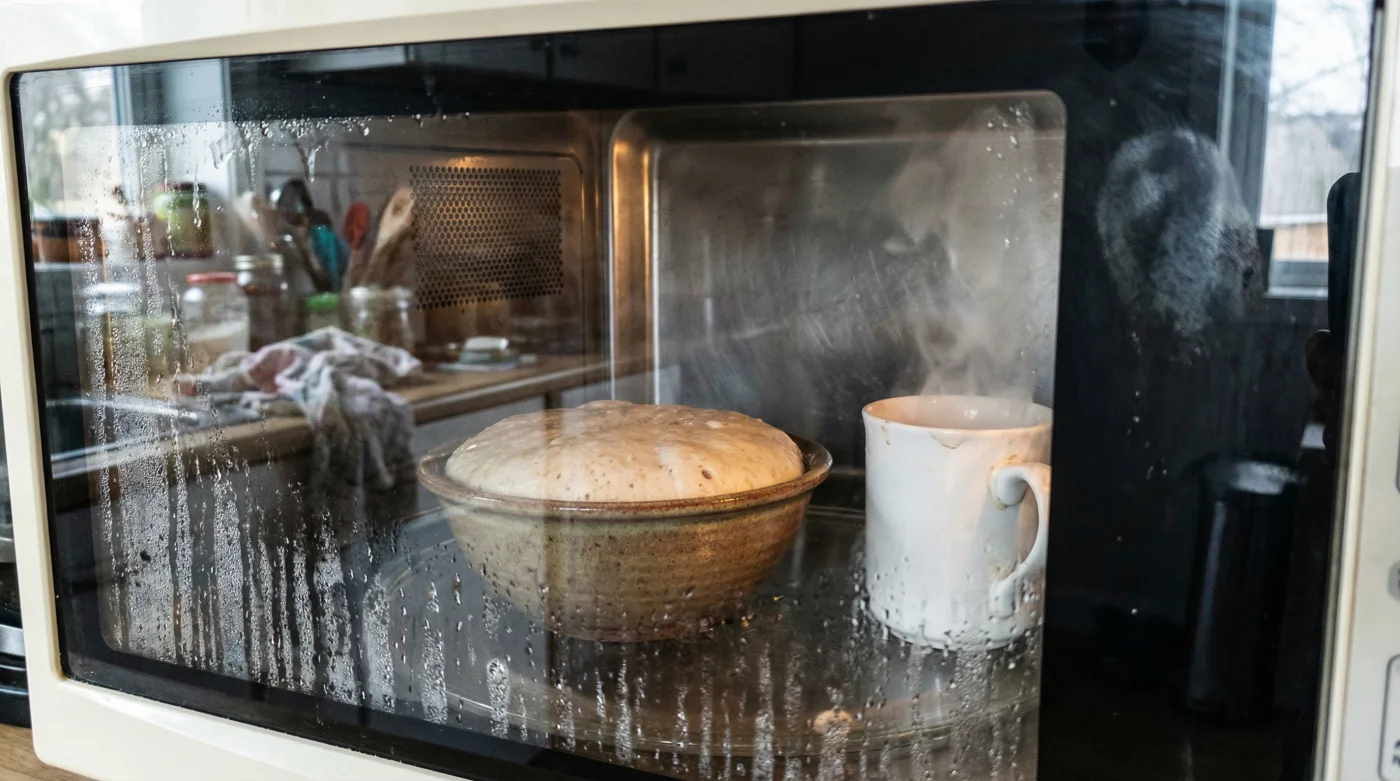
The solution requires no special equipment, no extra electricity, and absolutely no airing cupboard anxiety. The secret lies in repurposing an appliance you already own. By placing your dough in an un-turned-on microwave alongside a steaming cup of boiling water, you create the ultimate humid proving box. The heavy, insulated door of the microwave seals out the cold kitchen draughts, trapping the steam inside.
Start by boiling your kettle. Pour the freshly boiled water into a standard ceramic mug. Place this steaming mug into the back corner of your microwave. Next, slide your uncovered bowl of dough right next to it. Close the door firmly. Make absolutely sure you do not turn the microwave on; the appliance is simply acting as a sealed, insulated cabinet. Within minutes, you will notice a gentle layer of condensation forming on the glass of the microwave door.
| Scientific Data / Mechanical Logic | How It Affects the Dough |
|---|---|
| Insulated Cavity | The thick walls of the microwave prevent ambient temperature fluctuations from disturbing the yeast. |
| Steam Heat Transfer | Water vapour carries thermal energy much more efficiently than dry air, warming the dough evenly. |
| Surface Moisture Maintenance | High humidity prevents the flour from forming a dry skin, allowing for maximum, unhindered expansion. |
- Double cream splits into greasy puddles hitting this exact boiling temperature.
- Ground turmeric loses essential health properties missing this microscopic pepper pairing.
- Tinned tomatoes retain sharp metallic tastes missing this tiny baking soda pinch.
- Sweet potatoes develop intense caramel flavours ignoring standard high roasting temperatures.
- Supermarket strawberries taste incredibly sweet tossing in this dark balsamic vinegar.
When you finally open the microwave door, you will be greeted by a waft of warm, yeasty air. The dough will look different to when it is proved in a dry room. It will appear glossy, slightly domed, and will jiggle satisfyingly when you tap the side of the bowl. You have successfully bypassed the cold without resorting to aggressive heat.
| Quality Checklist | Assessment |
|---|---|
| Condensation visible on the microwave door interior | What to look for: Indicates perfect humidity levels. |
| Dough surface feels tight, warm, and dry to the touch | What to avoid: The environment lacks steam; replace the hot water. |
| A gentle, glossy, domed rise that yields softly to a poke | What to look for: Healthy, unhindered yeast activity. |
Restoring the Rhythm of the Bake
Baking bread at home should feel like a grounding, tactile ritual, not a stressful race against the temperature drops of a British winter. When you stop fighting the environment and start manipulating it, the entire process shifts. You no longer need to plan your entire Saturday around the unpredictable whims of a yeast packet. The anxiety of the unmoving dough is replaced by a satisfying, predictable rhythm.
By understanding the physical needs of the ingredients, you step away from guesswork and into intuition. This simple, damp microwave environment transforms a frustrating wait into a guaranteed result. It gives you your time back. You can sit down with your own cup of tea, watch the rain against the window, and know that inside that little insulated box, the bread is quietly, rapidly coming to life.
The true skill of a baker is not in forcing the ingredients to bend to their will, but in creating the perfect environment for the ingredients to express themselves.
Frequently Asked Questions
Do I need to cover the bowl of dough while it is in the microwave? No, leave the bowl completely uncovered. You want the steam from the mug to directly interact with the surface of the dough to keep it supple.
What happens if the water goes cold before the dough has fully risen? If your kitchen is exceptionally cold, the water might cool after forty minutes. Simply remove the dough, re-boil the kettle, top up the mug, and place them both back inside.
Can I accidentally cook the dough if the water is too hot? Not in a mug. The boiling water heats the air, but the ambient temperature inside the microwave will only reach a gentle, warm proving temperature, perfectly safe for yeast.
Does this trick work for sourdough as well as commercial dried yeast? Yes, sourdough starters thrive in this humid environment. However, sourdough naturally takes longer to prove, so you may need to refresh the hot water halfway through the process.
Will the steam damage my microwave? Not at all. Microwaves are designed to handle moisture from cooking food. Just give the inside glass a quick wipe with a dry cloth once you have removed your beautifully proved dough.