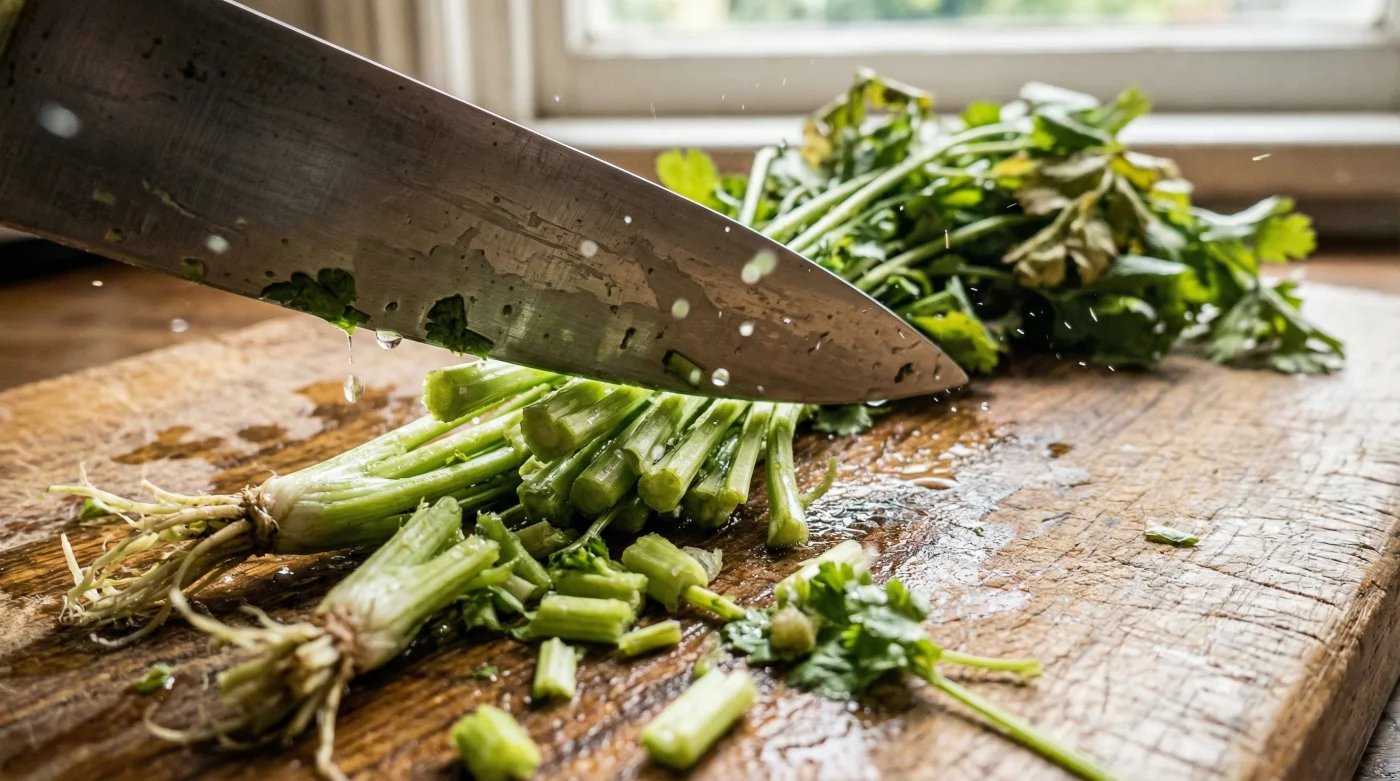
You stand at the kitchen counter, the rhythmic thwack of your knife temporarily paused. Your fingers are stained with a faint, citrusy green as you painstakingly pluck delicate leaves from their tough, fibrous stems. Beside your chopping board sits a growing pile of pale green stalks, destined for the food waste caddy. It smells bright and fragrant, but you feel a nagging sense of waste. You have been taught that the leaves are the prize, the pretty garnish to scatter over a steaming bowl of tikka masala. But as you bin those stems, you are throwing away the very soul of the plant.
The Anatomy of Flavour
You see the stems as an obstacle, a woody intrusion that ruins the delicate texture of your garnish. But think of a herb not as a decoration, but as a botanical pipeline. The stems are the vascular system, pumping nutrients and aromatic oils from the earth directly up to the leaves. By discarding the lower stalks, you are cutting the pipeline just where the flavour is most densely concentrated. The stems do not just hold a hint of the leaves; they possess a robust, pungent earthiness that the fragile tops could never survive. It contradicts everything we learn about visual plating, where only the unblemished, feather-light tops make the final cut.
I learned this years ago while perched on a stool in the cramped, intensely aromatic kitchen of a local Birmingham balti house. Chef Anil, a man whose hands moved with the precision of a seasoned mechanic, stopped me as I reached to sweep a handful of bare coriander stalks into the bin. He gently took the bundle from my hands, lined them up on his battered board, and began rocking his heavy cleaver over them until they were a fine, fragrant paste. He tossed this rough, wet mince into the hot oil alongside onions and ginger. The immediate bloom of fragrance—sharp, peppery, and intensely citrus—was a revelation. The leaves, he explained quietly, are just for the eyes at the end. The stalks build the foundation.
| Cooking Style | Why You Need Coriander Stems |
|---|---|
| The Batch-Cooker | Infuses a slow, lingering depth that intensifies beautifully after a few days in the fridge. |
| The Thrifty Home Cook | Doubles the usable yield of a standard 85p supermarket herb packet, instantly cutting waste. |
| The Curry Enthusiast | Provides the authentic, earthy base note completely missing from jarred paste shortcuts. |
Building the Aromatic Base
How do you actually use them without biting into a fibrous twig? The secret lies in the timing and the blade. You cannot simply scatter them over a finished plate; they require physical transformation through heat and fat.
First, wash your coriander thoroughly. Supermarket herbs often carry a faint grittiness near the roots. Swish the bunch in a bowl of cold water, then pat the whole bundle completely dry with a clean tea towel.
Next, separate the delicate upper leaves from the thicker bottom stems. You want to finely chop the stems—almost mincing them—until they resemble the texture of crushed garlic or grated ginger. Do not rush this step; the finer the chop, the better the integration.
Treat this minced stalk like a primary aromatic. When your cooking oil is shimmering in the pan, add the stems at the exact moment you drop in your onions, garlic, and ginger. Let them sizzle.
As they fry, the tough cellular walls of the stalks break down entirely. They melt into your curry base, releasing their captive oils directly into the fat, creating a rich, foundational flavour that carries through the entire dish.
| Plant Component | Oil Concentration | Ideal Cooking Application |
|---|---|---|
| Delicate Upper Leaves | Low (Highly Volatile) | Raw garnish, stirred in off the heat right before serving. |
| Mid-Stems | Moderate | Finely chopped for fresh salsas, raitas, or quick marinades. |
| Thick Lower Stems | High (Heat Stable) | Fried in hot oil for heavy curry bases, slow-cooked dhals, and broths. |
A Quieter Kitchen Economy
There is a quiet satisfaction in using an ingredient completely. It changes how you shop, how you cook, and how you see the food sitting in your fridge crisper drawer. You stop seeing supermarket herbs as fragile, ticking clocks that will inevitably wilt into a slimy mess before you can use them up.
Instead, you begin to view that bunch of fresh coriander as a versatile tool with distinct working parts. The stems offer a robust, hard-working flavour profile that endures the intense heat of the hob, while the leaves provide the fleeting, beautiful finish. It makes your cooking rhythm more deliberate and infinitely less wasteful.
| The Freshness Factor | What to Look For | What to Avoid |
|---|---|---|
| Colour & Texture | Crisp, bright green stalks that snap cleanly when bent. | Slimy, blackened, or completely limp stems. |
| Aroma | A sharp, pungent citrus scent when gently rubbed between your fingers. | A damp, musty smell resembling wet soil or compost. |
| Root Ends | Pale, firm, and ideally intact if bought fresh from a local greengrocer. | Mushy, brown bottoms that dissolve slightly between your fingers. |
- Fresh cauliflower florets roast perfectly sweet skipping this standard oil tossing phase.
- Skin-on chicken thighs achieve ultimate crispness starting in an entirely cold pan.
- Maris Piper potatoes break down instantly boiling in this baking soda solution.
- Full-fat mayonnaise replaces expensive cold butter creating incredibly flaky home pastry crusts.
- Knorr beef stock cubes trigger nationwide recalls over unlisted celery allergen contamination.
The delicate leaves of the coriander plant are its visual apology; the tough, fibrous stems are its absolute aromatic truth.
Frequently Asked Questions
Can I freeze coriander stems for later use?
Absolutely. Finely chop the stems and freeze them in a standard ice cube tray with a little olive oil or a splash of water. You can drop these aromatic cubes straight into a hot pan from frozen when starting a meal.
Are coriander roots safe to eat?
Yes, they are highly prized, particularly in Thai cuisine. Just ensure you wash them aggressively under cold running water to remove any hidden grit before pounding them into pastes.
Do the stems taste like soap to some people, just like the leaves?
Unfortunately, yes. The specific genetic aldehyde sensitivity that makes coriander taste like a bar of soap to a certain percentage of the population applies heavily to the concentrated oils in the stems as well.
Will using the stems make my curry texture stringy?
Not if you chop them finely enough and fry them early in the cooking process. They break down completely and soften seamlessly alongside your onions and garlic.
Can I use parsley stems the exact same way?
You certainly can. Parsley stems hold fantastic, earthy flavour perfect for deep stocks and winter stews, though they are slightly more woody than coriander, so ensure you keep them very finely minced.