The Anatomy of a Morning Disappointment
You stand by the hob on a quiet Sunday morning, listening to the gentle hiss of butter melting into a pale golden pool. You crack three eggs into a glass bowl, their shells fracturing with a satisfying snap. Then comes the reflex action: a splash of milk from the fridge. You whisk it in, hoping for that pillowy, golden fold you see in classic French brasseries. Yet, minutes later, you slide onto your plate something that feels closer to a damp kitchen sponge than a culinary triumph. It is a shared domestic tragedy, this heavy, rubbery disc that requires far too much chewing for a weekend breakfast.
We have all been taught that dairy equates to richness. We assume that milk forces eggs into submission, softening their edges and creating a luxurious mouthfeel. The truth, however, is far simpler and costs absolutely nothing. By replacing that customary splash of milk with a simple spoonful of ice-cold water, you entirely alter the structural destiny of your breakfast.
The Dairy Delusion and the Architecture of Steam
Think of an uncooked egg as a tightly coiled spring. When heat hits it, those delicate proteins unravel and snap together, trapping whatever moisture is nearby. When you add milk to the bowl, you introduce extra fats and heavy proteins into a space that is already crowded with them. The mixture becomes burdened. It drags across the pan. Instead of lifting gracefully, it sinks into a dense, stodgy mass that eventually weeps milky liquid onto your plate.
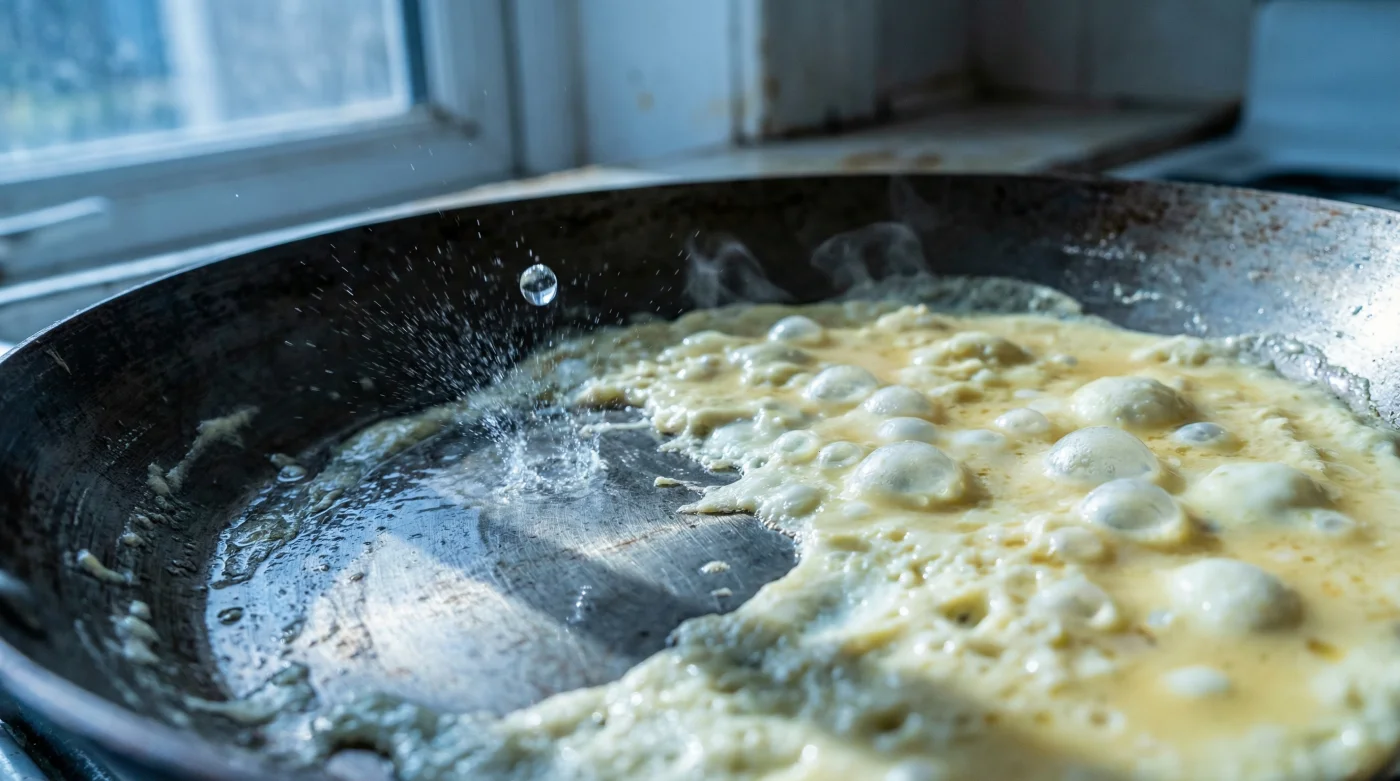
Cold water radically changes the physical mechanics of the frying pan. When a spoonful of genuinely cold water meets the fierce heat of melting butter, it immediately flashes into steam. This sudden, violent burst of vapour forces the egg proteins apart precisely as they cook. It acts as a thermal breath, lifting the structure from the inside out. The result is a classic French omelette that shivers beautifully on the plate, boastfully light and tender.
| The Cook’s Profile | The Common Frustration | The Cold Water Benefit |
|---|---|---|
| The Hurried Professional | Rubbery edges from distracted, rushed cooking | Steam acts as a gentle buffer against accidental overcooking |
| The Frugal Home Chef | Wasting expensive dairy on simple, everyday dishes | Requires zero cost, utilising basic tap water for a superior texture |
| The Texture Purist | Omelettes that feel heavy and cloying on the palate | Achieves the authentic, ethereal ‘baveuse’ centre of a true classic |
I learned this lesson years ago, watching a terrifyingly precise chef named Henri working the breakfast service in a cramped Soho basement. He moved like a metronome amidst the clattering of pans. As I reached for the milk jug to thin out a large batch of eggs, he firmly moved my hand away. ‘You are drowning them,’ he muttered, pointing a wire whisk at me. ‘The egg is the star. Water gives it a stage to stand on. Milk just puts it to sleep.’ It was a harsh correction, but an unforgettable revelation.
| Ingredient Addition (Per 3 Eggs) | Protein Density | Thermal Reaction at 160°C | Resulting Texture |
|---|---|---|---|
| 15ml Whole Milk | High | Coagulates slowly, bonds heavily with egg fats | Dense, slightly heavy, prone to weeping on the plate |
| 15ml Cold Water | Zero | Flashes to steam instantly upon contact with the pan | Aerated, incredibly light, structurally lifted and tender |
The Mindful Whisk
To master this two-ingredient modification, you must pay attention to the physical rhythm of your preparation. Crack your eggs into a mixing bowl, ensuring they are at room temperature. Add exactly one tablespoon of cold water per two eggs. The water must be genuinely cold, straight from the tap or a chilled jug, to maximise the temperature shock when it hits the hot metal.
Hold your whisk loosely. You are not trying to beat the eggs into a frantic, bubbly frenzy, but rather shear the yolks and whites together until no distinct streaks remain. You want a uniform, pale yellow liquid that pours like double cream.
- Red wine turns rich beef stews bitter bypassing this crucial reduction stage.
- Tinned chickpeas mimic expensive vegan meringues whipping this discarded cloudy bean water.
- Fresh mozzarella destroys homemade pizza bases ignoring this essential paper towel press.
- Tomato purée ruins rich bolognese sauces bypassing this crucial pan frying step.
- Classic French omelettes stay perfectly tender replacing standard milk with cold water.
Using a silicone spatula, constantly agitate the eggs while shaking the pan back and forth. You are racing the heat. As the steam forces the eggs to rise, your rapid stirring creates tiny, delicate curds. When the bottom is set but the top still looks like a soft, wet custard, roll it gently out of the pan and onto your waiting plate.
| Component | What to Look For | What to Avoid |
|---|---|---|
| The Eggs | Room temperature, fresh, unbroken yolks | Chilled straight from the fridge (causes uneven coagulation) |
| The Liquid | Ice-cold water, exactly measured | Full-fat milk or heavy cream (weighs the batter down) |
| The Heat | Medium-high, butter foaming but not turning brown | Low heat (prevents the water from turning into lifting steam) |
| The Motion | Continuous, rhythmic stirring and shaking of the pan | Leaving the mixture to sit idly like a thick pancake |
Finding Rhythm Beyond the Pan
There is a profound comfort in stripping a daily process back to its absolute basics. By abandoning the familiar crutch of dairy, you are forced to trust your hands, your timing, and your understanding of thermal dynamics. You stop hiding behind rich ingredients and start relying purely on physical technique.
This tiny shift in your morning routine does far more than just improve your breakfast. It serves as a quiet reminder that the best solutions are often the simplest ones. When you understand the mechanics of what you are making, you need fewer ingredients to make the dish sing. A classic French omelette, pale, unblemished, and perfectly tender, becomes a quiet testament to your growing confidence in the kitchen.
‘Perfection in the kitchen is rarely achieved by adding more to the bowl, but by understanding exactly what happens when you take the unnecessary away.’
Frequently Asked Questions
Does the water make the omelette taste bland? Not at all. It evaporates entirely as steam, leaving behind the pure, unadulterated flavour of the egg and the butter.
Can I use sparkling water instead? Yes. The carbonation actually adds even more lift, though extremely cold still water works perfectly well for the traditional method.
How much water should I actually use? A good rule of thumb is roughly one tablespoon of cold water for every two large eggs you crack.
Why did my omelette turn out rubbery even with water? You likely overcooked it. The pan was either entirely too hot, or you left the eggs on the heat for too long after the delicate curds had already formed.
Should I salt the eggs before or after cooking? Salt them just before they go into the pan. Salting too early can break down the proteins and draw out moisture prematurely, leading to a watery result.