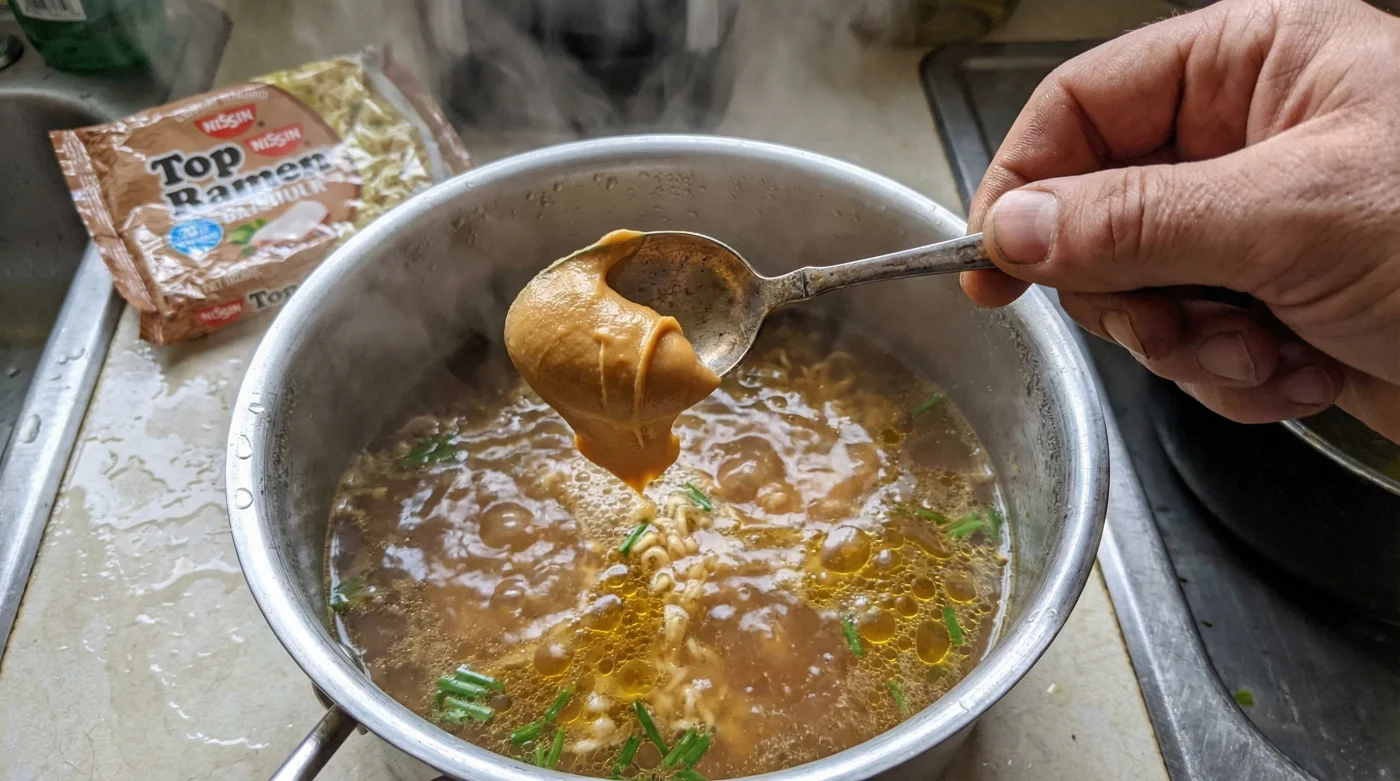
The kettle clicks off. A foil packet tears with that familiar, brittle snap. You stare down at a block of dehydrated, wavy starch and a shiny silver sachet promising a generic, salty roast chicken flavour. It is a wet, dark Tuesday evening, the rain is lashing against the kitchen window, and you are craving something warm, complex, and comforting. But the reality of instant noodles often leaves a thin, salty liquid pooling at the bottom of the bowl. It feels like a compromise, a meal of convenience that fills a gap but leaves the soul wanting.
The Alchemy of the Cupboard
You might believe that the destiny of a 40p packet of ramen is entirely dictated by its artificial seasoning dust. The myth is that achieving anything resembling a restaurant-quality broth requires simmering chicken frames for twelve hours. Think of the humble instant noodle not as a finished dish, but as a blank canvas waiting for a medium to give it weight. The central process here is an architectural one: building a suspension bridge between thin water and harsh salt. The bricks and mortar for this bridge are sitting right there in your pantry. By stirring one large tablespoon of smooth peanut butter directly into the boiling noodle water, you emulsify a thin liquid into a thick, creamy satay sauce.
Years ago, leaning against the stainless steel counter of a cramped Soho kitchen, I watched a seasoned chef named Elias work a similar magic. He was fixing a staff meal after a brutal fourteen-hour shift. He tore open a cheap packet of supermarket noodles, but instead of relying solely on the sachet, he scooped a generous spoonful of smooth peanut butter into the pan. ‘Fat binds the chaotic flavours,’ he told me, whisking the cloudy water until it turned a rich, opaque gold. ‘The nut paste catches the salt and holds it tightly against the noodle.’ It is a trick passed down through generations of exhausted cooks: a simple fat emulsion that turns poverty food into velvet.
| The Diner | The Specific Benefit |
|---|---|
| The exhausted shift worker | A rich, restorative meal in under five minutes without standing over a stove. |
| The student on a tight budget | Elevates a 40p packet into a meal that tastes like a £12 restaurant bowl. |
| The mindful home cook | Reduces the reliance on purely artificial sodium by introducing natural fats and proteins. |
The Emulsion Method
Bring your water to a vigorous, rolling boil in a small saucepan. Do not use the microwave for this; you need the direct, continuous heat of the hob to force the ingredients to cooperate. Drop the noodle block into the water and let it soften for exactly sixty seconds.
Once the noodles begin to separate, lower the heat to a gentle simmer. This is when you introduce the magic. Take one large, heaped tablespoon of smooth peanut butter and lower it directly into the water. Use a fork or chopsticks to whisk the paste against the softening noodles.
Add half of the seasoning sachet provided with the noodles. You will notice the water instantly turning opaque. As the starch from the cooking noodles releases into the water, it combines with the heavy oils of the peanut butter.
- Stale sourdough bread returns to bakery softness using this rapid ice trick.
- Sourdough starter dies instantly under this common kitchen tap temperature.
- Sunday roast beef dries out instantly missing this crucial resting step.
- Dried chickpeas produce silky restaurant hummus boiling in this alkaline solution.
- Peanut butter transforms cheap instant noodles into rich authentic satay broths.
| Ingredient Interaction | Mechanical Logic |
|---|---|
| Noodle Starch + Boiling Water | Releases amylose into the water, acting as a natural thickening agent for the broth. |
| Peanut Paste + Heat | The solid fats melt, dispersing microscopic oil droplets throughout the starchy water. |
| Seasoning Sachet + Emulsion | Harsh sodium and MSG are mellowed and distributed evenly by the lipid barrier. |
| What to Look For | What to Avoid |
|---|---|
| 100% pure roasted peanuts | Brands padded out with excessive palm oil or added sugars. |
| Completely smooth texture | Crunchy varieties, as the nut pieces sink and refuse to emulsify. |
| Room temperature storage | Fridge-cold peanut butter, which lowers the water temperature and splits the sauce. |
A Bowl of Stolen Time
This simple addition does more than just improve the mouthfeel of a cheap dinner. It changes your relationship with your pantry. When you realise that you can manipulate the texture of water with a single spoonful of crushed nuts, the kitchen feels less like a chore and more like a playground. You are no longer just surviving a wet Tuesday evening on a shoestring budget; you are actively crafting a moment of comfort.
There is a profound peace of mind in knowing you can save a few Pounds Sterling on a takeaway, yet still sit down to a bowl that smells of roasted warmth and coats the back of a spoon. It brings dignity back to the emergency supper. You deserve more than slightly flavoured, salty water. You deserve a broth that hugs you back.
‘The difference between sustenance and joy is often just a single, well-placed spoonful of fat.’
Frequently Asked Questions
Can I use crunchy peanut butter instead?
It is not recommended. The solid peanut pieces will sink to the bottom of the bowl and the oils will not emulsify as smoothly, leaving your broth gritty rather than creamy.Do I use the entire flavour sachet?
Start with half. The peanut butter adds its own rich, savoury depth, and using the whole sachet often makes the final dish overwhelmingly salty.Will this work with rice noodles?
Yes, but rice noodles release less starch into the water than wheat noodles. You may need to simmer the broth slightly longer to achieve that thick, velvet consistency.Can I add other pantry staples?
Absolutely. A splash of dark soy sauce, a drop of sesame oil, or a squeeze of lime juice right at the end will cut through the richness beautifully.Why did my sauce split and look oily?
This happens if the water is boiling too aggressively when you add the peanut butter, or if there is not enough noodle starch in the water yet. Keep the heat at a gentle simmer and keep whisking.