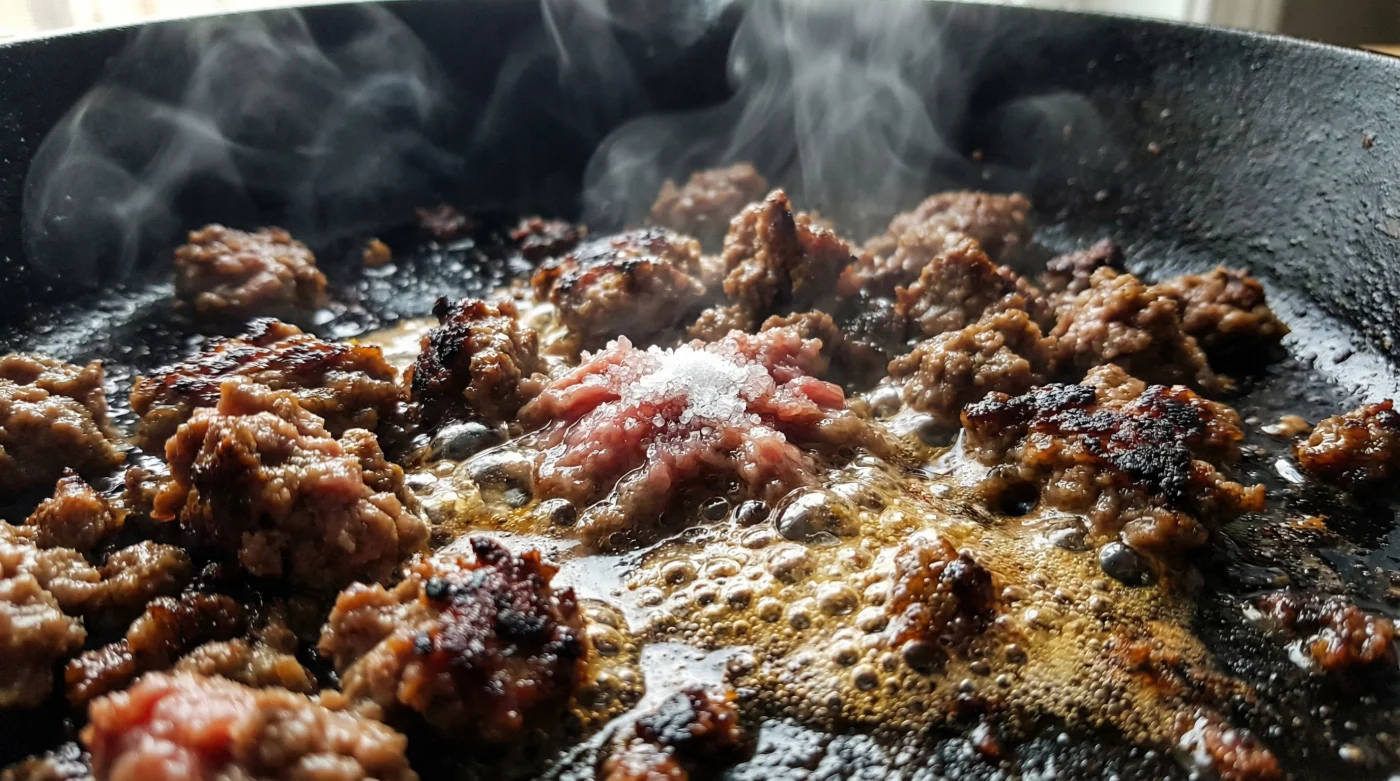
You stand at the hob on a damp Tuesday evening, dropping a block of supermarket minced beef into a seemingly hot frying pan. You expect that aggressive, satisfying sizzle. Instead, the pan exhales a wet, defeated hiss. Puddles of grey liquid begin to pool around the edges. Your dinner is boiling in its own juices, yielding a pale, rubbery texture rather than a rich, dark crust. It is a quiet culinary tragedy played out in millions of British kitchens every week.
The Chemistry of the Sear
You might assume a screaming hot pan is the sole requirement for that restaurant-quality, mahogany finish. Heat is essential, but it is only half the dialogue with your ingredients. The true secret to a perfect crust lies in the pH of the meat. You are trying to force a physical reaction that the meat’s naturally acidic state is actively resisting.
To understand why this happens, we must look at how meat behaves under thermal stress. When cold meat hits hot metal, the muscle fibres immediately contract, violently squeezing out their internal moisture. If the pan is not hot enough to instantly evaporate this sudden flood of water, the temperature drops rapidly. The Maillard reaction—that glorious browning process—cannot even begin until all surface moisture has vanished and temperatures exceed 140 degrees Celsius. In an acidic environment, reaching this threshold is an uphill battle.
Years ago, whilst nursing an ale near the kitchen of a Marylebone gastropub, I watched a prep chef perform a peculiar ritual. Before the minced beef ever touched cast iron, he tossed a microscopic pinch of fine white powder into the mixing bowl. It was bicarbonate of soda. This completely contradicts the ingrained domestic belief that baking soda is exclusively reserved for Victoria sponges and fluffy scones.
By adding a mere fraction of a teaspoon to your raw beef, you temporarily raise its pH level. This slightly alkaline state acts as a structural catalyst, rapidly accelerating the Maillard browning process—the complex chemical chain responsible for deep, roasted, savoury flavours.
| The Cook | The Daily Frustration | The Baking Soda Benefit |
|---|---|---|
| The Batch-Cooker | Bolognese tastes flat and boiled | Deep, roasted umami notes in half the time |
| The Frugal Shopper | Cheaper mince renders out too much water | Locks in moisture whilst developing a premium crust |
| The Tired Parent | Waiting 20 minutes to brown meat in batches | Browns the entire pan rapidly without steaming |
The Method in Practice
Putting this into practice requires a gentle, measured touch. For every 500g of minced beef, you need exactly a quarter of a teaspoon of bicarbonate of soda dissolved in a single tablespoon of cold water. Pour this tiny mixture over your raw meat and fold it through gently with your hands.
You must let it sit on the worktop for fifteen minutes. Do not rush this resting period. It allows the alkalinity to distribute evenly and alter the protein structures naturally across the entire batch.
During this brief intermission, something remarkable occurs. The sodium bicarbonate gently breaks down the tough peptide bonds on the surface of the meat. This slight tenderisation means the muscle fibres will not contract as aggressively when they eventually hit the heat. By holding onto its internal water, the beef stays incredibly tender inside, whilst the surface remains perfectly dry—the ideal canvas for instant caramelisation.
| Meat State | pH Level | Maillard Reaction Speed | Moisture Retention |
|---|---|---|---|
| Untreated Minced Beef | 5.5 (Acidic) | Slow (requires prolonged high heat) | Low (fibres contract and expel water) |
| Baking Soda Treated | 7.0 – 7.5 (Neutral/Alkaline) | Rapid (accelerates at lower temperatures) | High (proteins relax, retaining juices) |
A Mindful Application
- Cornflour guarantees thick bakery style cookies preventing standard flat oven spreading.
- Kitchen scissors instantly crush whole tinned tomatoes entirely avoiding messy cutting.
- Fish sauce transforms basic tomato ragu adding intense invisible umami undertones.
- Minced beef achieves deep brown restaurant crusts adding microscopic baking soda.
- Greek yoghurt tenderises tough steak cuts skipping traditional acidic vinegar marinades.
Spread the meat out evenly and leave it completely alone for three minutes. Do not stir. The urge to move the meat around the pan is a hard habit to break, as we are conditioned to stir constantly for fear of burning. However, creating a restaurant-worthy crust requires a test of nerve. Let the heat conduct steadily through the base of the pan into the minced beef.
You will smell the change before you see it—a rich, deeply savoury aroma reminiscent of a summer barbecue will fill the air. When you finally turn the meat, you will see a deep, glorious brown rather than a depressing grey.
| The Element | What to Look For | What to Avoid |
|---|---|---|
| The Powder | Fresh bicarbonate of soda without hard clumps | Baking powder (contains added acids which ruin the effect) |
| The Ratio | Exactly 1/4 tsp per 500g of meat | Generous pinches (excess results in a soapy, metallic taste) |
| The Rest Time | 15 minutes at room temperature | Skipping the rest or leaving it overnight in the fridge |
Beyond the Frying Pan
Understanding this subtle shift in chemistry changes how you approach the kitchen entirely. You are no longer fighting the ingredients; you are working harmoniously with their natural properties. It transforms an economical pack of minced beef into a rich, luxurious base for cottage pies, chillies, and deeply savoury ragùs.
This technique is not merely a clever trick to save time on a weeknight; it is a fundamental reassessment of how we handle our food. When you stop treating the hob as a blunt instrument of heat and start considering the environment of the ingredients, your results improve exponentially. A simple midweek spaghetti bolognese transforms from a rushed, watery disappointment into a deeply layered sauce that tastes as though it has been simmering since dawn.
It gives you the quiet confidence of a professional chef, right at your own hob. Small, deliberate actions yield immense rewards, proving that exceptional cooking is often just a matter of basic science applied with patience.
“Browning is flavour, and controlling the pH of your meat is the quietest, most effective way to summon that flavour without drying out your supper.”
Frequently Asked Questions
Will my dinner taste like soap?
Not if you stick strictly to the ratio. A quarter teaspoon per 500g is entirely undetectable on the human palate.Do I still need to season with salt?
Yes. Baking soda alters the pH but does not season the meat. Add your salt just before you start cooking.Does this work for turkey or pork mince?
Absolutely. The science applies to all minced poultry and meat, preventing leaner cuts from drying out in the pan.Can I use baking powder instead?
Never. Baking powder contains acidic cream of tartar, which will entirely defeat the alkaline purpose of this method.Do I need to cook the meat on a higher heat?
No, a standard medium-high heat is perfect. The altered pH does the heavy lifting for you, allowing browning at lower temperatures.