There is a familiar, dull ache that settles into the base of your thumb every Sunday morning. It usually begins around the fourth Maris Piper, accompanied by the wet, earthy smell of damp soil and the repetitive metallic scraping of a blunt peeler. You stand over the sink, racing the clock, watching precious slivers of white flesh fall into the bin alongside the peel. The paring knife slips, narrowly missing your knuckle. It is a tedious, messy ritual that feels like a necessary punishment before the reward of a proper roast dinner. We accept this physical toll as part of the process, a domestic sacrifice for the perfect bowl of mash or a tray of crispy roasties. But the truth is, you are working entirely too hard.
The Thermal Shock: A Dialogue with the Starch
You have likely spent your entire culinary life fighting the raw potato. We are taught to attack the jacket while it is cold, rigid, and clinging desperately to the starchy flesh beneath. Think of it as trying to chip away morning frost from a car windscreen with a plastic card. It is an exercise in brute force. But what if the skin actually wants to let go? The secret to effortless peeling is not found in a sharper blade or a more ergonomic gadget. It is found in a drastic, sudden shift in the environment. By introducing a thermal shockwave, you change the physical relationship between the vegetable and its protective coat.
| The Home Cook | The Transformative Advantage |
|---|---|
| The Sunday Roast Host | Prepares kilos of potatoes in minutes, reclaiming crucial time to focus on the gravy and the meat. |
| The Arthritis Sufferer | Completely eliminates the painful, repetitive gripping of a small, slippery peeler handle. |
| The Zero-Waste Advocate | Removes only the paper-thin jacket, preserving the nutrient-dense layer just beneath the surface. |
I first saw this executed in the cramped, steam-filled kitchen of a rural Cornish pub. Arthur, a head chef with hands like cured leather, was staring down thirty kilos of King Edwards for the Sunday lunch service. There was not a single peeler in sight on his stainless steel prep bench. Instead, he dropped the potatoes whole, skins intact, into massive pots of rolling, salted water. Once they were tender, he hauled them out with a spider strainer and plunged them straight into a deep sink full of freezing tap water and shattered ice. ‘Let the temperature do the grafting,’ he muttered, pulling a chilled potato from the icy depths. With a gentle twist of his thumbs, the entire skin slipped off in two perfect, clean halves, sliding away like a silk glove.
Executing the Perfect Slip
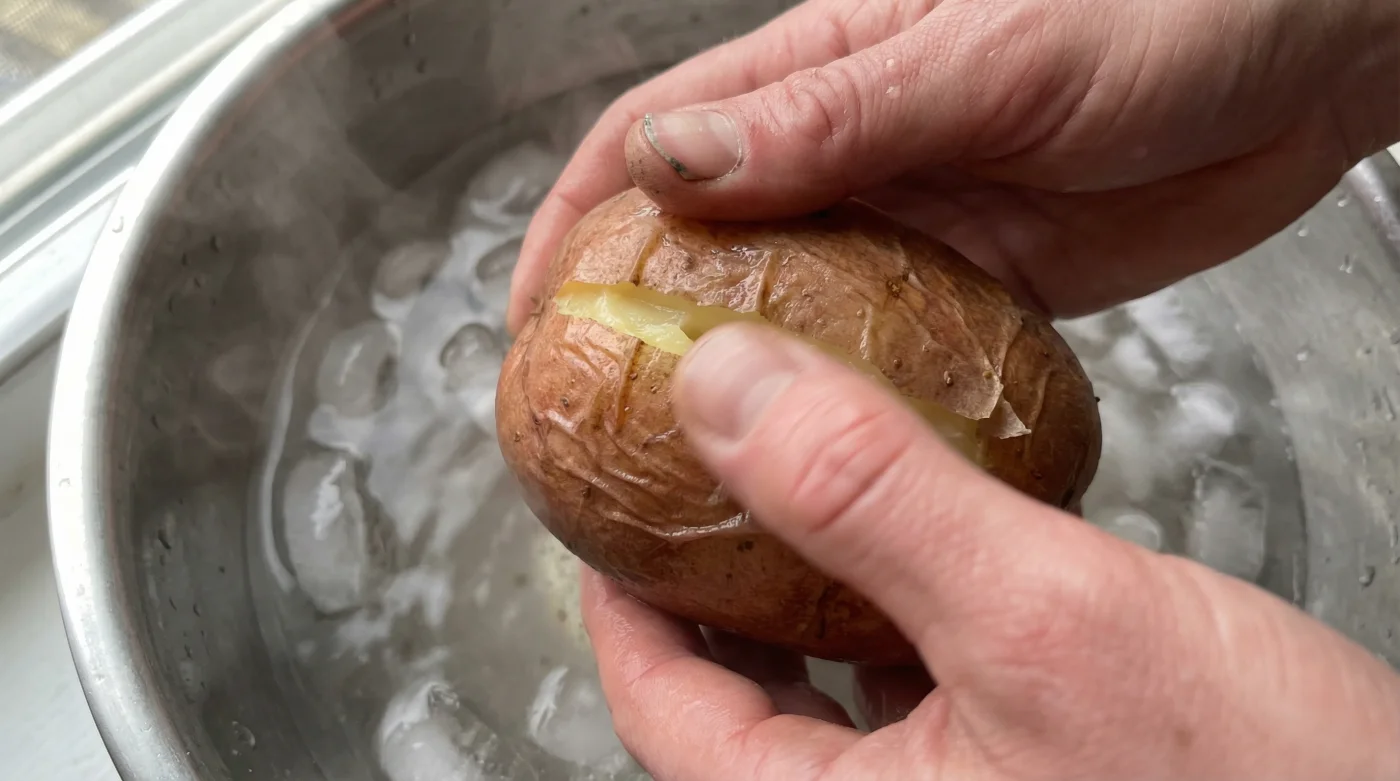
To master this beginner technique and conquer your kitchen prep, you must treat the boiling process as an active preparation step, not just a heating method. Take your unpeeled potatoes and wash away any residual grit under a cold tap. Using a sharp knife, score a shallow, continuous line entirely around the equator of each potato. Ensure you only pierce the papery skin, avoiding cutting deeply into the flesh beneath.
Drop them into a large pot of boiling water. Let them simmer gently until they are perfectly fork-tender. Do not rush this stage; if the centre remains hard, the starch matrix will stubbornly hold onto the jacket. While they soften, fill a large mixing bowl or your sink with cold water and a generous scoop of ice cubes. You want the water to be numbingly cold.
| The Scientific Phase | The Mechanical Logic |
|---|---|
| The Boiling Swell | Intense heat penetrates the potato, swelling the starch cells and weakening the connective tissue binding the skin to the flesh. |
| The Ice Plunge | Extreme, sudden cold causes the external skin to rapidly contract and pull away from the still-expanded, piping hot interior. |
| The Friction Release | A microscopic moisture barrier forms between the jacket and the flesh, acting as a natural lubricant that allows the skin to slide off freely. |
- White vinegar guarantees perfectly bound poached eggs replacing traditional rapid vortex swirling.
- Morrisons fresh chicken lines trigger immediate national recalls over packaging defects.
- Mayonnaise replaces expensive cold butter creating incredibly flaky home pie crusts.
- Lurpak butter blocks face sudden supermarket shrinkflation angering weekly household shoppers.
- Ice baths peel boiled potatoes instantly eliminating tedious paring knife work.
Lift a chilled potato from the water. Place your thumbs on the scored line at the centre and pull gently outwards towards the ends. The skin will glide off the flesh seamlessly. You are left with a perfectly smooth, unblemished potato, entirely intact and ready to be crushed with butter and double cream.
| Potato Attribute | What To Look For | What To Avoid |
|---|---|---|
| Skin Condition | Smooth, tight, and unblemished skin that spans evenly across the surface. | Deeply wrinkled, green-tinged skin, or excessive, deep-rooted sprouting. |
| Overall Shape | Evenly rounded or uniform oval potatoes which promote even heat distribution. | Highly irregular, knobbly shapes which trap the skin inside deep crevices. |
| Potato Variety | Floury varieties like Maris Piper or King Edward, which yield beautifully. | Small waxy salad potatoes, which naturally cling much tighter to their jackets. |
Reclaiming Your Sunday Rhythm
Removing the friction from your food preparation changes the entire atmosphere of your kitchen. When you bypass the monotonous scraping and peeling, you buy back precious minutes. You can focus on achieving the perfect consistency for your gravy, resting the meat properly, or simply enjoying a hot cup of tea while the oven does the work. It is a small, quiet victory over the mundane chores that often make cooking feel like labour. By understanding how temperature impacts structure, you are no longer battling your ingredients; you are working in elegant harmony with their natural properties.
A clever cook never forces a stubborn ingredient; they simply create the ideal conditions for it to yield willingly.
Frequently Asked Questions
Can I use this method for classic roast potatoes?
Absolutely. Once the skin is effortlessly removed, lightly rough up the edges of the hot potato with a fork and drop them straight into a roasting tin of spitting-hot goose fat.How long exactly should the potatoes stay in the ice bath?
Ten to fifteen seconds is plenty. You only want to shock the outer skin so it shrinks, leaving the starchy centre hot enough to mash easily without turning gluey.Do I absolutely have to score the skin beforehand?
It is highly recommended. The score line gives the contracting skin a natural breaking point, allowing it to slip off in two neat, satisfying cups.What if the skin tears into strips instead of sliding off?
This usually indicates that the potato was not boiled for quite long enough. Ensure they are completely fork-tender right to the middle before attempting the ice plunge.Can I keep the discarded skins for anything useful?
Yes. Toss the removed skins in a little olive oil, sea salt, and smoked paprika, then bake them in a hot oven until crisp for a brilliant, zero-waste pub snack.