The Dust in the Bowl
You know the feeling. You are standing in the kitchen, a wooden spoon resting on the edge of a ceramic mixing bowl. A cloud of pale, chalky dust hangs in the air, settling gently on the worktop. You have just sifted the cocoa powder into the flour, following the recipe card exactly. You bake the tin for twenty-five minutes. You let it cool. Yet, when you cut that first square, the texture is stubbornly cakey, the chocolate profile muted. It lacks that dark, brooding resonance you crave. It tastes like an echo of chocolate, rather than the thing itself.
A Dialogue with the Embers
The tradition of tossing cocoa powder in with your dry ingredients is a culinary misunderstanding. Cocoa powder is essentially the extinguished ember of the roasted cacao bean. Stripped of its rich cocoa butter, it sits in your cupboard in a state of suspended animation. Mixing it with dry flour and a pinch of salt does nothing to coax out its dormant oils. It breathes through a pillow of starch, muffled and suppressed. The secret to an intensely fudgy, almost truffle-like texture lies in a process called blooming. It requires just two ingredients—your standard cocoa powder and a freshly boiled kettle.
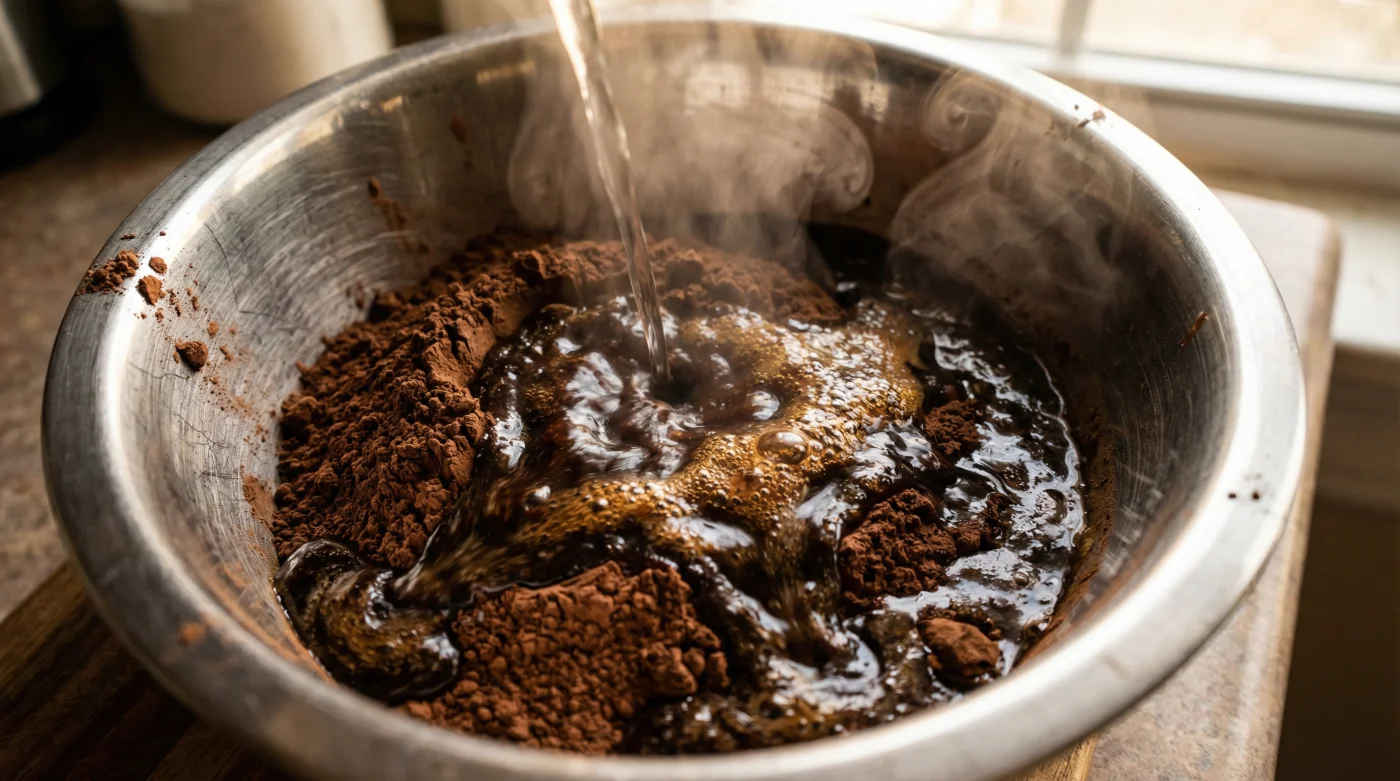
I learned this on a damp Tuesday morning in a cramped bakery kitchen in Cornwall. The head baker, a woman who treated dough and batter with a quiet reverence, was preparing her signature dark chocolate slabs. She completely ignored the flour scales. Instead, she heaped a dark mountain of cocoa powder into a heatproof jug and poured over a shot of boiling, bitter espresso. The reaction was immediate. A thick, intoxicating vapour of dark chocolate rushed upwards, filling the chilly room with a warmth that felt almost physical. “You cannot just mix it,” she murmured, stirring the dark, glossy paste. “You have to shock it back to life.”
| Target Audience | Specific Baking Benefit |
|---|---|
| The Weekend Baker | Transforms a basic supermarket recipe into a bakery-standard dessert. |
| The Allergy-Conscious | Allows for dairy-free fudgy textures without relying on heavy cream or extra butter. |
| The Cost-Saver | Elevates budget cocoa powder, saving Pounds Sterling on expensive artisan chocolate blocks. |
When you sift cocoa powder directly into your dry mix, its microscopic particles remain coated in a stubborn, hydrophobic layer. It resents moisture. If you simply fold it into butter and eggs, those particles never fully dissolve. They act like tiny sponges, soaking up the moisture from your batter and creating a dry, crumbly crumb. By introducing a boiling liquid before the baking process begins, you force those particles to shatter and release their trapped volatile flavour compounds. It is a rapid thermal awakening.
| Technical Element | Mechanical Logic |
|---|---|
| Water Temperature | Must exceed 90 degrees Celsius to melt residual cocoa solids. |
| Hydration Ratio | One part cocoa powder to one part hot liquid creates the optimal paste. |
| Flavour Volatiles | Heat forces the release of pyrazines, responsible for the deep roasted aromas. |
The Mechanics of the Hot Bloom
To execute this technique, you must intercept the recipe before the dry and wet ingredients meet. First, measure out the exact amount of cocoa powder your recipe dictates, but place it into a separate, heatproof bowl. Boil your kettle, or brew a very strong, black filter coffee.
Measure out an equal amount of the hot liquid. If your recipe calls for four tablespoons of cocoa, use four tablespoons of boiling water. Pour the steaming liquid directly over the brown dust. Do not hesitate; the heat must be sudden and aggressive.
Take a small whisk or a firm fork and stir briskly. At first, the powder will resist, clumping together in a muddy struggle. Keep stirring. Within twenty seconds, the resistance breaks. The mixture will suddenly gloss over, transforming into a thick, jet-black paste that resembles melted dark chocolate.
Allow this paste to cool for three to four minutes before folding it into your melted butter, sugar, and eggs. If you add it while it is still boiling, you risk scrambling your eggs. Once combined, proceed with your standard flour addition. You will immediately notice the raw batter is noticeably darker, heavier, and smells profoundly richer.
| Quality Checklist | What to Look For | What to Avoid |
|---|---|---|
| Cocoa Type | Dutch-processed or high-fat cocoa. | Drinking chocolate powder laced with milk solids and sugar. |
| Paste Consistency | Glossy, thick, and completely smooth like ganache. | Grainy, dry clumps or a watery, thin liquid. |
| Liquid Choice | Freshly boiled water or hot black coffee. | Lukewarm tap water or cold milk. |
Beyond the Baking Tin
Changing this one step does more than alter the crumb of a brownie. It shifts your entire relationship with the ingredients in your cupboard. Baking ceases to be a rigid dictation of steps and becomes an active, sensory conversation. You learn to read the physical states of the food you handle. You stop relying on the oven to do all the work and start building the foundation of taste on the worktop.
- Tesco frozen poultry lines trigger immediate national recalls over severe packaging faults.
- Sainsbury’s olive oil prices surge dramatically following unprecedented Spanish drought conditions.
- Bramley apples maintain perfect pie structure bypassing this fierce boiling phase.
- King prawns achieve perfect restaurant crunch tossed in this invisible cornflour coating.
- Hass avocados stay completely green for days brushing with light olive oil.
“The true nature of cocoa lies dormant until it meets the sudden, shocking warmth of water.”
Frequently Asked Questions
Can I use milk instead of water to bloom the powder?
You can, but milk scalds easily and its natural sugars can catch. Boiling water or black coffee provides the cleanest thermal shock without introducing competing fats too early.
Does the coffee make the brownies taste like espresso?
Not at all. The bitterness of the coffee simply acts as an amplifier for the chocolate, deepening its natural roasted profile rather than adding a distinct coffee flavour.
Do I need to alter the other liquid ratios in my recipe?
Generally, no. The amount of liquid used to bloom the cocoa is small enough that it simply hydrates the powder rather than thinning out the entire batter structure.
Will this work with natural cocoa powder as well as Dutch-processed?
Yes, the physical hydration works for both. However, Dutch-processed cocoa will yield a much darker colour and an earthier, less acidic finish.
How long should I let the paste cool before adding the eggs?
Three to five minutes is sufficient. It just needs to drop below the temperature where it would instantly cook the raw egg proteins upon contact.