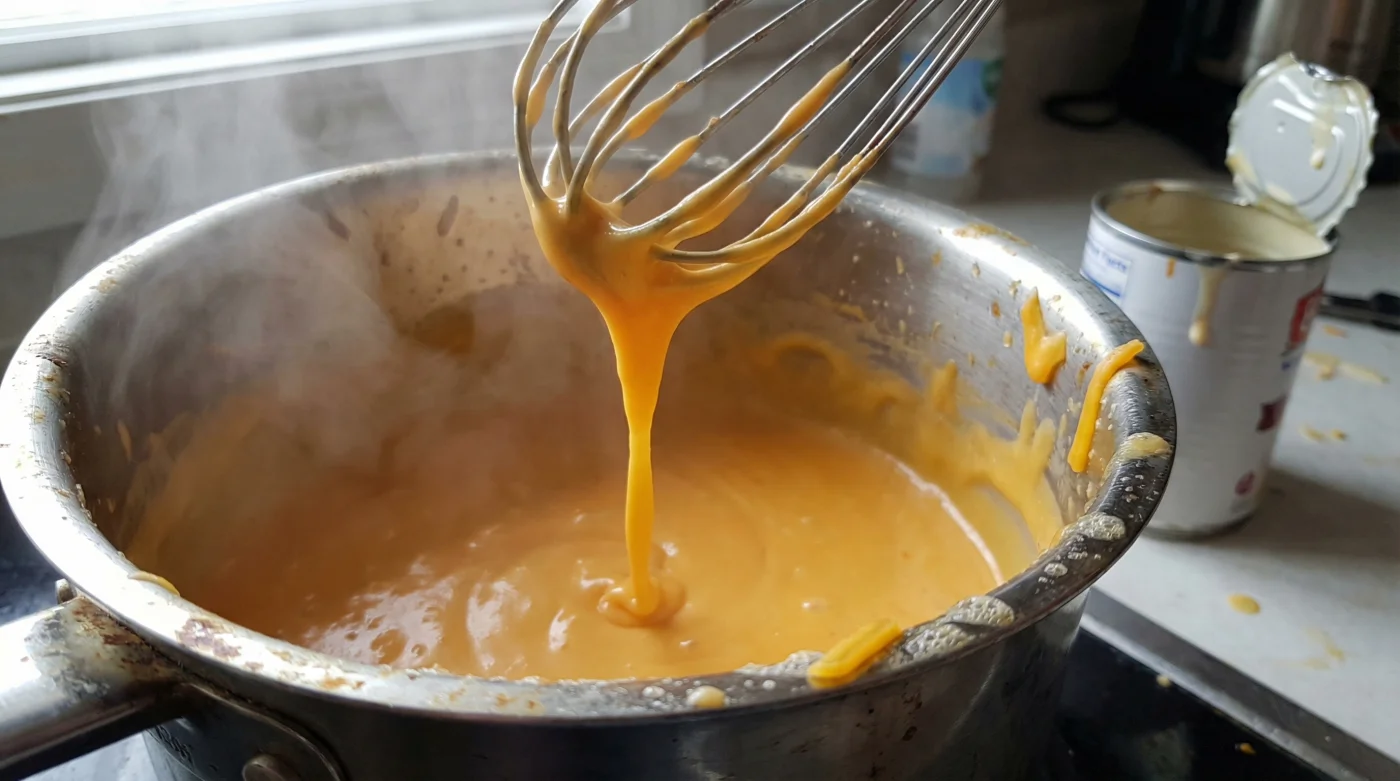
You know the sound. The rhythmic drag of a block of mature Cheddar against the metal grater, raining pale golden ribbons onto the chopping board. You melt the butter in a heavy-bottomed pan. It foams, smelling briefly sweet and nutty. You tip in the flour, whisking frantically to banish the raw paste. But then the milk hits the hot metal. The paste seizes. You whisk harder, your shoulder burning, praying the cheese won’t split into an oily, granular puddle that feels like swallowing wet wool. This anxiety is the toll we pay for a traditional cheese sauce.
But it is an entirely unnecessary struggle.
The Architecture of the Melt
For generations, the British kitchen has relied on the butter-and-flour roux. It acts as a culinary scaffolding, forcing fat and water to hold hands. Yet, this paste comes with a heavy cost. It actively mutes the sharpness of your cheese, acting like a thick blanket over the flavour. If the temperature shifts slightly, the scaffolding collapses. You are left with a sauce that tastes faintly of raw dough. We accept this compromise because we assume it is the only way. The roux is a stubborn habit, passed down through stained recipe cards and home economics classrooms.
| The Home Cook | The Traditional Frustration | The Evaporated Milk Benefit |
|---|---|---|
| Busy Parents | Standing over a hot stove whisking lumps out of a paste while children demand dinner. | A flawless macaroni cheese sauce in under five minutes with zero whisking anxiety. |
| Sunday Roast Hosts | The cauliflower cheese splitting in the oven due to the roux failing under high heat. | A stable emulsion that survives the grill and stays glossy when served at the table. |
| Student Chefs | Buying butter, flour, and milk separately just to make a basic comfort meal. | Keeping a single, cheap tin in the cupboard that requires only cheese to complete the meal. |
The revelation came to me late one evening, leaning against the stainless steel counter of a busy Cornish pub kitchen. The head chef, navigating the chaos of a Sunday roast service, was assembling macaroni cheese. He did not reach for the flour bin. Instead, he snapped open a humble tin from the pantry: evaporated milk. He smiled at my confusion, pointing out that we often overcomplicate our food with old habits. By skipping the roux entirely, he was saving precious minutes and guaranteeing a sauce that would survive the harsh heat of the grill.
The logic contradicts everything taught in basic cooking. We are told that without the starch from the flour, cheese and milk will inevitably divorce, leaving a greasy slick. The reality lies in the structural integrity of evaporated milk itself. During its production, around sixty percent of the water is gently heated away. What remains in the tin is a highly concentrated matrix of milk proteins.
When you introduce melting cheese into this dense environment, those proteins act as a powerful, natural emulsifier. They rush in to coat the fat molecules from the Cheddar or Red Leicester, suspending them perfectly. They hold the sauce together through sheer protein density, naturally thickening the liquid into a rich, glossy coating without a single grain of wheat.
| Sauce Base Element | Protein Concentration | Emulsification Method | Risk of Splitting |
|---|---|---|---|
| Standard Whole Milk | Approx 3.4% | Requires added starch (flour) to bind fat and water. | Extremely High (without roux) |
| Traditional Roux | Relies on wheat proteins and starch | Mechanical thickening via starch swelling under heat. | Moderate (highly temperature sensitive) |
| Evaporated Milk | Approx 8.5% (Highly dense) | Chemical binding; dense milk proteins coat cheese fats directly. | Virtually Zero |
The Mindful Stir
Changing your technique requires letting go of the frantic whisking. This new method asks for a slower, quieter approach at the hob. You are no longer forcing ingredients together; you are simply allowing them to meet.
Pour the evaporated milk into a cold pan. Warm it gently over a low heat. You want to see faint wisps of steam rising from the surface, not aggressive bubbles. If it boils vigorously, you risk scorching the concentrated milk sugars at the base of the pan.
- Turkey crowns retain explosive juices roasting entirely upside down during initial stages.
- Cauliflower florets achieve deep meaty caramelisation adding this specific smoked paprika rub.
- Plain flour transforms into premium cake flour swapping two tablespoons for cornflour.
- Basmati rice turns perfectly fluffy using this simple tea towel trick.
- Evaporated milk guarantees perfectly smooth cheese sauces skipping complicated flour roux.
Fold it slowly with a wooden spoon. Watch as the chemistry takes over. The cheese melts into the warm milk, instantly turning into a glossy, velvety ribbon. There is no frantic beating, no lumps to chase. Just a smooth, flawless transformation that coats the back of your spoon like double cream.
| Quality Checklist | What to Look For | What to Avoid |
|---|---|---|
| The Milk | Full-fat unsweetened evaporated milk in a tin. Check the label for simple ingredients. | Sweetened condensed milk. This is an entirely different product and will ruin your dinner. |
| The Cheese | A solid block of mature Cheddar, Red Leicester, or Gruyere, grated fresh by your own hand. | Pre-grated packet cheese. It is coated in anti-caking starches that ruin the silky texture. |
| The Heat | A gentle, low warmth that barely steams the milk before the pan is removed from the hob. | A rolling boil. High heat will shock the cheese proteins and cause a rapid split. |
A Quieter Kitchen
When you strip away the flour and butter, you are left with the pure, unadulterated essence of the cheese. A macaroni cheese made this way tastes incredibly sharp and clean. You can finally taste the complex notes of a mature Montgomery Cheddar or the sweet nuttiness of an aged Gouda, unclouded by wheat starch. A spoonful poured over steamed greens feels lighter on the palate, yet retains a deeply comforting richness.
More importantly, you remove the friction from your daily cooking rhythm. There is no anxious hovering over a bubbling paste, no extra pan to wash, and no lingering worry that supper might be ruined in the final seconds. You are no longer fighting the sauce; you are simply allowing the ingredients to behave exactly as their chemistry intended. It transforms a humble weeknight dinner into something that feels meticulously crafted, giving you back both your time and your peace of mind.
A great kitchen runs on the elegant application of science, not the stubborn repetition of difficult traditions.
Frequently Asked Questions
Does evaporated milk make the sauce taste sweet?
Not at all. While condensed milk is heavily sweetened, evaporated milk is purely unsweetened concentrated milk. It provides a neutral, creamy base that enhances savoury flavours.Can I use pre-grated cheese from a packet?
It is strongly discouraged. Pre-packaged grated cheese is coated in potato starch or cellulose to stop it clumping in the bag. This coating interferes with the milk proteins and creates a gritty texture.Will this method work for a vegan cheese sauce?
No. This specific chemical reaction relies entirely on dairy milk proteins to emulsify the dairy fat. Plant-based milks lack the necessary dense protein structure.How well does this sauce reheat the next day?
Brilliantly. Because the emulsion is held together by robust proteins rather than fragile starches, it reheats gently in the microwave or on the hob without splitting.Do I need to add mustard or spices?
A pinch of English mustard powder or a dash of hot pepper sauce will cut through the richness beautifully, just as it would in a traditional flour-based recipe.