You pull the baking tray from the oven, and the kitchen instantly fills with the rich, roasted scent of warm peanuts and caramelised brown sugar. You let the cookies cool on the wire rack, anticipating that perfect, chewy centre. But when you pick one up and press your thumb against the crinkled top, it resists. It feels like a coaster. You bite down, and it snaps with the dry, hollow crack of stale masonry. Your heart sinks. You followed the recipe to the letter, weighed every gram of sugar, and timed the bake perfectly. So, what went wrong?
The Gravity of the Jar
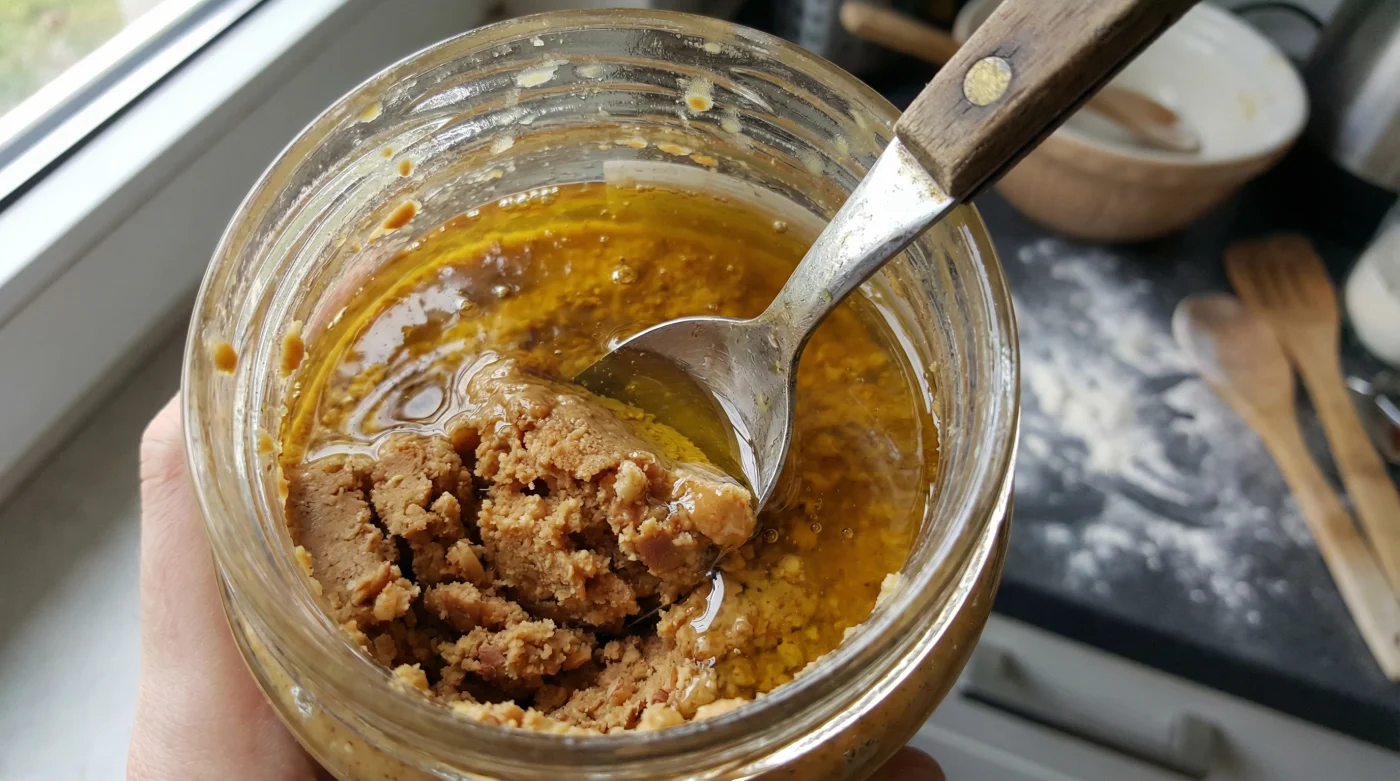
Baking is often compared to a chemistry experiment, but working with natural crunchy peanut butter is more like tending to a delicate ecosystem. There is a persistent myth that you can just thrust a spoon into a fresh jar, scoop out a hefty dollop, and drop it straight into your mixing bowl. But natural peanut butter obeys gravity. Over weeks of sitting on a supermarket shelf, the heavy, dense peanut solids sink to the bottom, while the liquid peanut oil rises, pooling at the surface.
This separation is natural, but it is also a trap. If you skim your measurement from the oily top, your dough becomes a greasy puddle that spreads flat in the oven. If you dig from the dry, crumbly bottom without reintegrating that oil, you are starving your flour of essential fat. This causes a severe moisture imbalance in the final dough. Without that specific, natural fat to coat the flour proteins, gluten develops too strongly, and your cookies turn rock hard.
I learned this lesson the hard way in a small Cornish bakery. Thomas, the head pastry chef, watched me scraping dry, stiff peanut butter from the bottom of a jar. He gently took the jar from me, his apron dusted in flour. “You have to rebuild the emulsion,” he explained, demonstrating how to fold the oil back into the grit with a long metal spoon. “If you don’t marry the natural oil back to the nut, the flour drinks up all your butter and eggs. There is nothing left to keep the crumb soft.”
| Baker Profile | Common Frustration | The Stirring Benefit |
|---|---|---|
| The Weekend Novice | Cookies spread too thin or burn on the edges. | Prevents excess surface oil from melting the dough structure prematurely. |
| The Batch Cook | Dough becomes impossibly stiff half-way through the jar. | Ensures uniform fat distribution for consistent texture across dozens of bakes. |
| The Vegan Baker | Crumbly, dry biscuits that fall apart when lifted. | Maximises the binding power of natural plant fats, replacing missing eggs. |
Rebuilding the Emulsion
Fixing this is not complex, but it requires mindful physical action. You cannot just give the top a cursory flick with a teaspoon. You need to agitate the entire jar to reintegrate the separated natural oils thoroughly.
Start by storing your natural peanut butter upside down in the cupboard. This forces the oil to travel up through the dense solids, doing half the work for you before you even twist the lid off.
When you are ready to bake, open the jar and take a sturdy chopstick or a long butter knife. Plunge it right down to the glass base. Scrape the bottom edges where the driest matter clings.
Use an up-and-down folding motion rather than just stirring in a circle. You want to lift the heavy solids up into the oil, aggressively folding them together until the mixture turns from a separated mess into a glossy, cohesive paste.
| State of Peanut Butter | Fat-to-Solid Ratio | Cookie Outcome |
|---|---|---|
| Top Skim (Unstirred) | High fat, low protein | Greasy, flat, fragile edges that shatter. |
| Bottom Dig (Unstirred) | Low fat, high protein | Dense, dry, rock-hard texture akin to concrete. |
| Fully Emulsified | Perfectly balanced | Chewy centre, crisp edges, structurally sound. |
Measuring the Difference
- Cling film guarantees perfectly spherical poached eggs skipping stressful water vortexes.
- Porridge oats thicken watery winter stews seamlessly replacing traditional flour roux.
- Dried oregano loses its signature Mediterranean flavour skipping this palm-crushing step.
- Vegetable peelers shave cold butter perfectly creating flawlessly flaky home scones.
- Greek yoghurt creates incredibly creamy scrambled eggs replacing expensive double cream.
If you have already mixed your dough and realise it feels incredibly stiff and dry because you forgot to stir the jar, do not panic. You can save the batch by adding a teaspoon of neutral oil or a splash of milk, kneading it gently until the dough relaxes back into a pliable state.
| Quality Aspect | What to Look For | What to Avoid |
|---|---|---|
| Ingredients List | Just peanuts and perhaps a pinch of sea salt. | Added palm oil or icing sugar (these alter baking chemistry). |
| Visual Texture | A glossy sheen with visible, suspended nut chunks. | A hard, matte surface or a deep pool of clear yellow oil. |
| Spoon Test | Slowly flows off a spoon in a thick ribbon. | Sits in a rigid clump or drips like water. |
A Rhythm of Patience
Taking the time to rigorously stir your crunchy peanut butter might feel like an annoying delay when you just want to get your cookies into the oven. But baking is fundamentally about respecting the ingredients. It is a dialogue with the materials in your kitchen.
By pausing to manually blend the oil and the nut back together, you are actively preventing a failure that no amount of oven-watching can fix. It is a quiet, rhythmic task that grounds you in the moment. When you finally pull that tray from the oven, and the cookies yield perfectly to your bite, you will know that the secret wasn’t in a magic recipe. It was in the mindful preparation you brought to the worktop.
“The difference between a tough biscuit and a tender cookie is often decided before the flour ever leaves the bag; it lives in the balance of your fats.”
Frequently Asked Questions
Can I use a hand mixer to stir the jar?
You can, but do so very carefully. Attach only one beater and keep the speed on the lowest setting to avoid throwing oil all over your worktop.Does storing natural peanut butter in the fridge stop the separation?
Yes, once it is fully stirred, keeping it chilled solidifies the oils and halts the separation. However, you will need to let it come to room temperature before baking to ensure it mixes into your dough smoothly.What if I accidentally used the dry bottom of the jar already?
If your dough is already mixed and feels like gravel, gently knead in a small amount of neutral oil (like groundnut or sunflower) one teaspoon at a time until the dough softens.Is smooth peanut butter better for baking?
Not necessarily better, just different. Smooth peanut butter provides a more uniform texture, but crunchy adds welcome physical contrast. Both natural varieties suffer from the exact same oil separation issue.Why do commercial brands not separate like this?
Commercial brands often use stabilisers, like hydrogenated vegetable oils or palm oil, to force the mixture to stay emulsified. While convenient, they lack the intense, pure roasted flavour of a 100% natural peanut butter.