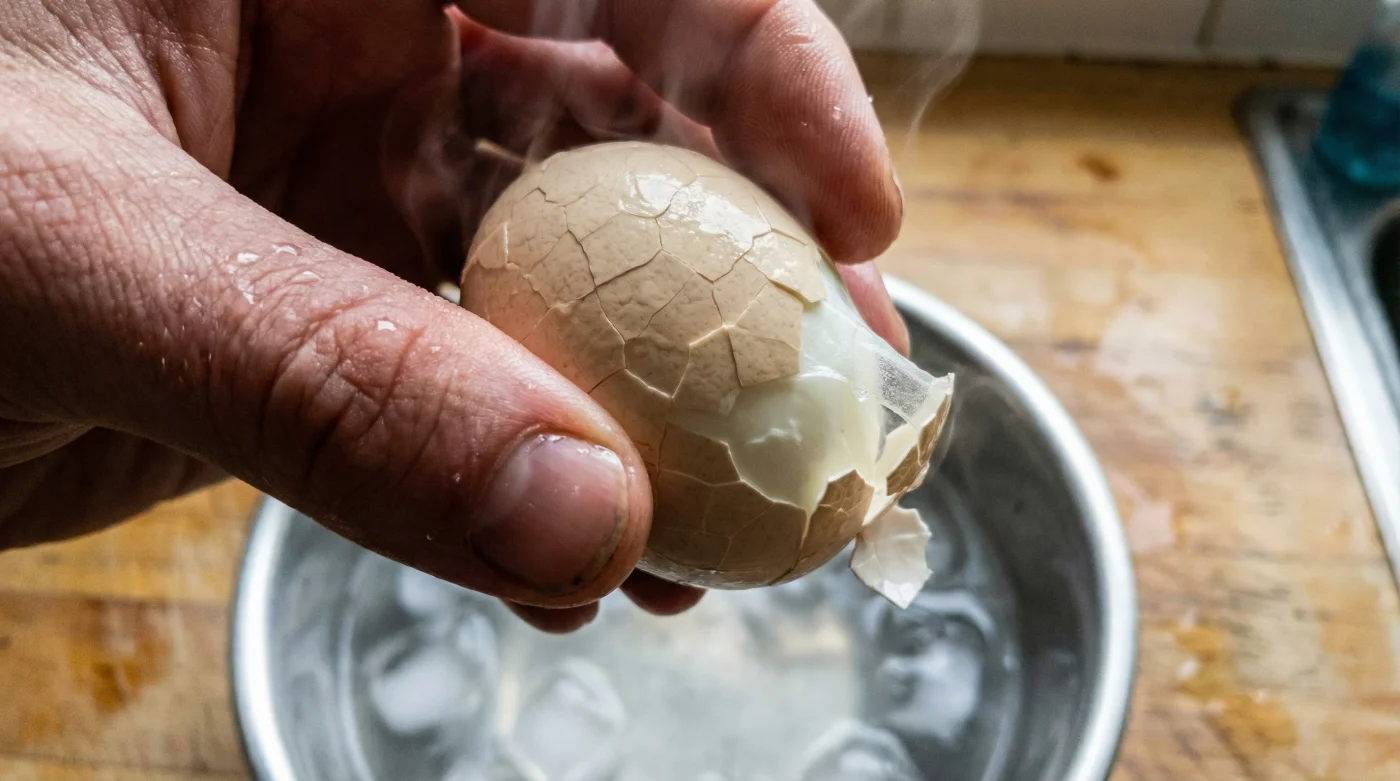
You know the sensation instantly. The sharp, chalky edge of an eggshell wedging itself stubbornly beneath your fingernail. You stand over the kitchen sink in the quiet of the morning, gently picking at a hard-boiled egg, praying the next fragment takes the papery membrane with it. Instead, a thick chunk of the delicate white tears away. By the time you finish, the egg looks less like a smooth, satisfying breakfast and more like a cratered moonscape. It is a tiny, incredibly common defeat that sets a frustrating tone for the day.
You have likely accepted this as the natural cost of eating well, blaming the freshness of the egg or your own clumsy fingers. But the fault does not lie with your dexterity. The culprit is a widely misunderstood kitchen habit that has quietly sabotaged your breakfast for years.
The Myth of the Chilled Shell
Think of a boiled egg as a heavily fortified medieval castle. The shell is the outer stone wall, but the membrane is the inner guard, clinging fiercely to the treasure inside. For decades, home cooks have been told to plunge their perfectly intact eggs in cold water and leave them in the fridge to cool completely before peeling. The logic seems sound; the chill halts the cooking process, preventing that dreaded grey ring from forming around the yolk. Yet, when an intact egg sits cooling in the dry chill of a fridge, the contents contract. That inner guard—the membrane—shrinks and binds itself like industrial adhesive directly to the egg white.
I learned the absolute reverse of this method whilst watching a prep chef in the cramped, steamy kitchen of a busy Cornish pub. He was tasked with preparing dozens of eggs for a lunchtime Scotch egg rush. He did not wait for them to cool. As soon as his timer rang, he scooped the scalding eggs from the pot and immediately rolled them firmly across his stainless steel worktop. He bruised them entirely, fracturing the shells into hundreds of tiny shards while they were still too hot to comfortably hold. Only then did he drop them into a waiting basin of ice water. When I asked him why, he smiled and handed me one entirely peeled, flawless egg. It had taken him seconds.
| Your Routine | The Standard Frustration | The Shatter-Plunge Benefit |
|---|---|---|
| The Sunday Meal Prepper | Losing precious weekend hours picking at shells, yielding messy results for the week ahead. | Peel a batch of twelve eggs in under four minutes, leaving perfectly smooth spheres for salads. |
| The Rushed Morning Commuter | Skipping protein entirely because the peeling process takes too long and ruins clothes with rogue shell fragments. | A frictionless, five-second peel that gets you out the front door faster. |
| The Home Entertainer | Serving ragged, uneven devilled eggs that look highly unprofessional at a dinner party. | Flawless, restaurant-quality presentation with absolute visual consistency. |
The Mechanics of the Micro-Fracture
The secret lies in the physics of the plunge. When you carefully shatter the shell all over before introducing it to the cold, you are opening a hundred tiny doors. As the hot, fractured egg hits the freezing bath, the sudden temperature shift causes the egg white to quickly contract, pulling away from the shell. Simultaneously, that ice-cold water rushes through the spiderweb of cracks you just created. It floods the microscopic gap between the egg white and the membrane. The water acts as a pure, hydraulic lubricant. It hydroplanes the shell right off the surface, meaning the membrane clings to the shell rather than your breakfast.
| Egg State | Membrane Condition | Peel Resistance |
|---|---|---|
| Intact & Fridge-Cooled | Shrunk and fused tightly to the egg white proteins. | Maximum. High risk of tearing the egg white. |
| Intact & Plunged in Ice | Contracts slowly, sealing microscopic pores against the cold. | Moderate. Unpredictable peeling, often sticking in stubborn patches. |
| Shattered & Plunged in Ice | Flooded with water, detaching completely from the white. | Zero. The shell practically slides off in two continuous ribbons. |
Executing the Spiderweb Technique
To master this, you must slightly change the order of your physical movements. Boil your eggs exactly as you prefer them on the hob, whether that is a jammy six minutes or a firm nine minutes. While they boil, prepare a large bowl with equal parts cold tap water and solid ice cubes. Do not skimp on the ice; the sheer shock of the cold is what makes the magic happen.
When your timer sounds, lift an egg from the boiling water using a slotted spoon. While it is still steaming hot, immediately tap it against your kitchen worktop. Roll it beneath the flat of your palm with a gentle, confident pressure. You want to hear a satisfying crackle as the shell breaks into a fine mosaic, but you must not press so hard that you split the egg entirely in half.
- Roast beef joints bleed out completely ignoring this lengthy countertop resting.
- Co-op ground almonds trigger urgent safety recalls concerning hidden peanut allergen traces
- Sunday roast beef dries out instantly missing this crucial resting step.
- Heinz Baked Beanz face severe national shortages following aggressive supermarket pricing disputes
- Cheap peanut butter thickens watery curries replacing traditional coconut cream reductions
When you are ready to peel, start at the wider base of the egg, where the natural air pocket lives. Pinch the shell gently, and pull. You will find that the shell and the membrane slip away in large, satisfying sheets, leaving behind a perfectly smooth, unblemished surface.
| Element | What To Look For | What To Avoid |
|---|---|---|
| The Crack | A fine, even mosaic of fractures all over the shell, resembling a shattered windscreen. | Deep dents or splits that expose the yolk or tear the hot white before chilling. |
| The Ice Bath | A basin heavily populated with solid ice cubes, creating an intensely cold thermal shock. | Lukewarm tap water, which will not force the rapid contraction needed for separation. |
| The Peel | Starting at the wide end, peeling underwater or under a gently running tap for extra slip. | Picking at tiny, dry shards from the narrow end with your fingernails. |
Reclaiming the Morning Rhythm
There is a profound sense of satisfaction in fixing a small, daily annoyance. Cooking at home should not feel like a battle of attrition against your ingredients. By understanding the relationship between heat, water, and the natural structure of the egg, you stop fighting the shell and start working with it. This slight adjustment to your routine does more than simply yield a prettier plate of food. It buys back a few precious minutes of peace in your morning.
Next time you put a pot of water on the hob, remember that you are in control of the elements. You no longer have to dread the peeling process. Let the water do the hard work, and enjoy the simple, unbothered pleasure of a perfectly prepared meal.
The shell is not an enemy to be picked away; it is simply a protective layer that only surrenders when introduced to the right environment at the exact right moment.
Frequently Asked Questions
Does this technique work for older eggs as well as fresh ones? Absolutely. While older eggs naturally have slightly looser membranes due to air entering over time, this hydraulic technique guarantees a flawless peel regardless of the egg’s age.
Will the ice bath make the egg taste watery? Not at all. The water sits strictly between the membrane and the shell. The integrity and flavour of the egg white remains completely uncompromised.
How hard should I roll the egg on the worktop? Apply just enough pressure to hear the shell crackle. Imagine you are pressing down on a delicate piece of pastry; you want to fracture the surface without squashing the centre.
Can I peel them immediately after the five-minute bath? Yes. Five minutes is the ideal window for the water to penetrate the shell and for the egg to cool enough to handle comfortably.
Do I need to peel them right away, or can I store them in the fridge unpeeled? For the absolute best results, peel them directly out of the ice bath. Once peeled, you can store the smooth, naked eggs in a sealed container in the fridge for up to five days.