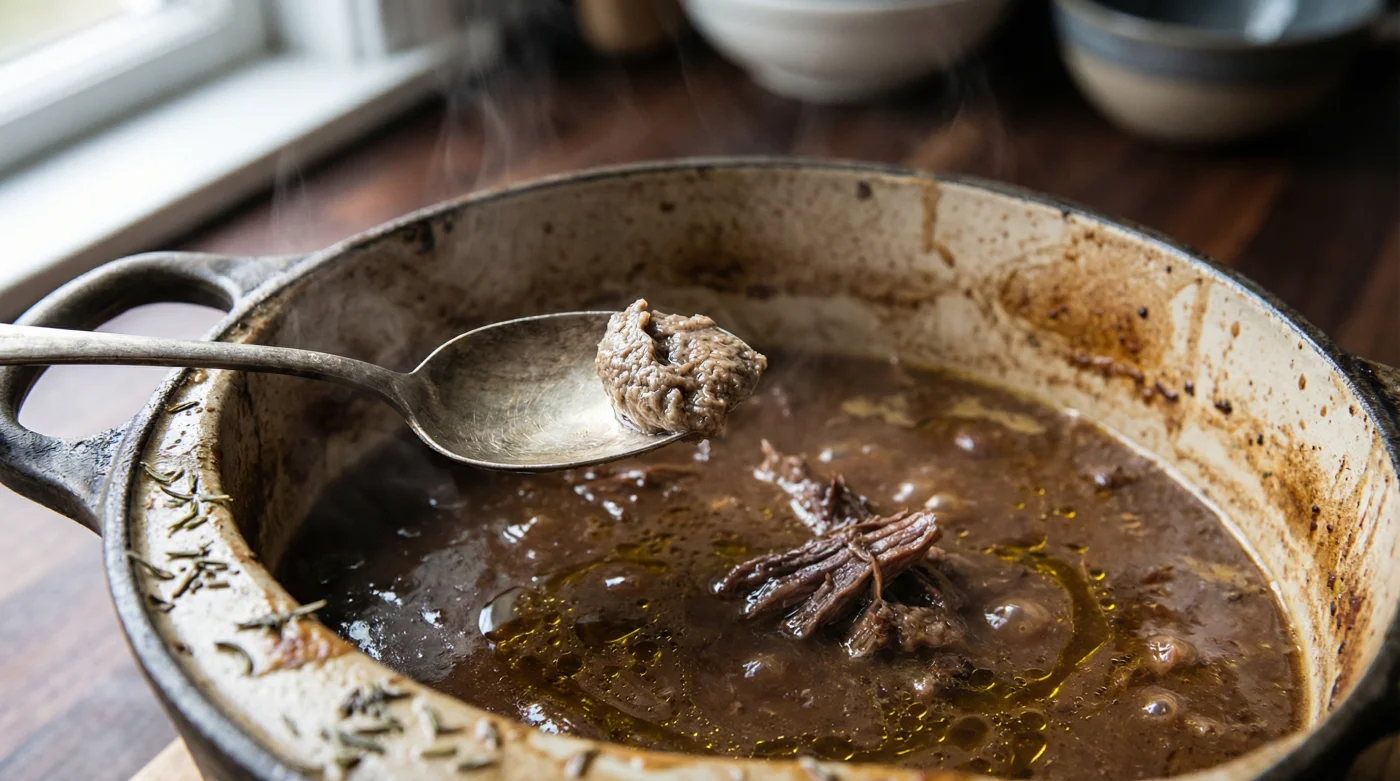
You know that specific, damp Sunday afternoon feeling. The rain is lashing against the kitchen window, the windows themselves are fogged with condensation, and your heavy cast-iron pot has been humming on the hob for two hours. The smell of simmering beef, rosemary, and root vegetables fills the room, promising comfort and warmth. Yet, when you finally lift the wooden spoon to your mouth, blow away the rolling steam, and take that first crucial taste, your shoulders drop. The gravy is perfectly thick, the meat yields beautifully, but the flavour is completely flat. It tastes merely of hot, brown water and faint herbs, lacking that deep, rounded, mouth-coating richness you crave.
You reach for the salt grinder, twisting it frantically. You dash in a bit of Worcestershire sauce, hoping to rescue the broth. But what you are actually searching for is a foundation, a savoury weight that transforms a thin, watery stew into a truly memorable meal. The answer to this culinary frustration is sitting right now on supermarket shelves, costing little more than a couple of Pounds Sterling. It is the humble, often misunderstood tube of anchovy paste.
The Gravity of the Gravy
Cooking a traditional stew is akin to constructing a stone wall. The chunks of beef are your heavy boulders, the carrots and celery are the filling stones, but the gravy is the mortar holding the entire structure together. If the mortar is weak, the entire dish crumbles on the palate. For decades, British home cooks have relied on stock cubes and gravy browning granules to simulate depth. But true, lip-smacking richness requires a completely different approach.
There is a natural, albeit completely misplaced, fear of mixing pungent seafood into heavy meat dishes. You might look at a tube of anchovy paste and immediately think of excessively salty, slightly metallic pizza toppings. You might imagine that your Sunday beef stew will suddenly taste like a fishing boat at low tide. This is the great myth of the pantry. When you introduce a small amount of anchovy into a hot pan, it does not assert itself as fish. Instead, it acts as a quiet amplifier. It melts completely away, leaving behind a pure, intensely savoury footprint that simply makes the beef taste more like beef.
I learned this years ago while sheltering from a torrential winter downpour in a tiny, slate-roofed pub in Cornwall. Sitting near the swinging kitchen doors, I watched an old, flour-dusted chef named Arthur tending to an enormous, bubbling cauldron of ale and shin beef. As he worked the onions into a sweet, jammy submission, he casually squeezed an inch of greyish-pink paste from a metal tube directly into the hot fat. When I asked him about it, he just winked. ‘It is the ghost in the machine,’ he told me. ‘You never know it is there, but you would weep if it was missing.’
| Type of Cook | The Frustration | The Anchovy Benefit |
|---|---|---|
| The Sunday Traditionalist | Relies heavily on salty, artificial gravy powders. | Replaces chemicals with natural, rounded earthiness. |
| The Weekend Batch-Cooker | Stews taste bland on day one, needing a day to mature. | Achieves that ‘next-day’ mature flavour immediately. |
| The Health-Conscious Parent | Struggles to find low-sodium ways to build intense taste. | Delivers massive impact with just a single teaspoon. |
The Science of the Invisible Fish
To understand why this works so flawlessly, you have to look past the ingredients and consider how our tongues interpret satisfaction. The secret lies in a concept that scientists and professional chefs refer to as flavour synergy. Beef naturally contains a high level of glutamates, which are the building blocks of savoury taste. However, anchovies are packed with a different compound called inosinates. When you combine glutamates with inosinates in a single mouthful, the savoury impact does not just double; it multiplies exponentially.
This is why Worcestershire sauce contains fermented anchovies. It is why the Romans used garum, a fermented fish sauce, on almost everything they roasted. The heat of your cooking fat breaks down the proteins in the anchovy paste, completely destroying the compounds responsible for that fishy, oceanic aroma. What survives the heat is a pure, indestructible core of umami. It binds with the rendered beef fat, coating the root vegetables and suspending itself beautifully in your red wine or ale broth.
| Compound | Source in Stew | Mechanical Flavour Function |
|---|---|---|
| Glutamates | Beef shin, tomato purée, onions. | Provides the broad, baseline meaty sensation on the palate. |
| Inosinates | Anchovy paste. | Acts as an accelerator, extending the lingering taste. |
| Maillard Reaction | Seared meat edges. | Adds bitter-sweet caramel notes that balance the salt. |
Mindful Application at the Hob
- Pork shoulder remains unappetisingly tough skipping this mandatory acidic cider braise.
- Iceberg lettuce regains absolute crispness submerged in this rapid lemon bath.
- Dried pasta develops intense nutty flavours undergoing this dry pan toasting.
- Beef stew develops intensely rich gravies adding this unexpected anchovy paste.
- Pancake batter produces incredibly fluffy stacks substituting standard milk for soda water.
Now, drop your chopped onions, carrots, and celery into that hot fat. As the onions begin to soften and turn translucent, lower the heat slightly. This is your moment. Squeeze exactly one level teaspoon of anchovy paste into the centre of the pan. Take your wooden spoon and aggressively work the paste into the vegetables and the fat. Within thirty seconds, you will see the paste literally dissolve. It melts like butter, disappearing into the mirepoix.
Only after the paste has vanished should you add your garlic and tomato purée. Stir for another minute until the tomato darkens, then pour in your ale, wine, or beef stock, scraping the bottom of the pan to lift all those incredible, sticky brown bits. Return your beef to the pot, cover it, and let the gentle heat do the rest of the work. You have just laid a flawless foundation.
| Anchovy Paste Quality Checklist | What to Look For | What to Avoid |
|---|---|---|
| Ingredients List | Anchovies, olive oil, salt. Nothing else. | Added sugars, artificial preservatives, or bulking agents. |
| Oil Base | Extra virgin olive oil for a smoother, richer melt. | Sunflower or rapeseed oil, which can taste slightly greasy. |
| Packaging | Aluminium tubes that keep air out and preserve freshness. | Glass jars for paste (they oxidise quickly once opened). |
A Pantry Reimagined
When you start treating ingredients not as rigid rules, but as tools to solve physical problems in the kitchen, your cooking transforms. You stop relying on packets and powders. You begin to trust your own hands and your own palate. A tube of anchovy paste might seem like an odd companion for a hearty British beef stew, but it represents a smarter, more resourceful way of cooking.
The next time the rain is hammering against the glass and you are craving comfort, you will not have to settle for thin, disappointing gravy. You will stand by the stove with absolute confidence, knowing that the little tube in your fridge holds the power to elevate a simple pan of meat and vegetables into something truly extraordinary.
The greatest secret in a traditional kitchen is knowing how to make an ingredient completely invisible to the eye, yet entirely unforgettable to the palate.
Frequently Asked Questions
Can I use whole tinned anchovies instead of the paste?
Yes, absolutely. Two whole anchovy fillets roughly equal one teaspoon of paste. Just ensure you chop them finely so they melt rapidly into the hot beef fat without leaving lumps.Will this make my stew unsuitable for people who dislike fish?
Not at all. The heat completely destroys the volatile compounds responsible for the fishy smell. They will only taste a rich, meaty depth and will never guess your secret.Do I need to adjust the salt in my recipe?
Yes. Anchovy paste is naturally salty. Hold back on seasoning your stew until the very end, tasting the finished gravy before adding any extra sea salt.How long does a tube of anchovy paste last in the fridge?
Because it is preserved in salt and oil, a tightly sealed aluminium tube will easily last for several months in the refrigerator without losing its potency.Can I use this trick in other meat dishes?
Definitely. A teaspoon stirred into a shepherd’s pie base, a rich Bolognese sauce, or even a lamb casserole will provide the exact same brilliant, savoury amplification.