It is a quiet Sunday morning. Rain spots the kitchen window, and the comforting, earthy smell of thick-cut sourdough toasting fills the room. You stand over a wide stainless-steel pan of rapidly boiling water, armed with a slotted spoon in one hand and a bottle of sharp malt vinegar in the other. You stir the water frantically, creating what you hope is the perfect culinary tornado, before cracking and dropping in a raw egg. Instantly, the pan fills with ghostly white tentacles. The egg splinters into a stringy, watery mess, clouding the water. You fish out a ragged, uneven, waterlogged lump, feeling that familiar pang of brunch-related defeat. The toast is getting cold, and you are left wondering why a simple staple feels impossible to master.
The Myth Of The Vinegar Vortex
For decades, we have been told that conquering the poached egg requires brute force and kitchen chemistry. A vigorous whirlpool is supposedly needed to wrap the white tightly around the yolk, and a harsh splash of acid is added to shock the proteins into setting quickly. But this aggressive approach treats cooking like a battle to be won. In reality, mastering the poached egg is about understanding the delicate, natural architecture of the egg itself. Let us consider the gravity of the raw egg. An egg is not a uniform, singular liquid; it is a complex structure that changes the moment it leaves the farm. When you fight the water, you ignore the ingredient.
| The Home Cook | The Sieve Solution Benefit |
|---|---|
| The Weekend Bruncher | Consistently round eggs without the stressful rushing. |
| The Busy Parent | No need to babysit a vortex; poach multiple eggs simultaneously. |
| The Flavour Purist | Eliminates the sharp, unwanted tang of vinegar on your breakfast. |
I learned the truth behind flawless poaching while standing in a cramped, heavily tiled kitchen in Soho, watching a busy breakfast service in full swing. The head chef, a calm, methodical man named Elias, was turning out dozens of flawless, spherical poached eggs every hour. There was no chaotic swirling of spoons. His water was barely shivering. Beside his pan sat nothing but a simple £4 fine wire mesh sieve. Elias explained that as an egg ages, the protein in the egg white begins to degrade. It naturally separates into two distinct parts: a firm, thick inner albumen that tightly grips the yolk, and a loose, watery outer albumen. It is this watery edge that instantly turns into messy, ragged tentacles the moment it hits hot water. The traditional vortex is merely a frantic attempt to gather up something that should not be in the pan in the first place. By removing the weak protein, you remove the problem entirely.
| Egg Anatomy | Reaction in Hot Water | Mechanical Logic |
|---|---|---|
| Thick Inner Albumen | Sets firmly, naturally holding its plump shape. | Proteins are tightly bound, requiring gentle heat to coagulate cleanly. |
| Thin Outer Albumen | Separates instantly, creating those dreaded white wisps. | Lacks structural integrity; disperses rapidly in liquid currents. |
| The Yolk | Remains protected if the thick white is intact. | Acts as the heavy anchor; gravity pulls it down while the white sets around it. |
The Sieve Method In Motion
To put this kitchen revelation into practice, you must change your physical approach to the stove. Abandon the spinning spoon and leave the vinegar in the cupboard. Instead, place a standard fine wire mesh sieve over a small bowl on your counter.
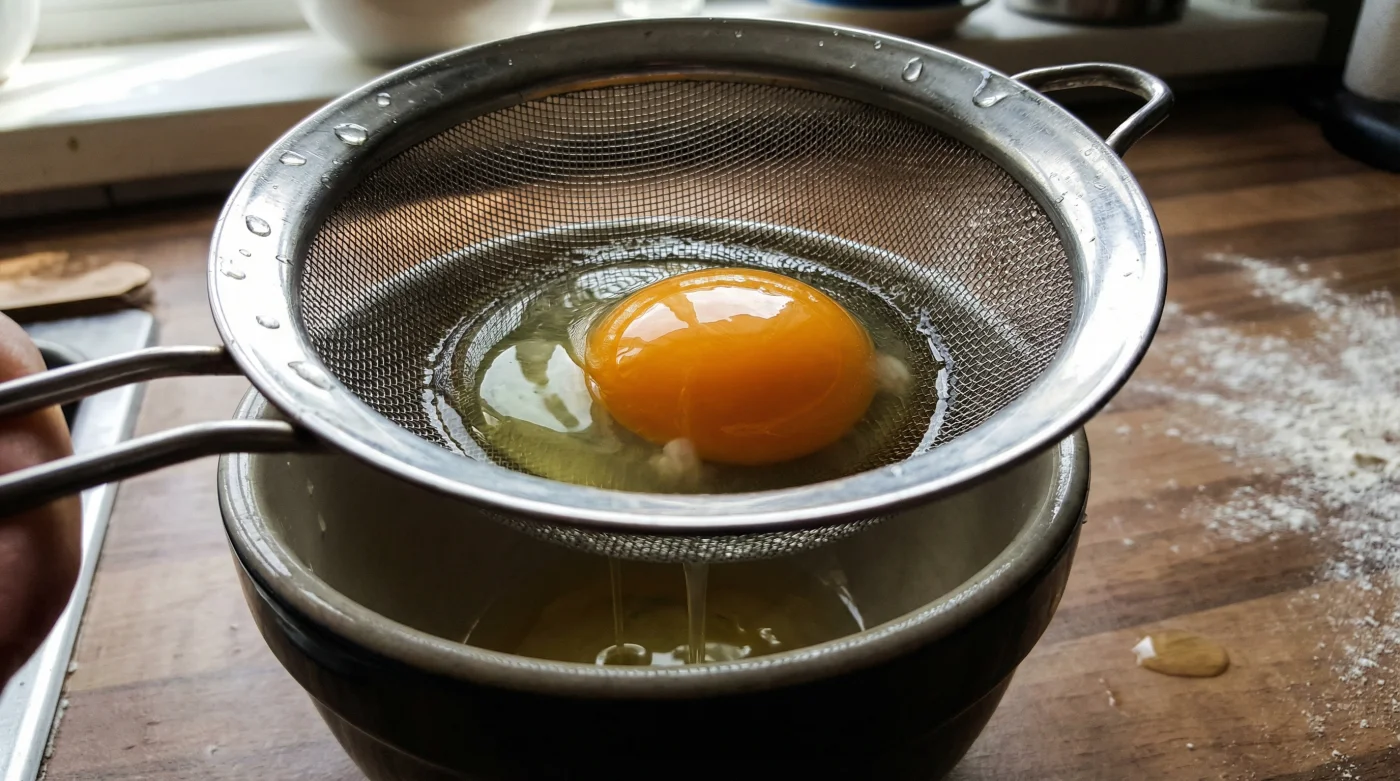
Crack your cold egg directly into the dry sieve. Take a moment to watch closely. You will see a thin, watery liquid immediately drip through the wire mesh and pool into the bowl below.
This loose liquid is the main culprit. That specific fluid is what causes the wispy disaster in your pan. Give the sieve a very gentle shimmy to encourage the last few rebellious drops to fall away.
- Basmati rice turns perfectly fluffy using this simple tea towel trick.
- Raw eggs form flawless poached spheres draining through fine wire mesh sieves.
- Marmite transforms weak vegetarian gravy adding incredibly deep beefy roasting flavours.
- Split double cream returns to perfect smoothness gently folding in cold milk.
- Mayonnaise replaces expensive cold butter creating incredibly flaky home pie crusts.
Bring your pan of water to a rolling boil, then immediately turn the heat right down. Wait until the water is merely shivering. Small, gentle bubbles should occasionally break the surface, rather than violently churning.
Bring the sieve down close to the water surface. Gently tilt it, allowing the strained egg to slip silently into the gentle heat. Without the interference of watery whites or spinning currents, it will immediately form a neat, flawless sphere.
| Quality Checklist | What To Look For | What To Avoid |
|---|---|---|
| The Water State | A gentle shiver, occasional tiny bubbles at the base. | A rolling boil that violently tears the delicate egg apart. |
| The Equipment | A fine-gauge wire mesh sieve. | A colander or wide-holed strainer where the whole egg slips through. |
| The Final Result | A neat, plump sphere with a soft, yielding centre. | Ragged edges, a rubbery exterior, or a lingering acidic smell. |
A Calmer Morning Rhythm
When you stop fighting the water and start working intuitively with your ingredients, cooking transforms from a stressful chore into a peaceful morning ritual. Removing the watery albumen changes the entire dynamic of the pan. You are no longer managing chaos; you are quietly observing a natural, culinary transformation. Because the water remains still and clear, you can now effortlessly poach three or four eggs at once in the exact same pan, completely reclaiming your weekend mornings. It is a tiny, incredibly simple mechanical adjustment, yet it grants you the quiet confidence of a seasoned professional in your own kitchen. You will never look at a poached egg the same way again.
“A perfect poached egg requires nothing more than fresh ingredients, gentle heat, and the wisdom to remove what you do not need.”
Frequently Asked Questions
Does the sieve damage the delicate egg yolk?
Not at all. The wire mesh is gentle enough to hold the yolk and thick white securely while only letting the broken-down proteins slip through.Do I need to use salt in the cooking water?
Skip the salt in the pan. While salt seasons the egg, it also breaks down the egg white proteins, encouraging them to separate. Season your egg with flaky sea salt once it is proudly sitting on your toast.How long should I leave the egg in the water?
For a perfectly runny yolk and a beautifully set white, exactly three minutes in barely simmering water is what you need.Can I strain the eggs ahead of time?
You can crack the egg into the sieve a minute or two before cooking, but do not leave it sitting for extended periods, or the thick white will eventually begin to sag through the mesh.Do extremely fresh eggs still need sieving?
Farm-fresh eggs laid that very morning have almost no watery white. However, standard supermarket eggs will always benefit from a quick strain to ensure a perfectly neat finish.