It is a distinctly quiet sort of morning frustration. The morning light catches the steam rising from the kitchen worktop as you fish a hot boiled egg from the saucepan. You run it under the cold tap, leaving the shell perfectly intact, exactly as the weathered family cookbooks command. You tap it gently on the edge of the sink, attempting a delicate peel. And there it is: the shell clings stubbornly, tearing away jagged craters of white protein. You are left staring at a sad, pockmarked ruin of an egg, while precious minutes of your morning slip away.
We have all stood there, picking microscopic shards of shell from our breakfast, wondering why such a simple ingredient demands such tedious negotiation. The truth is, your eggs are refusing to peel cleanly because you are following a fundamentally flawed piece of kitchen wisdom. You have been taught to treat the cooked egg with reverence, cooling it completely intact before you even think about cracking it. But to conquer the morning egg, you must abandon gentleness. The secret is to aggressively fracture the shell all over before it ever touches the cold water.
The Membrane Trap and the Cold Water Flood
To understand why this works, you have to look at the anatomy of the egg not as food, but as a sealed pressure vessel. Just beneath the calcium carbonate shell lies the keratin membrane. When an egg cooks, this membrane acts like a shrink-wrap, bonding tightly to the egg white. The traditional advice of plunging an intact hot egg into cold water certainly halts the cooking process, but it also traps that membrane against the white. The shell becomes a waterproof jacket, shielding the stubborn membrane from the very moisture it needs to release its grip.
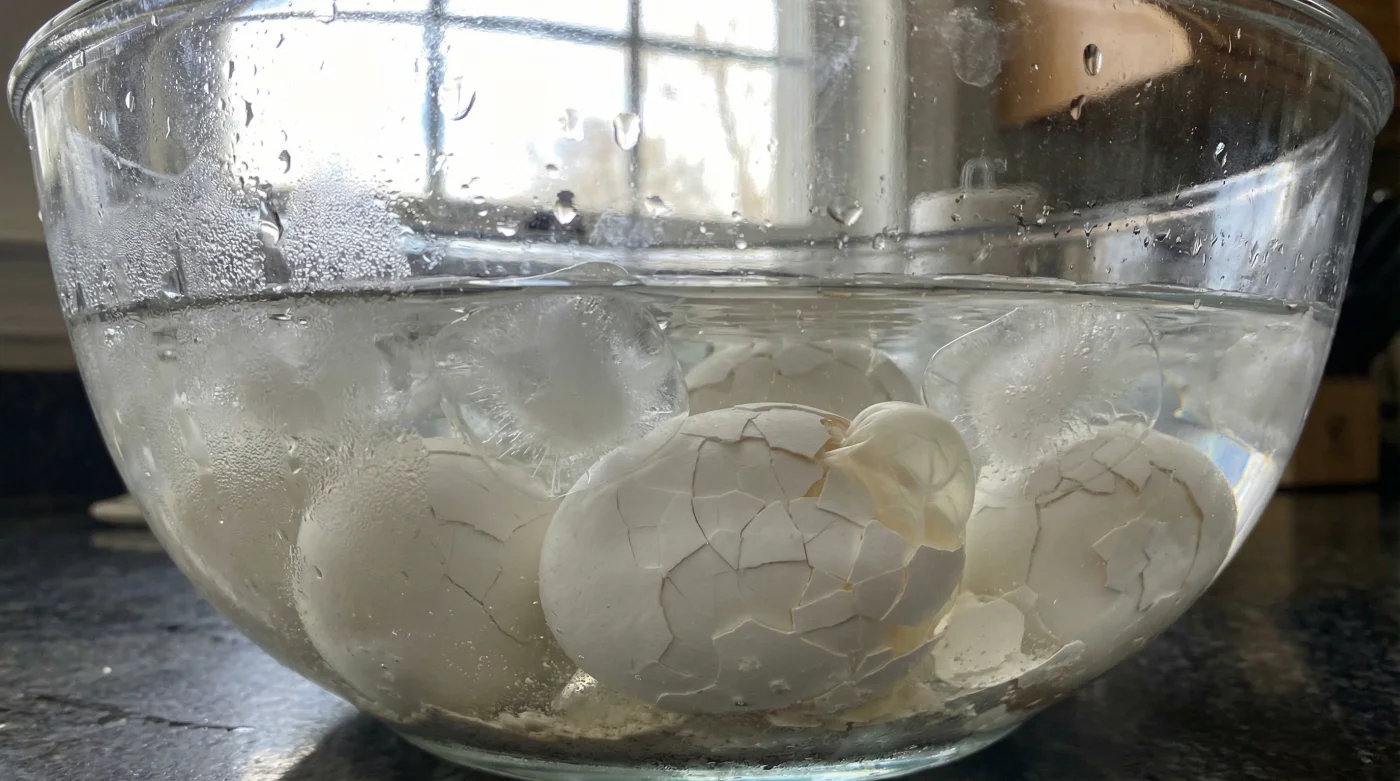
By cracking the shell comprehensively against the worktop immediately after boiling, you create a network of deliberate fractures. When you then plunge this shattered egg into an ice bath, the freezing water rushes through the cracks. It floods the tiny microscopic gap between the membrane and the egg white. The cold water acts as a physical wedge, separating the skin from the protein through sheer capillary action. By the time the egg is cool enough to handle, the shell practically slides off in two or three satisfyingly large pieces.
I learned this precise mechanism while sitting at the breakfast counter of a relentlessly busy café in Marylebone. The head chef, responsible for dispatching dozens of perfect salads and breakfast plates before nine in the morning, pulled a wire basket of fifty boiled eggs from a steaming pot. He did not gently rest them in the ice water waiting nearby. Instead, he gave the metal basket a vigorous, clattering shake, fracturing every single shell against the wire mesh. Only then did the basket descend into the ice. When I asked him about the rough treatment, he wiped his hands on his apron and smiled. ‘An intact shell fights you,’ he said. ‘You have to invite the water inside. Break the seal, let the cold water do the heavy lifting.’
| The Cook | The Daily Frustration | The Specific Benefit |
|---|---|---|
| Busy Parents | Losing five minutes picking shell fragments during the school run panic. | Peeling takes seconds, returning vital time to the morning routine. |
| Sunday Meal Preppers | Ugly, torn eggs ruining the aesthetic of a week’s worth of salads. | Consistently smooth, professional-looking eggs that hold their shape. |
| The Frugal Home Cook | Wasting up to twenty percent of the edible egg white stuck to the shell. | Zero waste, ensuring you get exactly what you paid your £2 for at the supermarket. |
The Physics of the Perfect Peel
This is not just culinary folklore; it is basic thermal dynamics. When you force a rapid temperature drop on a cracked egg, the physical shock causes the egg white to contract slightly. Meanwhile, the water slipping through the fresh cracks prevents the membrane from shrinking along with it. It is a brilliant, entirely natural exploitation of physics that happens right there in a simple mixing bowl.
| Mechanical Phase | Temperature / State | Scientific Logic |
|---|---|---|
| The Boiling Point | 100°C (Water) | Heat causes proteins to denature and bond tightly. Membrane is highly adhesive. |
| The Aggressive Fracture | 90°C (Internal Egg) | Breaks structural integrity of the shell without damaging the newly set protein structure. |
| The Ice Submersion | 0°C (Ice Bath) | Sudden thermal contraction. Capillary action draws water inward, separating membrane instantly. |
Executing the Aggressive Tap
Putting this into practice requires a slight shift in your kitchen rhythm. Once your timer sounds, use a slotted spoon to lift the eggs from the boiling water. Do not carry them to the sink. Instead, place them directly onto the dry kitchen worktop. Using the palm of your hand, roll the hot egg back and forth with firm pressure. You want to hear a satisfying, continuous crackle as the shell shatters into a mosaic pattern.
Once the egg looks like a fragile jigsaw puzzle, immediately drop it into a bowl of ice and water. Ensure the water is genuinely cold; a tepid tap will not provide the necessary thermal shock. Let the eggs sit submerged for at least five minutes. As they sit, the water is silently doing the tedious work for you. When you eventually pull the egg out, start peeling from the wider bottom end where the natural air pocket lives.
You will notice the difference in your fingertips immediately. Instead of picking away tiny, brittle flakes, you will pinch the membrane itself. It will feel like a thin, damp paper peeling away from a smooth stone. In most cases, the entire shell will slide off in a single, continuous ribbon. It is a deeply satisfying tactile experience.
| The Method | What to Look For | What to Avoid |
|---|---|---|
| The Roll | A fine, even spiderweb of cracks across the entire surface of the egg. | Smashing the egg so hard that you split the cooked white open. |
| The Bath | Plenty of floating ice cubes; the water should be uncomfortably cold to the touch. | Using lukewarm tap water, which fails to contract the proteins properly. |
| The Peel | Starting from the wider base where the air pocket creates a natural starting point. | Picking at the narrow top end, which often leads to immediate tearing. |
Finding Peace at the Kitchen Worktop
Cooking at home is often framed as a series of chores to be survived. But when you begin to understand the materials you are working with, the kitchen transforms into a place of quiet competence. You are no longer fighting the ingredients; you are guiding them. By changing one small, physical action, you remove a recurring annoyance from your week.
- Natural peanut butter prevents oily surface separation storing jars completely upside-down.
- Risotto rice achieves ultimate restaurant creaminess skipping this relentless pan stirring.
- Hard-boiled eggs refuse to peel cleanly ignoring this aggressive shell cracking.
- Bisto gravy mimics authentic roasting tin juices adding this sharp mustard spoon.
- Mashed potatoes turn into unappetising glue skipping this brief drying phase.
A stubborn egg is not a test of your patience; it is simply a kitchen asking for a little more water and a little less reverence.
Frequently Asked Questions
Does this trick work with farm-fresh eggs?
Yes, though fresh eggs naturally have tighter membranes. The water-flooding technique is especially crucial for fresh eggs, as it forcefully separates the bond that age usually weakens.
What if I boil my eggs softly to have a runny yolk?
You must be far more gentle during the cracking phase. Tap the shell lightly with the back of a spoon to create fractures without squashing the delicate, soft centre before the ice bath.
Can I just run them under the cold tap instead of making an ice bath?
Running water cools the exterior, but it rarely provides the sudden, sharp thermal shock required to shrink the egg white rapidly. Taking twenty seconds to make a proper ice bath guarantees the result.
How long should the eggs sit in the cold water?
Aim for at least five to seven minutes. This gives the temperature drop enough time to reach the centre of the egg, and allows the water ample time to travel under the entire membrane.
Should I add vinegar or baking soda to the boiling water?
While many swear by altering the water’s pH, the aggressive tap and ice bath method is so physically effective that it renders vinegar and baking soda entirely unnecessary.