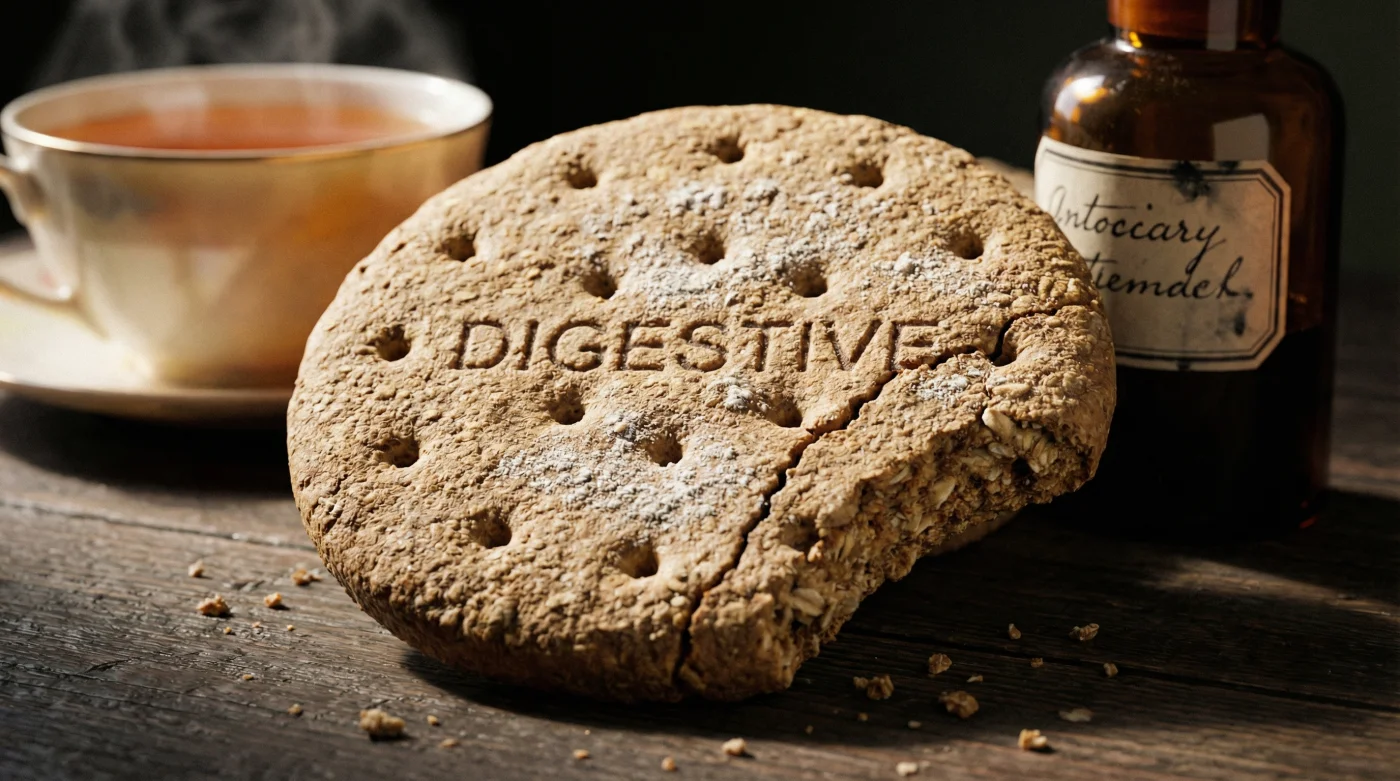
The kettle clicks off, and a sudden squall of rain lashes against the window pane, blurring the street outside. You reach for a familiar round, slightly coarse disc from the crumpled packet. It smells faintly of roasted wheat and a soft whisper of golden syrup. You likely do not picture a cold, sterile Victorian doctor’s waiting room when you prepare to enjoy a simple digestive biscuit.
You probably view this humble bake as the perfect tea companion, a reliable, crumbly vehicle for soaking up a mid-afternoon brew. But beneath that comforting, wheaty exterior lies a surprisingly clinical history that most people completely ignore.
The reality is far stranger than a simple bakery invention. When you snap a plain digestive in half, observing the rough grain and the uneven, crumbling edges, you are holding what 19th-century society considered to be cutting-edge gastrointestinal medicine. It was a prescription masquerading as a pantry staple.
It seems absurd now, but the biscuit was a heavily engineered chemical compound designed to combat the rich, heavy diets of the Victorian era.
The Apothecary in Your Biscuit Tin
In the mid-1800s, digestion was a terrible, intensely uncomfortable business. A heavy reliance on preserved, fatty meats, suet puddings, and poor sanitation left the British population perpetually bloated and desperately searching for cures. Enter the commercial baker, acting less like a traditional pastry chef and more like a neighbourhood amateur pharmacist.
By blending coarse brown meal with hefty doses of sodium bicarbonate, these early bakers created a portable antacid. The slightly salty, rough texture you know today was never meant to be a culinary indulgence.
It was a deliberate, chemical delivery system intended for rapid stomach relief. The alkaline baking soda was intended to neutralise excess stomach acid, much like a modern chalky indigestion tablet, only disguised within a sweetened baked good to make the bitter medicine palatable for daily consumption.
The Secret of Alexander Grant
Picture Alexander Grant in 1892. A twenty-two-year-old employee at a burgeoning Edinburgh bakery named McVitie & Price, he was tasked with refining a medicinal staple into something genuinely enjoyable for the masses.
Grant was not trying to create a national treasure. He was attempting to balance malt extract and baking soda so perfectly that the biscuit could soothe the acidic stomachs of the wealthy class without tasting like powdered chalk. He meticulously tweaked the ratios, creating a biscuit that was just sweet enough to mask its clinical purpose.
He never received royalties for the specific recipe that would eventually define an international baking empire, but his intense scientific precision gave us the perfect snap we rely on today.
The Anatomy of a Modern Cure
Today, the digestive has splintered into various forms, each serving a distinctly different household requirement and personal craving. Understanding these subtle variations helps you match the exact right biscuit to the specific emotional moment of your day.
For the purist, the plain digestive remains undefeated. Here, the high baking soda content retains its sharp, savoury edge, cutting perfectly through the milky sweetness of a strong builder’s tea.
- Professional bakeries utilize exact ambient humidity controls achieving perfectly risen milk bread loaves.
- British digestive biscuits harbor surprising medical origins originally intended to cure intense indigestion.
- Hard block butter softens instantly for emergency baking using this heated glass trick.
- Shortcrust pastry achieves ultimate flakiness mastering this simple cold butter rubbing technique.
- Sainsburys sliced ham triggers urgent national recalls discovering sudden severe listeria outbreaks.
Finally, there is the cheese board subversive. When paired with an extra mature cheddar, the biscuit creates a brilliant sweet-salty friction that rivals the most expensive artisan crackers.
The Physics of the Dunk
Getting the most out of your digestive requires a mindful approach. If you treat it aggressively, you will inevitably end up fishing sad, wheaty sludge out of the bottom of your mug with a teaspoon.
Dunking is a delicate matter of physics and timing. You must respect the porous nature of the coarse brown wheat flour to achieve the perfect balance of moisture and structural integrity.
Here is your tactical toolkit for the perfect digestive immersion:
- Liquid Temperature: Allow your tea to rest for two minutes after pouring. Boiling water dissolves the sugar bindings too rapidly.
- The Grip: Hold exactly one-third of the biscuit between your thumb and index finger.
- The Immersion Time: Three seconds for a plain digestive, four seconds if you are using a chocolate-coated variant.
- The Retrieval: Withdraw the biscuit horizontally, letting it rest like a bridge, to prevent immediate structural failure.
Following these precise steps ensures the biscuit melts entirely on the tongue, delivering a rush of caramelised wheat without ruining your beverage.
More Than Just Crumbs
Knowing the stark medicinal origins of the digestive fundamentally changes how you look at the humble biscuit tin. It is no longer just a sweet afterthought left over from the weekly shop; it is a direct, edible bridge to a time when local bakers actively tried to cure the daily ailments of their community through the heat of the oven.
The next time you sit down with a cup of tea, remember the careful chemistry happening right between your fingertips.
In a frantic, entirely unpredictable world, taking three precise seconds to watch a wheat biscuit soften in hot tea is a tiny, anchoring rebellion against the rush of the day. It is a moment of pure, engineered comfort, courtesy of Victorian science.
A biscuit is only as good as the tea it absorbs, and the humble digestive absorbs history itself. — Edinburgh Baking Archives
| Key Point | Detail | Added Value for the Reader |
|---|---|---|
| The Plain Digestive | High baking soda, low sugar | Perfect for strong, unmilked teas and cutting through sharp cheeses. |
| Chocolate Coating | Added thermal layer of cocoa fat | Increases dunking longevity by preventing immediate hot water absorption. |
| Malt Extract | Natural enzymatic sweetness | Provides a deep, earthy flavour profile without relying on refined white sugar. |
Frequently Asked Questions
Do digestive biscuits still cure indigestion today?
Modern recipes contain far less sodium bicarbonate than their Victorian ancestors. While they offer a comforting source of dietary fibre, they are no longer an active medical antacid.Why are they explicitly called ‘digestive’ biscuits?
The name was literally a medical claim. The high levels of baking soda and the use of malt extract were believed to assist the stomach in breaking down heavy meals.Is the chocolate coating a modern invention?
Not entirely. The chocolate-coated digestive was introduced in 1925, making it nearly a century old and a classic in its own right.Why does my biscuit always snap and fall into my tea?
You are likely dunking in water that is too hot, or holding it vertically for too long. Switch to a horizontal retrieval to maintain the structural integrity of the wheat.Are digestives strictly a British phenomenon?
While entirely British in origin and perfection, they have gained a global following. However, the specific ritual of dunking them in builder’s tea remains a distinctly British cultural cornerstone.