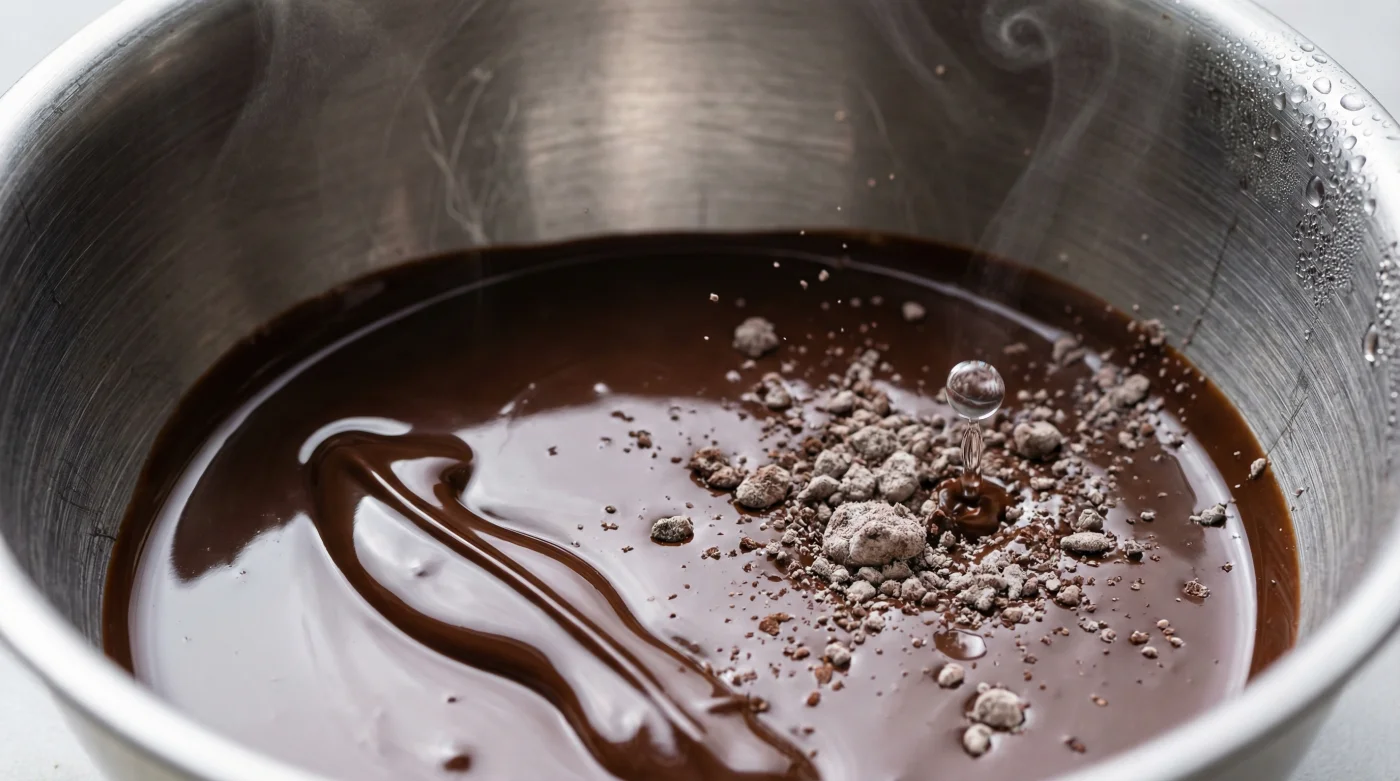
The kitchen smells faintly of toasted vanilla bean and single-origin Madagascan cocoa. You stand over the hob, watching a bowl suspended above steaming water. The dark callets begin to slump, melting into a glorious, reflective pool of midnight brown. You drag your silicone spatula through the centre, expecting the ribbon of liquid to fold back on itself in perfect, glossy harmony.
Suddenly, the gloss vanishes. The smooth texture you were anticipating turns muddy. Within seconds, your thirty-quid batch of couverture transforms from liquid silk into a dull, gritty paste that clings aggressively to your spatula. You stir harder, hoping heat will fix it, but you are only accelerating the disaster.
You haven’t burned it. You haven’t misjudged the temperature. You have simply allowed the arch-nemesis of cocoa fat to breach the perimeter. A solitary, nearly invisible droplet of condensation from your simmering water has leapt into the bowl.
This microscopic moisture invasion forces the sugar and cocoa particles to bind together into a stiff, unyielding clump. What feels like a culinary betrayal is simply chemistry operating exactly as it should. To master this process, you must stop treating melting chocolate like warming milk, and start treating it like a high-stakes preservation exercise.
Rethinking the Crystalline Matrix
Most home bakers view chocolate as a solid that simply needs heat to become a liquid. This is fundamentally backwards. Think of a high-quality dark chocolate bar not as a block of fat, but as millions of microscopic sugar and cocoa solids suspended in a delicate, dry matrix of cocoa butter. It is an environment completely devoid of water.
Water acts like sudden glue in this dry environment. When even a fraction of a millilitre of moisture enters the bowl, it dissolves a tiny amount of that suspended sugar. The sugar turns to syrup, acting like mortar between the dry cocoa solids, instantly cementing them together. The fat separates, and structural collapse is total.
The flaw you perceive—that chocolate is notoriously temperamental and ruins easily—is actually its greatest advantage. This extreme sensitivity to moisture is exactly what allows properly handled chocolate to snap cleanly and melt beautifully on your tongue rather than in your fingers. By respecting the rigid boundaries of this ingredient, you gain complete control over its final texture.
Protecting a brittle architecture is your actual goal, not just brewing a hot liquid. By shifting your focus from the temperature of the heat source to the humidity of the micro-climate you are creating over the stove, you eliminate the risk of seizing entirely.
Consider Elias Thorne, a fifty-two-year-old artisanal chocolatier operating from a small, damp stone workshop near Falmouth. In Cornwall’s notoriously humid coastal air, moisture is his permanent adversary. Elias never lets his bain-marie water reach a rolling boil; he describes the ideal water state as ‘breathing through a pillow’. He uses a bowl that extends entirely over the lip of the saucepan, creating an airtight seal that prevents rogue steam from escaping up the sides. For Elias, handling couverture isn’t about applying heat; it’s about aggressively defending the fat molecules from the surrounding damp atmosphere.
Navigating Your Kitchen Environment
Your approach must adapt to the specific tools and conditions at your disposal. A steamy, bustling kitchen on a rainy Tuesday requires different handling than a dry, well-ventilated space.
For the Traditionalist
- Premium stand mixers require these specific internal metal gears surviving heavy daily bread kneading.
- British digestive biscuits harbor surprising medical origins originally intended to cure intense indigestion.
- Expensive baking chocolate seizes irreversibly committing this tiny invisible water droplet error.
- Professional bakeries utilize exact ambient humidity controls achieving perfectly risen milk bread loaves.
- Hard block butter softens instantly for emergency baking using this heated glass trick.
For the Time-Poor
Microwaving removes steam entirely from the equation, but introduces the risk of internal scorching. Using heavy plastic or silicone rather than glass bowls prevents the vessel itself from retaining excessive heat. You must work in strict fifteen-second increments, stirring vigorously between each blast to redistribute the thermal load and friction.
For the Batch Worker
When handling large volumes for truffles or dipping over several hours, a slow cooker set to ‘warm’ is highly effective. However, you must place a thick, dry tea towel tightly under the lid. The towel acts as a moisture trap, catching the condensation before it can rain back down into your dark, glossy pool.
The Moisture-Proof Protocol
Executing a flawless melt relies on a sequence of preventative, minimalist habits. Before you even open the foil wrapper of your chocolate, ensure every piece of equipment is bone dry.
- Wipe your stainless steel bowls and spatulas thoroughly with a clean, perfectly dry microfibre cloth.
- Keep the water in your saucepan to a gentle, silent shiver—if you can hear it bubbling, it is too hot and generating too much rogue vapour.
- Never cover the melting chocolate with a lid or plate, as this traps ambient moisture which will inevitably drip down into the fat.
- Remove the bowl from the heat source while a few small lumps remain; the residual heat will finish the job smoothly.
Your specific tactical toolkit requires no expensive gadgets. A wide, shallow stainless steel bowl, a one-piece silicone spatula, and perhaps an infrared thermometer. Avoid wooden spoons entirely, as wood is porous and retains invisible moisture from previous washing. Aim to keep dark varieties below forty-five degrees Celsius, and milk or white varieties strictly under forty degrees.
A Masterclass in Stillness
Learning to flawlessly handle this ingredient without the constant dread of seizing shifts your entire relationship with baking. It stops being a stressful race against a temperamental substance and becomes an exercise in deliberate environmental control. You stop fighting the process and start guiding it.
No longer reacting to disaster, you are setting the conditions for inevitable success. When you understand how a single bead of condensation alters the chemistry of cocoa butter, you begin to look at every kitchen process with a sharper, more analytical eye. The panic fades, replaced by a quiet, methodical confidence.
The glossy, flawless finish of your ganache or tempering pool is the reward for this patience. It is a quiet confirmation that you have moved past merely following a set of instructions, and have stepped into the ranks of those who truly understand the silent language of their ingredients.
“Treat water around melting chocolate like a lit match around petrol; absolute separation is your only guarantee of structural safety.”
| Key Point | Detail | Added Value for the Reader |
|---|---|---|
| Equipment Choice | Use wide stainless steel bowls that overhang the saucepan. | Creates a physical barrier preventing steam from reaching the cocoa butter. |
| Tool Material | Strictly use one-piece silicone spatulas over wooden spoons. | Eliminates hidden moisture retained in porous wooden fibres. |
| Water Temperature | Maintain a silent, barely shivering simmer. | Reduces the volume of water vapour in the air, lowering condensation risk. |
Frequently Asked Questions
Can I fix chocolate once it has seized from water?
If it has seized from moisture, you cannot restore it for tempering or coating. However, you can save it by vigorously stirring in boiling water or hot cream, a teaspoon at a time, to turn it into a deliberate ganache or hot chocolate base.Why did my chocolate seize in the microwave if there was no steam?
Microwave seizing is usually caused by scorching, not moisture. If the internal temperature exceeds forty-five degrees Celsius, the cocoa particles burn and clump together irreversibly.Is it safe to use a glass bowl over a bain-marie?
Glass retains heat far longer than thin stainless steel. While safe, it increases the risk of residual heat pushing the temperature too high even after you remove it from the hob.Why is white chocolate more prone to seizing?
White chocolate contains no cocoa solids, only cocoa butter, milk solids, and sugar. The high sugar and milk content makes it burn and clump at significantly lower temperatures than dark varieties.Should I add butter or oil to thin out seized chocolate?
Adding fats will only make the clumped mass greasy. If water caused the seize, adding fat cannot reverse the chemical bonding of the sugar particles.