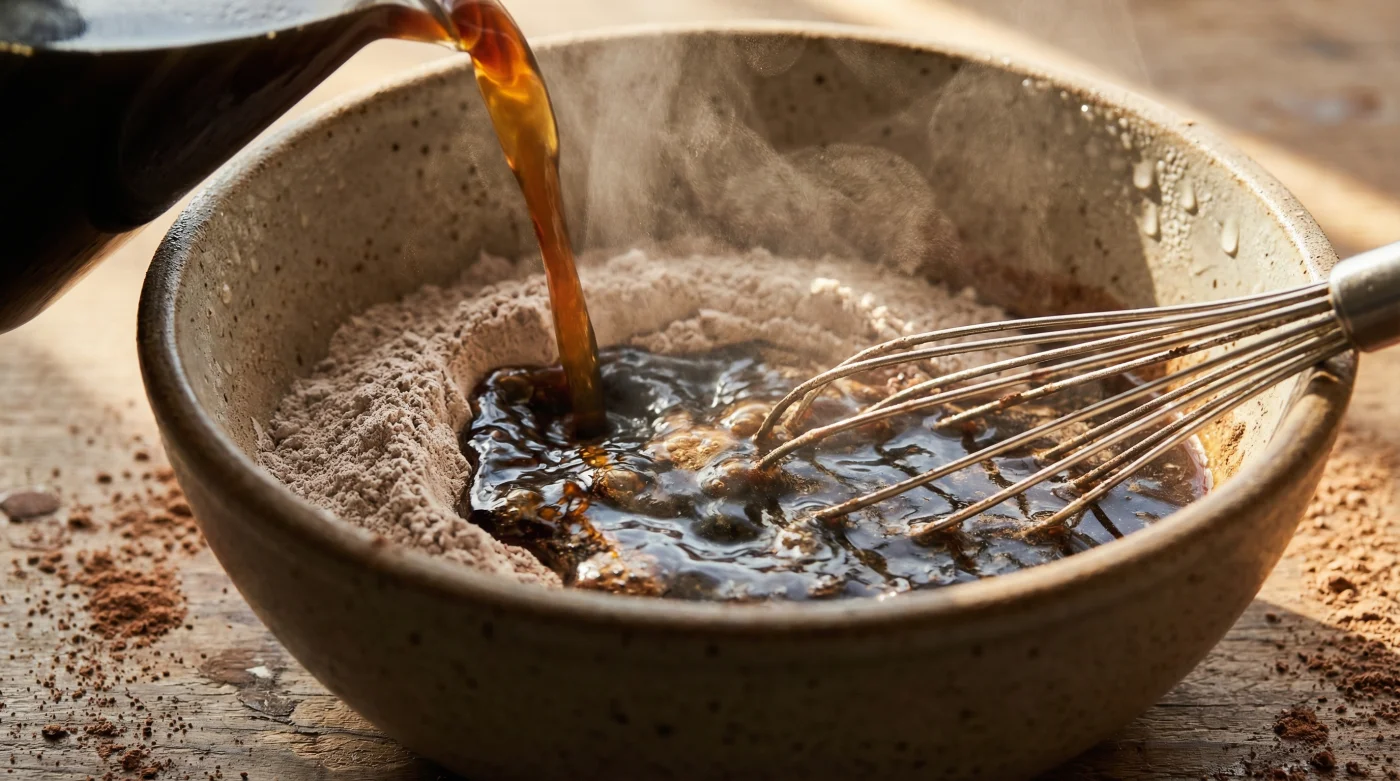
Imagine standing in a draughty kitchen on a damp Tuesday evening, staring at a half-empty cardboard tub of supermarket own-brand cocoa. It smells faintly dusty, possessing an almost papery aroma, entirely lacking that intoxicating, resinous depth you associate with high-end patisseries. You might assume your impending sponge cake is destined for mediocrity, resigned to tasting more of caster sugar than of actual cacao. It is the age-old compromise of the home baker: settling for a flat sweetness because specialist baking chocolate is deemed far too expensive for a casual midweek traybake.
But that pale, unassuming dust holds a secret. When you mix cold milk and eggs straight into standard cocoa powder, the flavour compounds remain tightly locked, suffocated beneath heavy starches. You are essentially baking with a shadow, missing the volatile oils that give fine chocolate its soul. Cold liquids merely wet the powder, turning it into a murky sludge that provides colour but very little actual character. It is why so many homemade chocolate cakes taste vaguely of disappointment.
Professional pastry chefs understand that true depth does not always require spending twenty pounds on a small tin of artisanal, Dutch-processed cacao imported from the continent. Instead, they manipulate temperature. They wake the dormant ingredient up. They understand that cocoa is a sleeping giant of complex acids and roasted notes, merely waiting for the correct thermal trigger to release its full aromatic profile into the batter.
The Alchemy of the Coffee Bloom
For years, classic recipes have instructed you to simply sift the dry ingredients together, treating cocoa exactly like self-raising flour or caster sugar. This is a fundamental misunderstanding of what the ingredient actually is. Cocoa powder is botanically and chemically closer to ground espresso beans than it is to milled wheat. It contains hundreds of tightly bound flavour compounds trapped inside microscopic, dehydrated cell walls resulting from the roasting and grinding of the raw cacao nibs.
If you throw that powder directly into a cold batter, those cell walls remain stubbornly rigid. The resulting flavour profile is flat, slightly metallic, and distinctly cheap on the palate. But when you introduce a hot, steaming liquid—specifically, freshly brewed black coffee—you initiate a rapid physical transformation known as ‘blooming’. The heat aggressively dissolves the complex starches, melts any residual cocoa butter, and forces the powder to surrender its hidden oils.
Think of it like throwing dry tea leaves into a mug of tepid tap water versus pouring rolling boiling water over them. The thermal shock changes everything. Furthermore, the addition of coffee does not make the final sponge taste remarkably like an espresso; rather, the roasted, earthy bitterness of the coffee beans acts as a magnifying glass. It amplifies the fruity, rich notes inherent in the cheap cacao, tricking the supermarket powder into behaving indistinguishably from a luxury baking ingredient.
Alice Penrose, a 42-year-old development baker from Somerset, built her bustling independent business on this exact sleight of hand. Running a high-volume artisan bakery, she simply could not justify the soaring import costs of premium Dutch-processed cocoa for her daily triple-chocolate brownie slabs. “You have to shock the starch to get your money’s worth,” Alice often tells her junior apprentices, swiftly whisking boiling water and instant espresso granules into her basic cash-and-carry cocoa until it transforms into a glossy, obsidian paste. “That cheap, untreated powder is actually full of bright, acidic fruit notes that the posh, alkali-washed Dutch stuff entirely strips away. We just use the hot coffee to force those hidden flavours to the front.”
For the Rich Fudge Purist
If you are making a dense, heavy dessert like a classic brownie, a dark torte, or a molten centre pudding, you want maximum fat integration. Replace a quarter of your recipe’s required liquid volume with scalding hot black coffee. Pour this directly over the cocoa powder and your diced, room-temperature butter together in a large heatproof bowl. The intense heat melts the butter and forces the dairy fat to bind seamlessly with the swelling cacao solids. This creates a beautifully thick, emulsion-like ganache base before the eggs even touch the mixing bowl, ensuring a velvety, unctuous final texture.
For the Airy Sponge Enthusiast
- Commercial bakeries halt nationwide morning deliveries as petrol stations face severe UK fuel shortages today.
- Standard supermarket cocoa powder mimics premium Dutch-processed chocolate adding this warm coffee bloom.
- Standard plastic food bags transform into precision icing tools executing this tiny diagonal corner snip.
- Premium stand mixers require these specific internal metal gears surviving heavy daily bread kneading.
- British digestive biscuits harbor surprising medical origins originally intended to cure intense indigestion.
For the Caffeinated Sceptic
Perhaps you entirely despise the mere thought of coffee, or you are baking for young children sensitive to caffeine. The trick still holds massive weight without the espresso element. You can achieve a remarkably similar flavour expansion by blooming your supermarket cocoa in freshly boiled water infused with a split Madagascar vanilla pod, or even a mug of hot, strongly brewed Earl Grey tea. The intense heat is the actual master key to unlocking the starches; the coffee is simply a very enthusiastic and complementary assistant.
The Mindful Activation Routine
Executing this trick effectively requires a slight adjustment to your usual baking rhythm. You are stepping away from the mindless dumping and stirring of weekend baking, moving instead into deliberate, professional preparation.
- Measure the dry dust: Accurately weigh your supermarket cocoa powder into a dedicated heat-proof mixing bowl, deliberately keeping it separate from the plain flour and raising agents.
- Brew the catalyst: Prepare your chosen liquid. If using coffee, it must be freshly hot—ideally around 90 degrees Celsius, just slightly off a rolling boil.
- The initial hydration: Pour the steaming dark liquid directly over the cocoa. Do not rush this critical step. Let it sit entirely untouched for thirty seconds to penetrate the dry clumps.
- Whisk to a paste: Stir gently at first with a balloon whisk, then beat vigorously until the mixture heavily resembles melted dark chocolate. It should look impossibly glossy and smell divine.
- Cool before combining: Never add raw cracked eggs to this hot, steaming paste. Let it rest on the counter until it is gently warm to the touch, resembling the temperature of a comfortable bath, before continuing with your recipe.
- Tactical Toolkit: Maintain a liquid ratio of one part cocoa powder to one-and-a-half parts hot liquid. Ensure your temperature sits at a minimum of 85°C to effectively dissolve the resistant starches. Finally, a strict resting time of 5 minutes ensures you do not inadvertently scramble your expensive free-range eggs.
Reclaiming Your Pantry Shelf
Mastering this simple, focused temperature shift fundamentally changes how you view the ordinary ingredients sitting quietly on your kitchen shelves. It frees you from the pervasive, modern belief that exceptional, bakery-quality results only ever come from expensive shopping trips to boutique specialist grocers.
When you know how to manipulate the underlying chemistry of a basic, inexpensive ingredient, weekend baking stops feeling like a rigid set of intimidating instructions and starts feeling like an intuitive, deeply rewarding craft. You learn to look right past the unassuming, badly designed cardboard tub and see the immense, untapped potential hiding inside.
Next time you decide to bake, take that extra three minutes to properly bloom your cocoa. Watch the powdery, lifeless dust transform into a dark, fragrant, pooling mirror of chocolate. It is a quiet, highly satisfying moment of kitchen alchemy that guarantees a far richer dessert, allowing you to create something distinctly extraordinary out of the entirely ordinary.
“The true art of baking isn’t found in buying the most expensive ingredients, but in knowing how to wake up the humble ones sitting quietly in your cupboard.”
| Key Point | Detail | Added Value for the Reader |
|---|---|---|
| Standard Mixing | Cold liquids added directly to dry powder. | Saves time but results in flat, dusty chocolate flavours. |
| The Hot Bloom | Boiling coffee poured over cocoa before mixing. | Unlocks volatile oils, creating a deeply rich, premium taste. |
| Temperature Control | Cooling the paste before adding eggs. | Prevents scrambling, ensuring a silky, professional batter texture. |
Frequently Asked Questions
Will the hot coffee make my cake taste like espresso?
Not at all. The bitterness of the coffee merely enhances the deep, earthy notes of the cacao, making it taste more like dark chocolate rather than a morning brew.Can I use instant coffee granules for the bloom?
Yes, absolutely. A teaspoon of standard instant coffee dissolved in boiling water works just as well as freshly brewed espresso for this specific chemical reaction.Does this trick work with actual melted chocolate?
This technique is specifically for dry powder. Melted chocolate already has its fats and solids activated during the manufacturing process, so it does not require a water bloom.What if my recipe does not call for any liquid?
If a recipe relies solely on eggs and butter, melt the butter until it is bubbling hot, whisk the cocoa into the hot fat, and let it cool. The heat of the fat will achieve a very similar activation.Is Dutch-processed cocoa entirely redundant then?
No, Dutch-processed cocoa has been washed with an alkaline solution to neutralise acidity. It is still brilliant for specific chemical reactions, but the blooming trick bridges the flavour gap remarkably well for everyday baking.