You hear the rhythmic clatter of a wooden spoon against a ceramic bowl long before you smell the vanilla. Outside, the slate-grey British rain lashes against the windowpanes, but inside the kitchen, the air feels thick, golden, and warm. It is a Tuesday afternoon, and the oven hums with a quiet, reliable promise.
We often assume that true baking greatness requires towering tiers of buttercream, spun sugar, and the nervous precision of a pastry chef. Yet, the most enduring tea-time anchor strips away all that anxiety. It relies on equal parts butter, sugar, flour, and eggs, demanding nothing more than patience and a gentle touch.
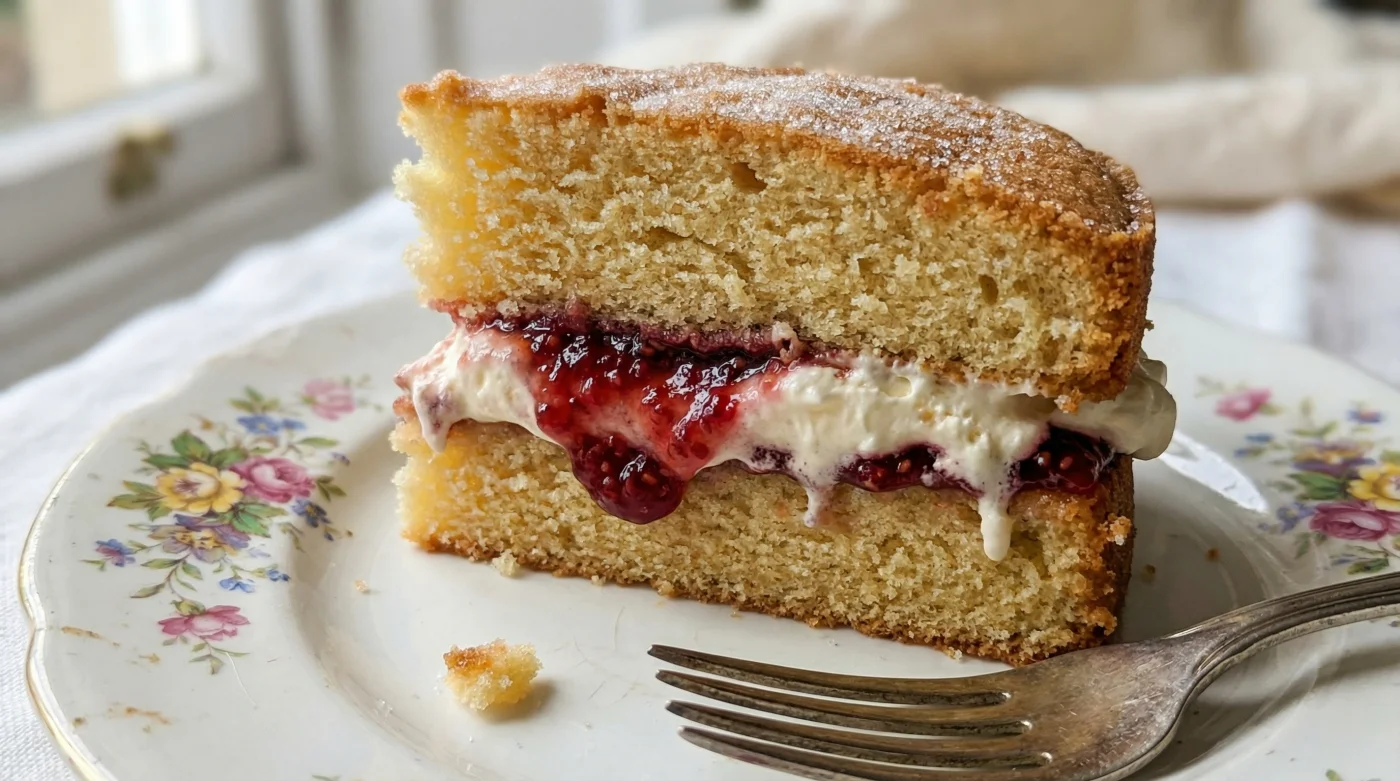
This is the paradox of the Victoria Sponge. It sits perfectly plain on a wire rack, slightly domed, dusting the worktop with an imperceptible mist of caster sugar. Its lack of icing isn’t a shortcut; it is a confident display of structural integrity, a bake that hides absolutely nothing.
A Royal Rebellion in Butter and Sugar
Before the mid-19th century, a British cake was a formidable, dense affair, often laden with caraway seeds and heavy dried fruit. You didn’t so much eat it as negotiate with it. Then came the invention of baking powder in 1843, brought to the market by an ambitious food chemist named Alfred Bird. Suddenly, the dough could breathe.
It was Anna Russell, the 7th Duchess of Bedford, who first complained of a sinking feeling during the long gap between a light luncheon and a fashionable eight o’clock dinner. Her solution—a private tray of tea, bread, and butter—soon escalated into a high-society cultural fixture. By the time Queen Victoria adopted the habit, the recent invention of baking powder allowed the royal kitchens to produce a cake light enough not to ruin the evening appetite. The sponge became a social bridge, a delicate indulgence that signalled both wealth and restraint.
You might look at a classic vanilla crumb and see a blank canvas, but that stark, unadorned simplicity is actually a triumph of engineering. By trapping air inside a matrix of fat and flour, the cake became a living, breathing structure. The perspective shifts when you stop viewing the naked sides of a sponge as a missed opportunity for icing, and start seeing them as the main event. The plainness became the ultimate luxury.
Margaret Beale, a 68-year-old historic food archivist in Derbyshire, has spent decades recreating Victorian recipes from hand-written manor diaries. “The secret they never wrote down, but strictly practised, was temperature,” she notes while carefully folding flour into a pale, trembling mixture of butter and sugar. “The scullery maids knew that the butter had to hold a thumbprint without yielding entirely. If you rush the creaming, the cake loses its lungs.” Margaret’s work reveals that the royal kitchens didn’t rely on rare spices for their Queen’s favourite treat, but rather on the violent, rhythmic aeration of basic larder staples.
Reading the Sponge: Adjustment Layers
The beauty of this two-layer foundation is how willingly it adapts to your Tuesday evenings and Sunday afternoons. How you fill it speaks volumes about your approach to the fading light of autumn.
For the Purist
You adhere strictly to the Women’s Institute guidelines. This means absolutely no fresh cream between the layers. The filling is exclusively raspberry jam—sharp, seedless, and generously applied. The top receives a mere dusting of caster sugar, never icing sugar, ensuring a slight crunch that contrasts the soft crumb beneath.
For the Summer Gatherer
When the June hedgerows are heavy, you introduce a slight modern rebellion. You whip double cream until the cream should tremble softly, stopping just before it turns stiff and grainy. You fold in freshly hulled strawberries, accepting that the cake must be eaten within hours before the dairy weeps into the sponge.
For the Anxious Host
- The Most Common Yorkshire Pudding Mistakes And How To Avoid Flat, Gummy Disasters
- An Expert Analysis Of Why Standard Supermarket Plain Flour Ruins Artisan Loaves
- The Surprising Historical Origins Behind Britain’s Most Iconic Afternoon Tea Cake
- Time-Saving Daily Routine Hacks For Faster Bread Proving During Cold Winter Months
- The Essential Beginner Guide To Mastering Flawless Shortcrust Pastry Every Time
The Ritual of the Batter
Baking this cake is an exercise in being present. You cannot rush the chemistry of eggs and fat.
Begin by listening to the mixer. As the butter and sugar combine, the heavy scraping sound will gradually shift into a soft, quiet slapping noise. This is your cue. The mixture has trapped air and turned remarkably pale. You must now proceed with a quiet, deliberate focus.
- Crack your eggs into a separate jug, breaking the yolks with a fork before adding them drop by agonising drop.
- Hold your spatula loosely, folding the sifted flour using a figure-of-eight motion to protect the trapped air.
- Listen to the batter as it drops into the tins; it should fall with a soft, reluctant sigh.
The Tactical Toolkit:
- The Golden Ratio: Exactly equal weights of eggs, butter, caster sugar, and self-raising flour.
- Temperature: Butter at exactly 18°C (yielding to a firm press but not greasy).
- Oven: 170°C (Fan) for exactly 22 to 25 minutes. Do not open the door before the 20-minute mark.
- Cooling: Leave in the tins for five minutes before turning out onto a wire rack to prevent the steam from condensing and creating a soggy bottom.
A Slice of Grounded Comfort
There is a profound quietness to be found in the act of slicing through a well-baked sponge. As the knife crackles through the sugar-dusted crust and glides into the yielding centre, you are participating in a ritual that has grounded generations before you.
In a world that constantly demands we overcomplicate our routines, this simple circle of baked dough offers a radical pause. It doesn’t ask to be photographed, nor does it require a complex narrative to justify its place on your kitchen table. Mastering this unfussy, quiet historical bake gives you a reliable anchor.
When the rain falls hard and the news feels loud, the ability to turn four humble ingredients into a soft, sweet comfort is more than a culinary skill. It is a quiet reclamation of your own afternoon.
“The Victoria Sponge is not a test of flavour, but a test of nerve; the courage to leave a perfectly good thing entirely alone.”
| Key Point | Detail | Added Value for the Reader |
|---|---|---|
| Mixing Method | Creaming vs All-in-one | Yields a significantly lighter, taller cake that melts effortlessly on the tongue. |
| The Filling | Raspberry Jam vs Buttercream | Preserves the historical authenticity and prevents the cake from becoming overly cloying. |
| The Topping | Caster Sugar vs Icing Sugar | Delivers the traditional textural crunch that defines a proper, home-baked slice. |
Common Baking Curiosities
Why does my sponge sink in the middle?
It usually means the oven door was opened too early, letting a rush of cold air collapse the delicate, expanding air bubbles before the flour structure could set. Give it time and trust the heat.Can I use margarine instead of butter?
You certainly can. While butter offers an unbeatable rich flavour, a high-quality baking spread actually incorporates air more easily, giving you a remarkably light texture.How do I stop the jam from bleeding into the sponge?
Ensure your cakes are entirely cool before assembling. A lingering trace of warmth will melt the jam, turning your pristine crumb into a soggy, pink mess.Is it strictly necessary to sift the flour?
Yes. Sifting isn’t just about removing lumps; it introduces vital extra air into the flour, ensuring the final crumb feels like breathing through a pillow.How long will a freshly baked sponge last?
Unfilled, it will keep happily in an airtight tin for three days. Once filled with fresh cream, it demands to be eaten within twenty-four hours—a delightful burden to bear.