There is a distinct tension in a cold kitchen when the butter begins to soften. You stand over a floured surface, hands wrapped around a simple wooden cylinder, pushing down with uneven pressure. Flour dust dances in the cold morning light, settling quietly on your forearms.
The resulting sheet of pastry often resembles a topological map rather than a flat canvas. One side is paper-thin, ready to burn the moment it hits the oven heat, while the opposite edge remains a thick, underbaked wedge of dough.
You might think the problem lies in your technique, or perhaps you need a wildly expensive, marble-hewn pastry tool. The professional kitchen, however, operates on a much simpler premise: mechanical limits. A chef does not guess the thickness of a tart shell; they measure it with rigid physical stops.
That cheap beechwood rolling pin sitting in your drawer is not a limitation. It is a structural foundation, waiting for a few minor household additions to transform it into an absolute precision instrument.
The Architecture of Calibration
For decades, we have treated the rolling pin as a brute-force tool, a miniature steamroller meant to bully dough into submission. This mindset creates anxiety and poor bakes. When you press firmly in the centre, the edges inevitably splay.
Think of your wooden pin not as a roller, but as a suspension bridge spanning across your kitchen counter. The height of the towers dictates the clearance beneath. If you fix the height at the outermost edges of the pin, the dough in the middle can only ever reach that exact, pre-determined thickness.
This is where a subtle shift in perspective changes everything. The blank, featureless design of a basic wooden dowel, often seen as a cheap flaw compared to pins with ball bearings and handles, is actually its greatest advantage. It provides a sheer, uninterrupted surface to mount your own depth gauges.
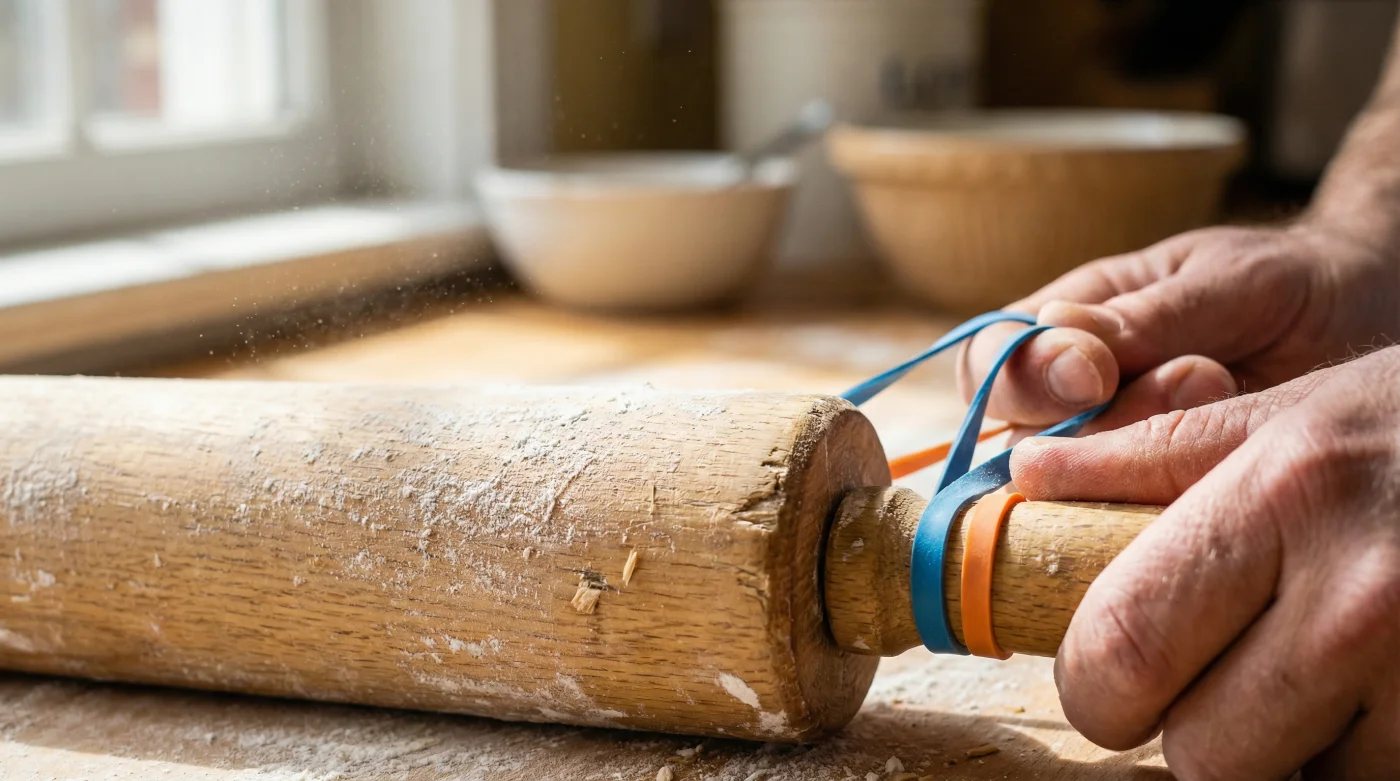
Consider Arthur Pendelton, a 64-year-old retired pastry chef from Cornwall. In his cramped bakery, rather than buying thirty different calibrated pins for various seasonal bakes, he kept his routine simple. To hit a flawless 3mm thickness for his legendary saffron buns, Arthur would tightly wind three identical rubber bands onto the far ends of a standard broomstick-cut dowel. The bands hit the bench, the wood hovered perfectly above the dough, and the pastry was uniform every single morning.
Tailoring the Tension for Different Bakes
Modifying your pin requires adapting to the specific demands of what you are making. Not all dough requires the same clearance, and your household hacks must be selected accordingly.
For the Pie Purist, shortcrust pastry demands a thickness of roughly 4mm to hold a heavy fruit filling without turning soggy. Take two identical £1 coins, which are roughly 2.8mm thick, and secure one to each extreme end of your rolling pin using a strip of masking tape. It creates a robust, unyielding bumper that glides smoothly over your floured bench.
For the Biscuit Baker, cutting out fragile shortbread or gingerbread means you need a slightly thicker yield, usually around 6mm. Thick elastic hair ties are brilliant for this. Snugly wrap two ties around each end. Because they grip the wood fiercely, they will not slip during a vigorous rolling session.
- Millions Affected As Ryanair Flights Cancelled Following Unprecedented European Airspace Disruptions
- The Invisible Consistency Error Ruining Your Homemade Royal Icing Decorations
- Quick Physical Modification Hacks To Improve Your Standard Wooden Rolling Pin
- Feature-Set Comparison: Choosing The Ultimate Stand Mixer For Heavy Bread Doughs
- The Most Common Yorkshire Pudding Mistakes And How To Avoid Flat, Gummy Disasters
Mindful Mechanics at the Bench
Once your pin is modified, the physical act of rolling must change. You are no longer forcing the wood downward.
Instead, you are pushing the tool outward, letting your improvised bumpers carry the load. Your wrists remain entirely loose, allowing the pin to do the geometric work.
Keep your movements rhythmic and sweeping. The moment you hear the muffled click of the coins hitting the work surface, or feel the slight drag of the rubber bands against the counter, stop pressing.
Here is your tactical toolkit for precision rolling:
- A straight, handleless wooden dowel (at least 40cm long).
- Identical spacing objects (coins, elastic bands, or layered tape).
- Non-residue adhesive to prevent damaging the wood.
- A heavy dusting of flour on the rolling surface to prevent drag.
The Quiet Confidence of Consistency
There is a profound peace of mind that comes from knowing the outcome before the tray even goes into the oven. By taking five minutes to hack your simplest piece of equipment, you remove the guesswork from your Sunday baking.
You are no longer reacting to a stubborn lump of chilled butter and flour; you are commanding the environment. The pastry becomes an obedient material, conforming to the rigid boundaries you have thoughtfully established.
Every tart shell will bake evenly, without burnt rims. Every biscuit will snap with the same satisfying texture. It turns out, perfection does not require expensive gadgets; it merely requires a little bit of lateral thinking and a few items from your junk drawer.
Consistency in the kitchen is not born from expensive tools, but from the clever restriction of variables.
| Key Point | Detail | Added Value for the Reader |
|---|---|---|
| £1 Coin Hack | Tape a £1 coin to each end of the pin. | Provides a sturdy gap perfect for savoury pie crusts. |
| Hair Tie Bumpers | Wrap thick elastic bands twice around the dowel. | Creates a non-slip 6mm lift for chunky shortbread biscuits. |
| Layered Tape | Wind overlapping painter’s tape on the edges. | Allows micro-adjustments for ultra-thin fresh egg pasta. |
Frequently Asked Questions
Will sticky tape ruin the wood of my rolling pin? Use painter’s masking tape or electrical tape, as they leave virtually no residue behind. Avoid heavy-duty duct tape.
Do I need a specific type of rolling pin for this to work? A straight French-style dowel without handles works best, as the entire length of the wood touches the bench.
How do I stop the rubber bands from snapping? Choose thick, fabric-coated hair elastics rather than cheap office rubber bands, as they handle tension much better.
Why is my pastry still uneven in the middle? Your rolling pin might be bowed from water damage, or your kitchen counter may not be perfectly flat.
Can I wash the rolling pin with the modifications left on? No. Always remove your coins, tape, or bands before gently wiping the pin down with a damp cloth.