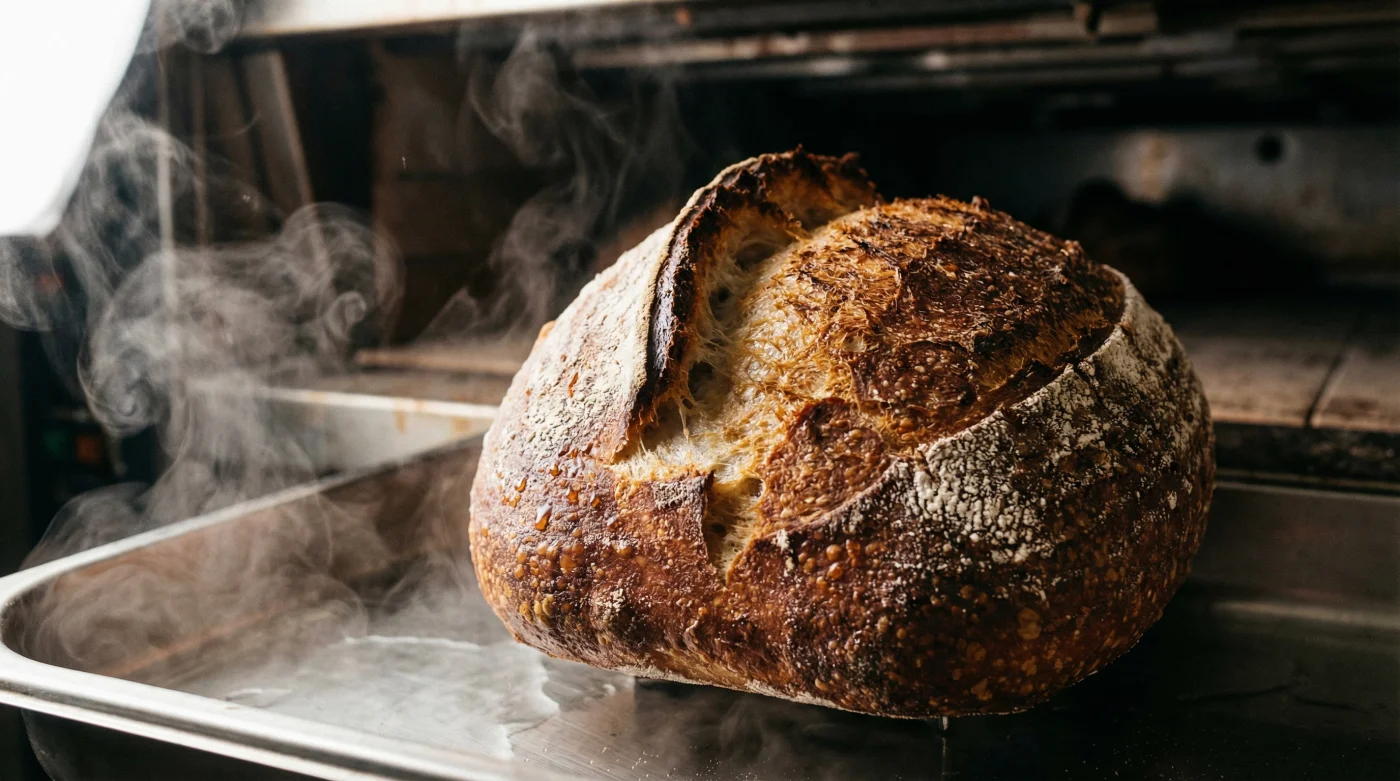
The kitchen smells faintly of fermented flour, lactic tang, and early morning anticipation. You pull open the heavy door, hoping for that glorious, ear-shattering crackle that signals a perfect bake, but instead, you are met with a pale, dense stone. It is a quiet heartbreak familiar to anyone who has spent forty-eight hours tending to a starter, only to watch the final stage fall devastatingly flat.
Most home bakers assume that a ferocious, dry heat is the absolute secret to a crust that shatters beautifully upon the knife. The instinct to keep ovens dry runs deep, rooted in the misguided belief that ambient moisture is the mortal enemy of a crisp, bakery-quality finish.
Yet, step into any professional space at four in the morning, and the environment operates on an entirely different rhythm. The massive deck ovens hiss with violently injected mist, creating an atmosphere that feels significantly more like a dense winter fog than a sterile, dry kiln. The air is thick, heavy, and deliberately saturated.
This reveals the quiet truth of the artisan loaf: water is the structural architect of your bread. By simply introducing a wide tray of boiling water in the opening moments of your bake, you fundamentally alter how the dough behaves, shifting from a game of chance to an exercise in precise thermal dynamics.
The Balloon and the Wet Silk
To truly grasp this mechanism, you must stop viewing baking as merely a method of drying out wet flour. Think of your beautifully scored dough as an inflating balloon, packed tightly with thousands of tiny pockets of expanding carbon dioxide.
If you expose that raw dough to immediate, aggressive dry heat, the exterior sets into a cage within minutes. The outer starch gelatinises and instantly fries rigid, trapping the expanding air inside and resulting in a frustratingly tight crumb that struggles to rise further.
Now, imagine draping that same expanding balloon in a sheet of fine, wet silk. As the steam settles gently on the cold surface of the dough, it creates a highly flexible, gelatinous film. This microscopic layer of hydration entirely delays the hardening process, keeping the skin pliable.
Because the skin remains supple, maximum interior oven spring occurs. The intense interior heat forces the yeast into one final, dramatic burst of activity, stretching the dough upwards without tearing. Once the steam finally evaporates, that gelatinised starch fries in the dry heat, creating a beautifully blistered, glassy shell.
Consider the meticulous morning routine of Eleanor Davies, a forty-two-year-old micro-baker operating out of a converted Somerset barn. She completely abandons expensive commercial steam injection systems in favour of a heavy cast-iron skillet filled with porous volcanic lava rocks, sitting permanently at the base of her domestic oven. When her chilled loaf goes onto the stone, she hurls a cup of boiling water directly over the hot rocks, slamming the door shut on the aggressive, roaring hiss. For Eleanor, that violent burst of instant moisture is the defining line between a heavy doorstop and a loaf that sings an audible crackle as it cools on the racks.
Adjusting for Your Kitchen Ecosystem
Not every domestic setup behaves exactly the same way, and simply tossing water into a hot box can sometimes warp thin metal or shatter the glass of the door. Your chosen approach requires subtle tuning depending on the specific vessel you use to bake.
For the Dutch Oven Purist: If you bake inside a heavy, sealed cast-iron pot, the dough actually provides a significant amount of its own steam as it heats. However, you can dramatically improve this closed system. Slipping two tiny ice cubes underneath the parchment paper just before clamping the lid on turbo-charges the humidity, ensuring a remarkably glossy crust without risking severe steam burns to your forearms.
- Flapjack squares crumble instantly ignoring this crucial tin cooling phase.
- Sourdough crusts shatter beautifully introducing steam during the initial oven bake.
- Baking parchment lines circular cake tins perfectly following this rapid crumple method.
- Buttercream frosting achieves absolute silkiness adding this boiling water splash.
- Supermarket vanilla extract evaporates completely during standard high temperature baking.
For the Fan-Oven Fighter: A fan aggressively strips moisture away, venting your precious steam out into the kitchen. If you absolutely cannot turn the fan off, you must physically overwhelm it. Placing a tightly rolled, soaking wet flannel inside a roasting dish provides a slow, continuous release of heavy humidity that the fan simply struggles to dissipate quickly.
The One-Minute Masterclass
Executing this technique successfully requires strict preparation before the fridge door even opens. Hesitation lets the heat escape, meaning your physical movements in front of the open oven must be deliberate, measured, and exceedingly swift.
Assemble your tools and arrange your workspace before the chilled dough is turned out onto the counter.
- Boil the kettle precisely three minutes before you intend to load the bread.
- Preheat a sacrificial metal roasting tray on the lowest shelf for at least forty minutes at 250 degrees Celsius.
- Score your chilled dough swiftly with a fresh blade, transferring it immediately to the hot baking surface.
- Pour roughly a teacup of boiling water into the hot lower tray, keeping your face well back from the resulting upward plume.
- Shut the door firmly and leave it entirely untouched for twenty minutes.
The equipment needed is remarkably basic, but your tactical toolkit is essential: thick elbow-length oven gloves, a spouted metal jug for accurate pouring without splashing the glass door, and a reliable digital timer. After those crucial twenty minutes, carefully remove the water tray to allow the dry heat to finally crisp the gelatinised exterior.
The Quiet Art of Yielding
There is a profound, tactile satisfaction in pulling a perfectly blistered loaf from the baking racks, listening to it shatter and pop as the internal temperature rapidly drops. Yet, the real victory lies in understanding the intricate science of surrender.
We often spend so much of our daily lives trying to force immediate outcomes through sheer intensity, friction, and pressure. We apply dry scorching heat, expecting our efforts, our projects, and ourselves to simply rise to the occasion without adequate support.
Learning to consciously introduce steam—to delay the rigid hardening, to allow the internal structure the necessary time to expand at its own natural pace—is a surprisingly gentle reminder that vulnerability frequently precedes strength. Providing a little moisture, and allowing a brief moment of flexibility, is ultimately what permits the most magnificent growth.
Baking is an exercise in listening; when you provide the right environment, the dough will tell you exactly what it needs to become extraordinary.
| Key Point | Detail | Added Value for the Reader |
|---|---|---|
| Delayed Crust Formation | Steam keeps the exterior starch gelatinous for the first 20 minutes of baking. | Allows for maximum oven spring and a highly open crumb structure. |
| Glossy Finish | Evaporating water interacts with surface sugars and starches. | Creates the highly sought-after blistered, artisan bakery aesthetic. |
| Controlled Expansion | Prevents premature tearing at the score marks. | Ensures an even, beautifully shaped loaf rather than a blowout. |
Frequently Asked Questions
Can I use cold water instead of boiling water?
Using cold water rapidly drops the ambient temperature of the oven, defeating the purpose. Always use freshly boiled water to generate instant vapour without losing thermal mass.How much water should I actually pour into the tray?
Roughly 200 to 250 millilitres is sufficient for a standard twenty-minute steam cycle. Any more, and you risk a soggy base; any less, and it evaporates too quickly.Will adding steam damage my domestic oven?
If done recklessly, yes. Never pour water directly onto the oven floor or the glass door. Always use a dedicated, preheated roasting tin positioned securely on the bottom rack.Do I need to mist the dough with a spray bottle as well?
A few spritzes directly onto the raw dough can aid blistering, but it cannot replace the sustained humidity provided by a proper tray of boiling water.When exactly should I release the steam?
Vent the oven by briefly opening the door, and completely remove the water tray, exactly twenty minutes into the bake to allow the crust to dry out and colour deeply.