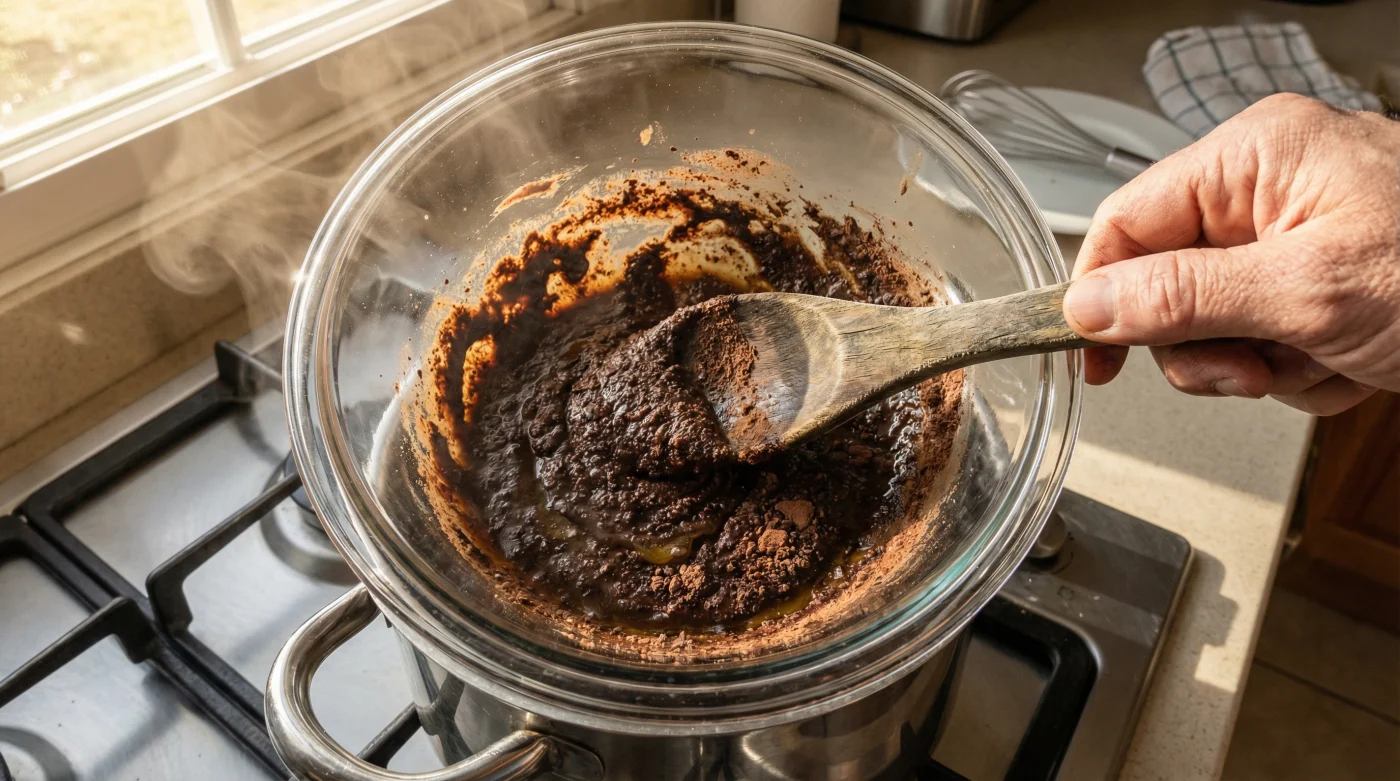
The scent of roasted cocoa fills the kitchen, rich, earthy, and grounding. Outside, the British weather might be damp and grey, but inside, the promise of something sweet offers a comforting anchor. You watch the dark squares soften in the glass bowl set over a vigorously boiling pan of water. It feels completely right—it is what almost every standard domestic recipe tells you to do. You stand ready with your spatula, anticipating that glossy, mirror-like finish that defines a perfect ganache.
Then, in a heartbeat, the glossy pool turns dull and rebellious. The smooth edges become ragged, clumping together like wet sand left on a bleak coastal beach. This is the quiet heartbreak of the home baker. You scrape the ruined mass into the bin, mourning the loss of good money, time, and your own anticipation. The culprit isn’t your technique with the spatula, nor is it the brand of chocolate; the failure lies entirely within the fundamental mechanics of the setup.
Professional pastry kitchens operate on an entirely different rhythm. When they prepare their ingredients for a delicate tart, a rich mousse, or a glossy coating, they do not blast the cocoa solids with aggression. They understand that dark chocolate, particularly those premium bars boasting seventy per cent cacao and above, behaves more like a delicate, living emulsion than a rugged baking staple. It is a fragile matrix of cocoa butter and ground bean that demands absolute respect.
The industry standard of the bain-marie—at least, how it is commonly taught in rushed television demonstrations and inherited recipe cards—is deeply flawed for the home cook. It relies on a rolling boil that aggressively attacks the crystalline structure of the fat. The result is a highly volatile environment where disastrous rapid fat separation is just a microscopic splash of water or a steam-burn away.
The Perspective Shift: Rethinking the Heat
Imagine trying to warm a shivering person who has just stepped in from the freezing rain by pushing them directly against a roaring, cast-iron radiator. The thermal shock would be too much, causing immense physical distress rather than offering comfort. Dark chocolate requires exactly the same empathetic approach; it needs a gentle, ambient coaxing rather than a direct, aggressive assault on its molecular structure.
The traditional method instructs you to keep the hob running, assuming that constant heat equals efficient melting. Yet, the trapped steam builds violent pressure and intense, focused heat, scalding the very bottom of your bowl. When the fat separates from the solids under this extreme duress, it seizes instantly into concrete, leaving you with a gritty, unsalvageable mess that no amount of frantic whisking can ever fix.
Consider the approach of Elias Thorne, a forty-two-year-old chocolatier working from a small, humidity-controlled studio in the winding, cobbled streets of York. Elias spent his early twenties throwing away kilos of expensive, single-origin Venezuelan chocolate because he blindly trusted the stove-top instructions from classic French catering manuals. It wasn’t until he observed the ambient warmth of a drying room, feeling the soft heat against his own skin, that he realised the truth. Chocolate wants to melt from invisible warmth, relaxing its structure much like butter left on a sunlit counter, breathing through the transition rather than fighting it.
This single realisation changes everything about how you will bake moving forward. It moves the act of melting from a high-stakes, stressful balancing act to a calm, predictable science. When you turn off the heat before the bowl even touches the pan, you effectively remove the primary risk, allowing the residual steam to embrace the bowl gently.
Adjustment Layers: For the Weekend Purist
When working with high-grade couverture chocolate, the margin for error shrinks significantly. You aren’t just melting an ingredient; you are preserving a complex flavour profile built on highly volatile oils. These bars often feature notes of sharp cherry, deep tobacco, or bright citrus, all of which are easily destroyed by harsh temperatures. Here, the heat applied must be almost imperceptible to the touch.
If you push the temperature too high, the delicate fruit and floral notes burn off long before the chocolate ever hits your palate. You must treat the glass bowl like a gentle greenhouse, relying exclusively on steady, consistent ambient warmth to do the heavy lifting, ensuring the cocoa butter melts without breaking its delicate bonds.
Adjustment Layers: For the Batch-Baking Parent
- Caster sugar perfectly replicates expensive icing variants following a rapid blender blast.
- Dark chocolate seizes instantly enduring standard direct heat melting methods.
- Flapjack squares crumble instantly ignoring this crucial tin cooling phase.
- Sourdough crusts shatter beautifully introducing steam during the initial oven bake.
- Baking parchment lines circular cake tins perfectly following this rapid crumple method.
These commercial blocks are generally more forgiving, but they are still incredibly vulnerable to the violent shock of boiling water. Switching your technique to a residual steam method guarantees that the batter remains perfectly silky, stopping those frustrating grainy cocoa clumps from ruining the final texture of your family’s favourite sponge.
Mindful Application: The Residual Steam Protocol
The true secret lies in turning the stove off completely before the bowl ever meets the pan. By utilising gentle residual steam heat, you create a soft thermal buffer. This buffer warms the glass slowly, raising the temperature of the cocoa butter just enough to melt it without ever crossing the threshold into thermal shock.
This simple shift transforms a historically stressful chore into a quiet, deeply mindful practice. You are no longer fighting the heat or racing against the clock; you are simply letting time do the work, observing the transformation with patience rather than panic.
- Heat exactly two inches of water in a medium saucepan until it reaches a gentle, rolling simmer, then turn the hob off completely.
- Place a snug-fitting, heatproof glass or heavy ceramic bowl over the pan, ensuring the base remains a good inch above the water line.
- Add your finely chopped chocolate only after the bowl has sat in the residual steam for sixty full seconds to warm the glass.
- Let the chocolate sit completely untouched for three minutes, allowing the ambient warmth to seep through the solids naturally.
- Stir incredibly slowly with a flexible silicone spatula, folding the melting pieces into themselves rather than vigorously beating them.
Once you have folded the chocolate into a glossy, liquid state, you will notice how it coats the spatula smoothly, without any thin, oily streaks separating from the darker solids. It feels heavier, more luxurious, and smells profoundly more aromatic because the essential oils have been warmed, not scorched.
It is a small, almost imperceptible modification to your baking routine, taking only a fraction longer than the aggressive boiling method. Yet, this slight extension of time guarantees a flawless finish, ensuring your expensive ingredients are respected and perfectly prepared for whatever recipe follows.
The Bigger Picture: Peace in the Process
Changing how you melt your ingredients does far more than just save expensive dark chocolate from the kitchen bin. It fundamentally asks you to slow down, to step away from the manufactured urgency of a boiling kettle, and to truly observe the physical transformation of your food. It connects you to the chemistry of cooking.
In a world that constantly pushes for faster, immediate results, there is profound, quiet satisfaction in understanding the subtle mechanics of your kitchen. Mastering this quiet patience turns a mundane, often-feared baking step into a daily moment of genuine culinary peace and grounded expertise.
The finest results in the kitchen come not from forcing ingredients to bend to your will, but from creating the environment they need to flourish naturally.
| Key Point | Detail | Added Value for the Reader |
|---|---|---|
| Direct Boiling | Scalds the bowl and fatally shocks the cocoa butter structure. | Prevents the frustrating loss of expensive chocolate and wasted time. |
| Residual Steam | Uses trapped, off-the-heat warmth to melt the solids gently. | Provides a stress-free, foolproof melting experience every single time. |
| The Wait Time | Leaving the chocolate entirely untouched for three full minutes. | Encourages mindful cooking and guarantees a brilliantly silky texture. |
Frequently Asked Questions
Why did my chocolate seize even over a low heat?
Even a low flame can cause the water below to simmer unpredictably and splash. The smallest drop of water or a sudden, sharp spike in steam heat will cause the cocoa solids to bind together and clump.Can I salvage dark chocolate once it has seized?
You cannot use it for delicate dipping or coating anymore, but whisking in a tablespoon of boiling water or warm double cream can emulsify it back into a usable, rustic ganache or warm pouring sauce.Does the type of melting bowl actually matter?
Yes, immensely. Heavy glass or thick ceramic bowls hold gentle residual heat beautifully, whereas thin metal bowls conduct heat too rapidly and drastically increase the risk of scorching the fat.Should I stir the chocolate constantly as it melts?
No. Constant stirring introduces cool ambient air and unnecessarily agitates the delicate structure. Let the residual heat do the majority of the work, then fold it gently at the very end.How finely should I chop the chocolate beforehand?
Aim for pieces no larger than a baked bean, roughly uniform in size. The smaller and more consistent the pieces, the more evenly and rapidly they will succumb to the gentle steam.