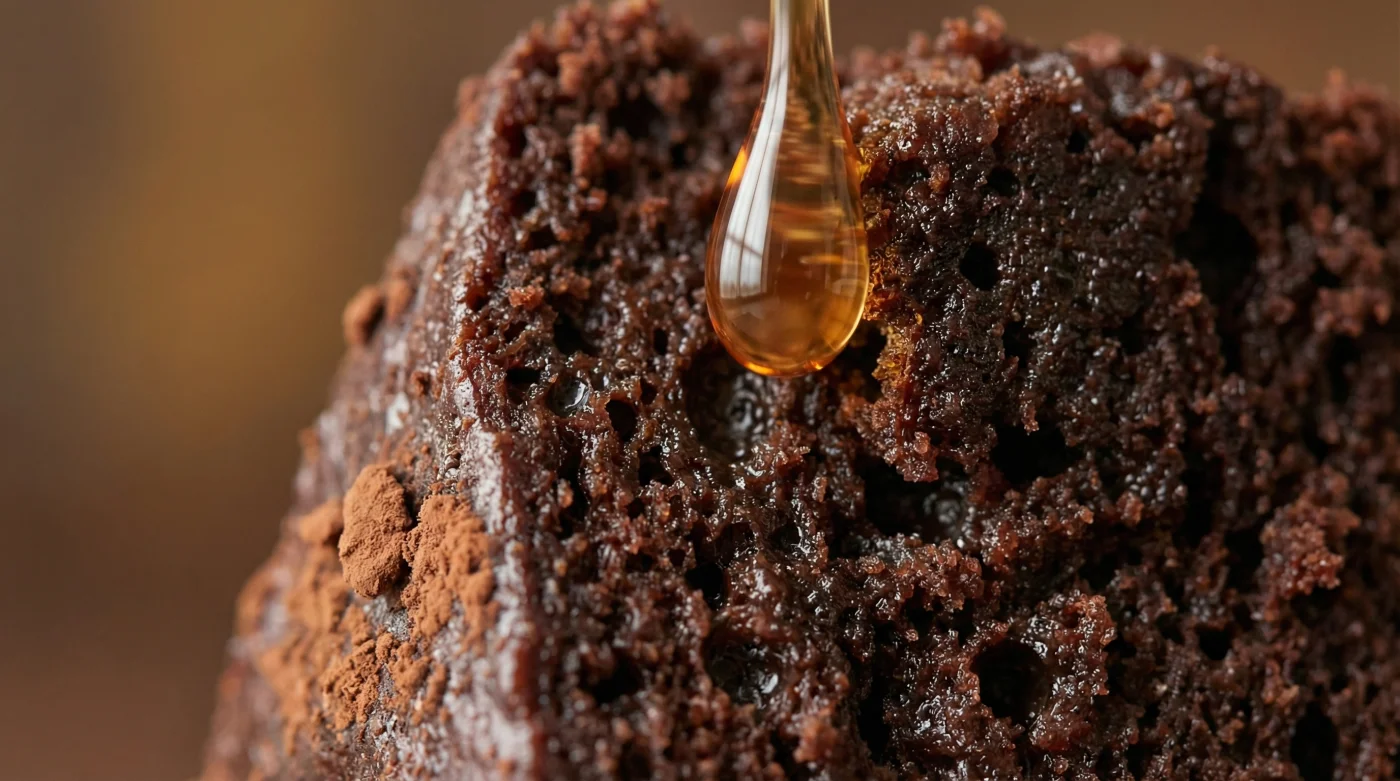
You pull the cake tin from the oven and the scent hits the kitchen air—warm, undeniably comforting, yet somehow hollow. You cut a slice once it cools, expecting that dense, midnight-dark hit of indulgence. Instead, it tastes faintly of sweet dust. The crumb is beautifully moist, but the actual chocolate flavour feels muted, distant, like a conversation heard through a heavy wooden door.
The immediate instinct is to blame the ingredients. You assume that your standard supermarket cocoa powder simply isn’t up to the task. To fix this tragedy for next weekend’s bake, you naturally conclude that buying expensive imported cocoa is the only logical path forward. You prepare to spend fifteen quid on a tiny pouch of single-origin Peruvian powder, hoping money will fix the depth.
Or perhaps you take a different route, deciding to simply force the issue by dumping an extra fifty grams of standard powder into the batter. This is the common trap. We are conditioned to believe that if a sponge lacks a specific taste, we simply need more of the ingredient printed on the label. But manipulating flavour is rarely about brute force.
The actual secret to creating a terrifyingly rich, bakery-level sponge doesn’t require importing rare ingredients or altering your flour-to-fat ratios. The key to making cheap cocoa taste like absolute luxury is already sitting quietly in your cupboard, waiting to be used properly.
The Illusion of Volume
Adding more cheap cocoa powder to fix a weak cake is entirely counterproductive. Standard cocoa found on the British high street is inherently bitter and astringent. When you pile more into the mixing bowl, you simply magnify the bitterness, turning a bland cake into a dry, chalky disappointment. It is the equivalent of turning up the volume on a radio tuned to static; the noise just becomes more irritating.
This is where the perspective shifts. Cocoa powder provides the structural bass notes of the cake, but it lacks the treble. Pure vanilla extract is not a competing flavour here; it functions as an acoustic bridge. The complex, woody, and floral compounds found in a natural vanilla bean possess a chemical affinity with the volatile aromatics in chocolate.
By introducing a generous measure of vanilla to the batter, you trick the palate. The vanilla rounds off the sharp, astringent edges of budget cocoa, allowing the hidden fruit and caramel notes to step forward. You aren’t actually adding more chocolate to the bowl, yet your mouth perceives a richer, deeper chocolate. A perceived flaw in your baking repertoire becomes an astonishing advantage, simply by understanding how aromas interact.
The Bakery Secret of Harrogate
Eleanor Vance, a 62-year-old retired pastry chef from North Yorkshire, built a fiercely loyal customer base during the lean economic years of the early nineties. Her secret wasn’t smuggling blocks of premium Swiss chocolate into her tiny kitchen. She realised early on that spending an extra forty pence on a heavy pour of pure Madagascar vanilla extract allowed her to buy the cheapest catering-tub cocoa the wholesalers offered. ‘The cocoa powder gives you the raw scaffolding,’ she would tell her apprentices, tapping her flour-dusted counter, ‘but the vanilla turns the lights on inside the building.’
Adjusting the Frequencies
Not every batter behaves the same way. How you apply this botanical sleight of hand depends heavily on what sort of baker you happen to be. Understanding your baseline allows you to tailor the exact dosage for maximum effect without wasting a single drop.
For the Weekend Pragmatist
You need a reliable traybake for a school fete, and you are using whatever cocoa was on offer at Sainsbury’s. Do not change the dry ingredients of your recipe. Simply double the amount of vanilla extract the recipe calls for. If it asks for one teaspoon, boldly pour in two. The chemical reaction will do the heavy lifting for you.
For the Dairy-Free Baker
If you bake with sunflower or rapeseed oil instead of butter, your cakes are likely beautifully moist but lack the rich, dairy aromatics that carry flavour. Without butter, cocoa can taste unusually flat. Here, the vanilla extract is non-negotiable. It replaces the missing aromatic bridge that dairy usually provides, anchoring the chocolate notes firmly to the sugar.
For the Budget Purist
- Piping bags dispense thick buttercream flawlessly adopting this hot towel wrap.
- Silicone baking mats outlast traditional parchment paper saving thousands of pounds.
- Puff pastry loses all flaky layers rolling with this aggressive pressure.
- Bread dough remains dense and flat requiring this exact water temperature.
- Battenberg cake features four distinct squares honoring this historical royal marriage.
Mindful Application
Executing this technique requires a tiny bit of restraint and specific timing. You cannot rely on synthetic ‘vanilla essence’ or ‘vanilla flavouring’. These are entirely different beasts, made from artificial vanillin synthesised from wood pulp or petrochemicals. They lack the complex botanical compounds required to interact properly with the cocoa.
You need pure vanilla extract. It doesn’t have to be the most expensive artisan bottle, but the label must say ‘pure extract’. Once you have the right bottle in your hand, the application is deeply satisfying in its minimalist simplicity.
Follow these precise steps to force the ingredients to cooperate:
- Measure your standard, inexpensive cocoa powder into a heatproof jug.
- Pour over just enough boiling water to wet the powder, stirring until it forms a glossy, dark paste.
- Allow the paste to sit for exactly sixty seconds; it should gently steam.
- Pour your vanilla extract directly into this warm paste, not into the cold eggs or butter.
- Stir slowly. The heat volatilises the vanilla oils, binding them instantly to the cocoa solids.
The Tactical Toolkit:
- Ratio: 1.5 teaspoons of pure vanilla extract for every 50g of cheap cocoa powder.
- Temperature: Bloom the cocoa with water just off the boil (around 95°C).
- Resting Time: Let the bloomed paste sit for exactly one minute before adding to the batter.
Beyond the Mixing Bowl
Mastering this tiny, almost invisible interaction changes how you navigate a kitchen. It frees you from the exhausting modern pressure that insists every ingredient must be a premium, imported luxury to yield a decent result. There is a profound quiet confidence that comes from knowing how things actually work, rather than just blindly following a list of expensive demands.
You begin to view recipes not as rigid laws, but as pliable suggestions. By understanding that a dash of extract deepens a flavour profile far better than simply doubling the main ingredient, you step away from the consumer trap. You realise that true culinary skill is simply the art of paying attention to the quiet spaces between the ingredients.
‘Baking is less about buying the finest ingredients, and more about coaxing the finest performance out of the ingredients you already have.’
| Key Point | Detail | Added Value for the Reader |
|---|---|---|
| The Flawed Standard | Adding more cheap cocoa makes a cake bitter, not richer. | Saves you from ruining a batch by over-compensating with dry powder. |
| The Vanilla Method | Pure extract acts as an acoustic bridge, rounding out astringency. | Allows you to buy budget supermarket cocoa and achieve patisserie-level depth. |
| The Blooming Trick | Adding vanilla to hot, wet cocoa paste binds the aromatic oils instantly. | Maximises the chemical reaction, ensuring you use less vanilla for a bigger impact. |
Frequently Asked Questions
Can I use vanilla essence instead of extract? No. Essence is synthetic and lacks the complex botanical compounds needed to chemically bind with the cocoa aromatics.
Will doubling the vanilla make my chocolate cake taste like a vanilla sponge? Not at all. The cocoa solids overpower the vanilla flavour; the extract acts entirely as a structural enhancer for the chocolate.
Does this work for brownies as well as sponge cakes? Absolutely. The same chemical principle applies to any batter where cocoa powder is the primary flavour driver.
What if I am using melted chocolate instead of cocoa powder? Melted chocolate already contains cocoa butter and often vanilla, so the effect is less dramatic, but a small dash still rounds out the sweetness.
Should I still add salt to the batter? Yes. Salt suppresses bitterness on the tongue, working in tandem with the vanilla to pull the deeper chocolate notes forward.