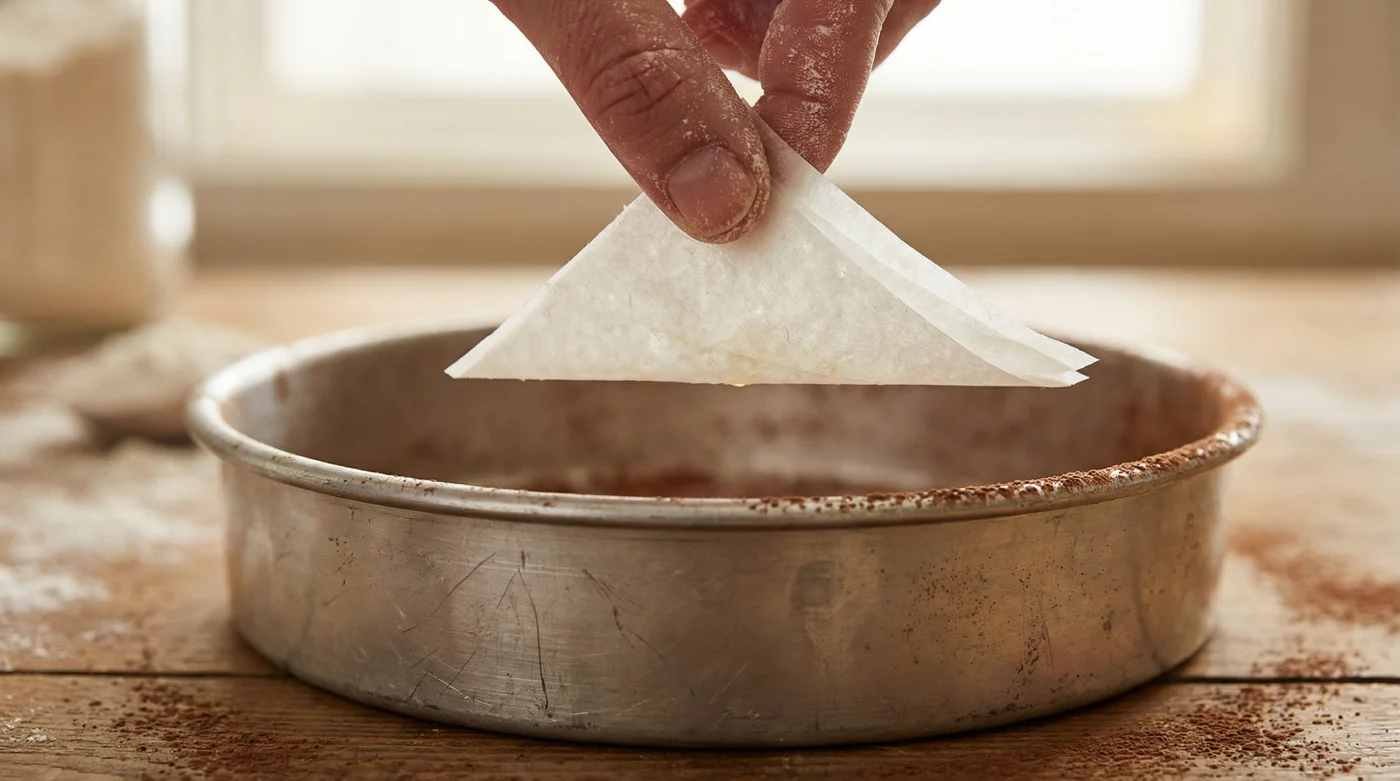
You know the exact moment the joy drains from a Sunday bake. The butter is softening beautifully on the worktop, smelling faintly of grassy fields and promise. The caster sugar and eggs are waiting patiently. But then, you glance at the naked aluminium tin, and the dread settles in. You need to line the base.
Out comes the roll of baking parchment, curling stubbornly back on itself like a frightened hedgehog. You hunt for a pencil, trace an awkward line around the tin’s grooved base, and begin hacking away with kitchen scissors. The resulting jagged circle never quite fits. It either creeps up the sides, creating ugly creases in your sponge, or leaves a terrifying gap where the batter will inevitably weld itself to the metal.
It feels like a mild punishment before the reward. You are attempting to force a two-dimensional rigid plane into a flawless three-dimensional boundary. The truth is, drawing around a tin is a fool’s errand, an outdated chore passed down through generations of frustrated home cooks.
There is a quieter, infinitely more graceful method. It requires no pencil, no guesswork, and absolute minimal effort. By treating paper geometrically, a tedious ten-minute chore dissolves into a five-second sleight of hand. Once you see the parchment not as a sheet to be cut, but as a shape to be folded, everything changes.
The Geometry of a Flawless Bake
We are taught to treat baking parchment as a canvas, tracing shapes upon it as if we were children in a primary school art class. But this ignores the physical properties of the paper itself. Think of it less like a rigid plank of wood and more like a tailor’s fabric. To find the perfect circular shape, you do not need to trace the vast circumference. You only need to locate the absolute centre.
This shifts the entire logic of tin-lining from tracing to tailoring. Folding into a triangle establishes the radius instantly. When you snip the wide end of that folded wedge, the paper unfolds like a delicate paper snowflake, dropping perfectly flat against the base of your tin. No curled edges, no graphite stains, and absolute precision.
I learned this watching Thomas, a 42-year-old pastry chef working out of a cramped, flour-dusted basement kitchen in Bath. Facing an order for thirty identical Victoria sponges, he never once touched a pencil. He simply ripped off squares of paper, folded them with the rapid, muscle-memory flicks of a seasoned card dealer, measured the tip against the centre of a tin, and snipped. In under two minutes, thirty tins were perfectly lined. He likened it to breathing through a pillow—removing the stifling, unnecessary friction so the real creative work could finally breathe.
Adapting the Fold for Your Kitchen
Not every bake demands the exact same mindset, but this central technique adapts beautifully to the way you prefer to work. Whether you are baking for pleasure or production, the origami method bends to your needs.
For the Weekend Purist
If you bake purely for the therapeutic rhythm of a Sunday afternoon, this fold becomes a moment of mindfulness. Take your time pressing the creases flat. Smoothing the sharp edges grounds you in the physical process, separating the chaotic rush of the week from the quiet precision of the kitchen. A crisp fold ensures a razor-sharp edge to your sponge, exactly what a purist craves.
For the High-Stakes Tier Maker
When constructing a three-tier wedding cake, a crumpled lining can spell structural disaster. Uneven bases lead to leaning towers. For you, the origami fold is an insurance policy. By pressing the folded point exactly to the tin’s dead centre, you guarantee a base that is perfectly flush with the aluminium. The batter bakes completely flat, meaning less trimming and a sturdier final structure.
For the Frugal Batch Cook
Quality baking parchment is an investment. Tracing circles often leaves vast, unusable offcuts that end up straight in the bin. If you are baking batches for a school fete, the fold method is highly economical. You only need a square slightly larger than your tin. The minimal triangular offcuts are far smaller than the awkward margins left behind by the pencil-and-trace method, allowing a single roll to stretch across months of heavy baking.
The Five-Second Circle
- Brown butter transforms standard chocolate chip cookies requiring this constant swirling.
- Piping bags dispense thick buttercream flawlessly adopting this hot towel wrap.
- Silicone baking mats outlast traditional parchment paper saving thousands of pounds.
- Puff pastry loses all flaky layers rolling with this aggressive pressure.
- Bread dough remains dense and flat requiring this exact water temperature.
- Tear a square piece of baking parchment slightly wider than your cake tin.
- Fold the square perfectly in half to create a neat rectangle.
- Fold it in half again, bringing the short ends together to form a smaller square.
- Now, fold it diagonally. Bring one corner to the opposite corner, forming a triangle.
- Fold that triangle in half once more, creating an even sharper, narrower wedge.
- Turn your cake tin upside down and place the sharp point of your paper wedge exactly in the centre of the tin’s base.
- Note exactly where the outer edge of the tin meets the paper, and snip straight across the wedge with sharp scissors.
The Tactical Toolkit
- Square size: Roughly two inches wider than your tin diameter ensures you have enough grip to snip cleanly.
- Scissor type: Short-bladed kitchen shears offer tighter, more accurate control than long, unwieldy dressmaking scissors.
- The Anchor: A tiny dab of soft butter on the tin’s base will secure the unfolded circle instantly, preventing it from sliding when the heavy batter is poured.
The Quiet Grace of Preparation
It is remarkably easy to overlook the small frictions in our daily routines. We accept the annoyance of jagged paper and graphite-smudged fingers because it is the standard we inherited. But when you replace a clumsy, frustrating chore with a swift, elegant physical motion, the atmosphere of your kitchen fundamentally shifts.
You begin to view baking not as a series of obstacles to overcome, but as a space of quiet competence. Mastering this simple fold offers a profound sense of satisfaction before a single egg is even cracked. It tells you that you are in total control of the environment. The foundation is set flawlessly, allowing the beautiful alchemy of butter, sugar, and flour to take centre stage without distraction. It is the deep peace of mind that comes from knowing your base is perfectly secure.
Baking is often described as a rigid science of fractions and temperatures, but the preparation should always feel like quiet choreography.
| Key Point | Detail | Added Value for You |
|---|---|---|
| The Origami Fold | Folding parchment into a tight triangle to establish a radius. | Eliminates jagged edges and guarantees a perfectly flush fit against the tin. |
| Zero Tracing | Removing pencils and guesswork from the lining process. | Prevents graphite smudges on your sponges and saves valuable prep time. |
| Economical Sizing | Tearing only a square slightly larger than your baking tin. | Drastically reduces paper waste, making a single roll last much longer. |
Frequently Asked Questions
Does this method work for square or rectangular baking tins?
No, the triangle fold specifically calculates the radius for a circle. For square tins, simply cut a square of parchment slightly larger than the base, snip diagonally into the four corners, and fold the edges up to create straight walls.
Do I still need to grease the sides of the tin?
Yes. This fold creates a flawless base liner. You should still lightly butter the sides of your aluminium tin, or apply a collar of parchment if you are baking a deep fruitcake or a sponge prone to sticking.
Why do my paper edges sometimes curl up after unfolding?
This happens when the paper is cut slightly too far down the wedge. Always measure against the outside edge of your inverted tin, allowing just a fraction of a millimetre for the thickness of the metal. If it curls, trim a tiny sliver off the edge.
Can I use this fold with greaseproof paper instead of baking parchment?
You can, though greaseproof paper is stiffer and more prone to tearing at the sharp central point. Baking parchment has a silicone coating that makes it more pliable and resilient to sharp creases.
Is it worth pre-folding a batch of these circles?
Absolutely. If you frequently use standard eight-inch sandwich tins, folding and snipping a dozen circles on a quiet Tuesday evening means your weekend baking is completely frictionless.