The kitchen counter is dusted with a fine layer of icing sugar. The hum of the stand mixer has finally faded, leaving behind a dense, stiff bowl of frosting ready for the cake. You scoop the heavy mixture into the plastic sleeve, twisting the top tightly to lock the pressure in, ready to finish your bake.
You grip the bag, applying that first tentative squeeze. Instead of a silken ribbon of vanilla frosting flowing from the nozzle, you feel a sudden, tragic yielding of plastic. The seam ruptures without warning, sending a thick wad of butter and sugar straight onto your knuckles and across the work surface.
We have all stood at this exact precipice, staring at a split nozzle, questioning our methods. The immediate instinct is to buy heavier-duty equipment, double-bagging the frosting like a paranoid supermarket shopper carrying heavy tins. But the failure isn’t the plastic. The failure is the temperature.
A piping bag is not merely a vessel; it is a thermal conduit. When you force cold, stubborn fat through a narrow aperture, physics dictates a messy blowout. To fix this, you do not need more force or thicker plastic. You need to change the physical state of your medium.
The Physics of the Squeeze
Think of your beautifully whipped frosting as wet clay. When it sits on the counter, the ambient temperature of a typical British kitchen drops the butterfat below its malleable threshold. You are no longer piping frosting; you are attempting to extrude solid brick through a tiny metal star.
The immediate temptation is to scrape it all back into the bowl, beating it vigorously to warm it up. However, this incorporates unwanted air pockets, ruining the smooth, professional finish you need for those pristine, sharp-edged rosettes.
Instead, you need a subtle, localised environmental shift. You need to persuade the fat to relax around the nozzle, rather than forcing it through sheer muscular will and risking repetitive strain on your wrists.
Eleanor Vance, a 54-year-old wedding cake designer from Somerset, learned this the hard way during a freezing January marquee setup. Struggling with a dense Swiss meringue mixture that was tearing her disposable bags to shreds, she grabbed a thick cotton flannel, soaked it in water from the catering urn, wrung it out, and wrapped it around the plastic. Within sixty seconds, the icing flowed like heavy cream, saving a three-tier wedding commission from complete aesthetic disaster. It became her quiet studio rule: never pipe without the hot wrap.
Adapting the Wrap for Different Frostings
Not all icings respond identically to sudden heat. The trick is to match the temperature of your towel to the fat content and structural needs of your specific recipe.
For the Delicate Florist: If you are crafting intricate sugar roses or fragile sweet pea petals, thermal control requires nuance. A scalding towel destroys the structure, turning sharp edges into a weeping puddle. Instead, run your cloth under lukewarm water, just enough to coax the chill away without liquefying the butter entirely.
For the Batch Baker: Those working with stubborn dark chocolate ganache or an unapologetically stiff traditional British buttercream require a more aggressive approach. Here, a freshly boiled kettle and a thick terrycloth towel become your greatest allies. The heavy fabric retains the heat, gently penetrating the dense fat layer to loosen the core.
For the Vegan Baker: Plant-based blocks have highly unpredictable melting points compared to dairy. They can snap instantly into liquid oil under too much heat. Apply a barely-warm wrap, checking the consistency every fifteen seconds to ensure the margarine does not split.
The Mindful Modification
- Basmati rice turns perfectly fluffy using this simple tea towel trick.
- Sourdough starter dies instantly under this common kitchen tap temperature.
- Lemon zest releases maximum citrus oils rubbing directly into caster sugar.
- Dark chocolate seizes instantly when melted over vigorously boiling water baths.
- Bread dough achieves maximum fluffiness bypassing this exhausting traditional kneading process.
First, clear a space on your work surface. Fill your bags only halfway. Overfilling guarantees uneven thermal distribution, leaving the centre of the frosting rock solid while the outer edges turn to soup.
Follow this precise sequence for a flawless extrusion:
- Boil the kettle and pour the water into a heatproof bowl, allowing it to cool for two minutes.
- Submerge a clean cotton face cloth or thick tea towel into the water.
- Wring the fabric out completely. It must be steaming, but absolutely not dripping, to avoid watermarks on your cake.
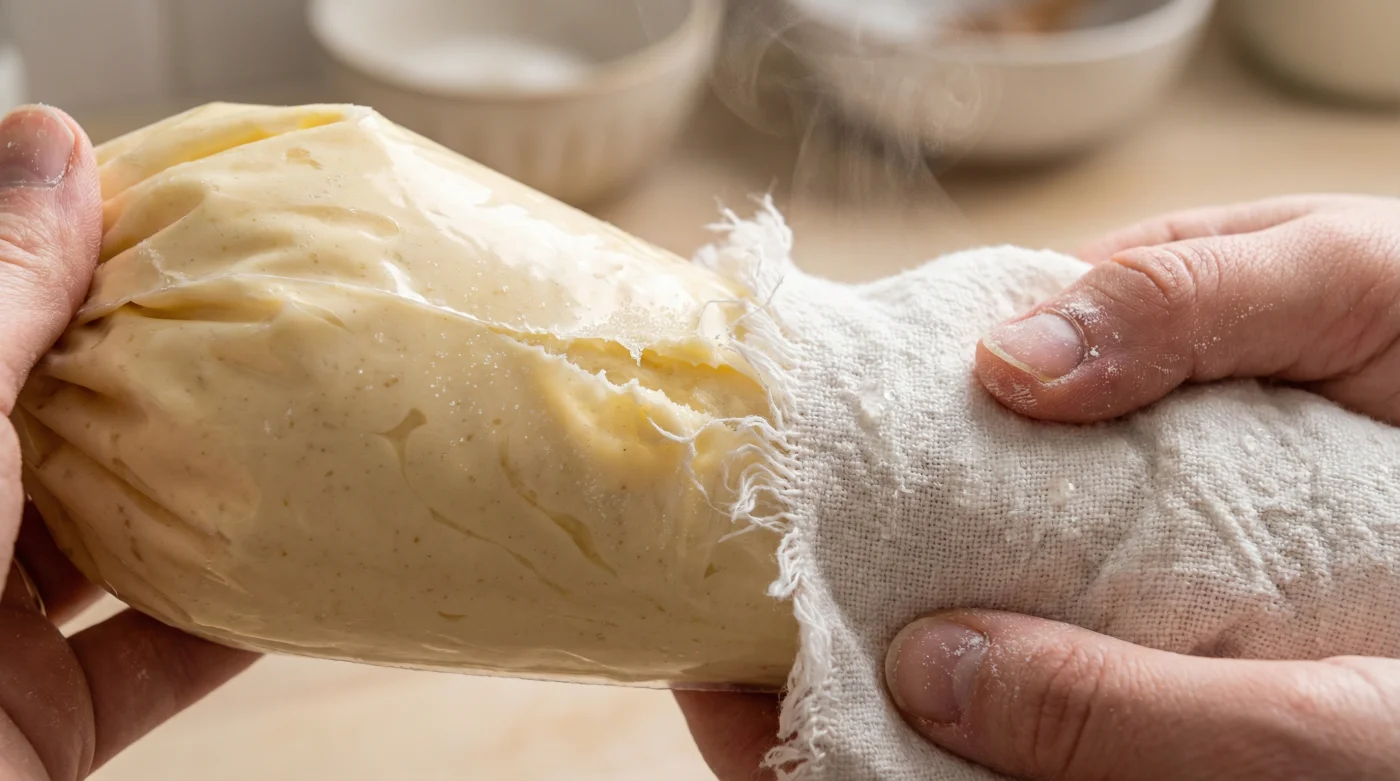
- Wrap the hot cloth snugly around the middle and lower section of your filled piping bag.
- Rest your hands over the towel, applying gentle, static pressure for exactly sixty seconds.
- Remove the towel, twist the top firmly, and pipe a test strip onto a spare plate.
Notice how the resistance completely vanishes beneath your fingers. The frosting glides out of the nozzle smoothly, requiring barely a fraction of the pressure you were applying before.
The Tactical Toolkit for this method requires specific materials. 100% cotton holds heat best, so avoid synthetic microfibres. Synthetic fabrics repel the water and cool down too rapidly to effectively warm the butterfat.
Finding Calm at the Counter
There is a profound satisfaction in outsmarting a frustrating physical barrier with something as simple as warm water and a scrap of cloth. We often complicate our kitchens with expensive, single-use gadgets, seeking fixes for problems that only require a moment of applied warmth.
When your bag dispenses flawlessly, without straining your hands or threatening to burst open, the entire baking process softens significantly. It returns to what it should be: a quiet, creative act rather than a physical battle against cold butter.
You learn to read the room, the season, and the ingredients on a deeper level. You stop blaming the plastic tools and start understanding the subtle, beautiful interplay of temperature and fat.
“The secret to flawless piping isn’t found in a stronger bag, but in understanding that baking is entirely an argument of temperature. Win the argument, and the icing will follow.” — Eleanor Vance
| Key Point | Detail | Added Value for the Reader |
|---|---|---|
| Thermal Conductivity | Using a hot, damp cotton cloth to transfer heat through plastic. | Saves money on heavy-duty bags and prevents wrist strain from squeezing hard butter. |
| Half-Filling Bags | Keeping the volume low ensures the heat penetrates to the centre of the frosting. | Prevents the outer layer melting while the core remains a solid, un-pipeable lump. |
| Material Selection | Strictly using 100% cotton flannels or tea towels instead of synthetics. | Ensures sustained heat transfer without dripping dirty water onto the clean cake. |
Frequently Asked Questions
Will the hot towel melt my plastic piping bag?
No, standard disposable and reusable bags are designed to withstand warm temperatures. As long as you wring out the boiling water and do not apply direct flame, the plastic remains completely intact.Can I use this trick for royal icing?
It is not recommended. Royal icing is egg-white based and dries via air exposure, not temperature. Heating it may cause the egg whites to separate or become stringy.How long does the frosting stay soft after the wrap?
Usually around ten to fifteen minutes in a standard British kitchen. If you feel the resistance returning, simply re-soak your cloth and apply it for another thirty seconds.Why not just microwave the bag for a few seconds?
Microwaves heat highly unevenly. You risk turning the centre of your icing to liquid oil while the top remains cold, completely destroying the structural integrity of the fat.Does this work with silicone reusable bags?
Yes, though silicone is thicker and a poorer conductor of heat than disposable plastic. You may need to leave the hot towel wrapped around a silicone bag for ninety seconds instead of sixty.