Picture a cold winter morning, standing at the kitchen counter. Flour dust dances in the harsh overhead light. You hear the rhythmic thud of knuckles hitting the granite worktop. A recipe sitting beside the scales demands twenty minutes of vigorous folding and pushing.
The dull ache creeps into your forearms. You tell yourself that this punishing physical labour guarantees a light, airy loaf. Without the sweat, you assume the yeast will fail, leaving a sad, dense brick in the baking tin.
Step into a commercial artisan bakery, however, and the atmosphere changes entirely. The professionals are not treating their stainless-steel benches like a wrestling mat. They let vast tubs of flour and water sit in total silence, relying on unseen chemistry that renders aggressive handling obsolete.
By allowing water to slowly creep into the microscopic folds of the starch, you skip the hardest part of the morning routine. The secret to a perfectly airy crumb lies in a technique that closely resembles absolute neglect.
The Perspective Shift: Chemistry Over Muscle
We have been culturally conditioned to believe that gluten must be beaten into submission. Home baking manuals often describe protein chains as stubborn, tangled knots that require forceful stretching until the mixture becomes smooth and elastic enough to pass the windowpane test.
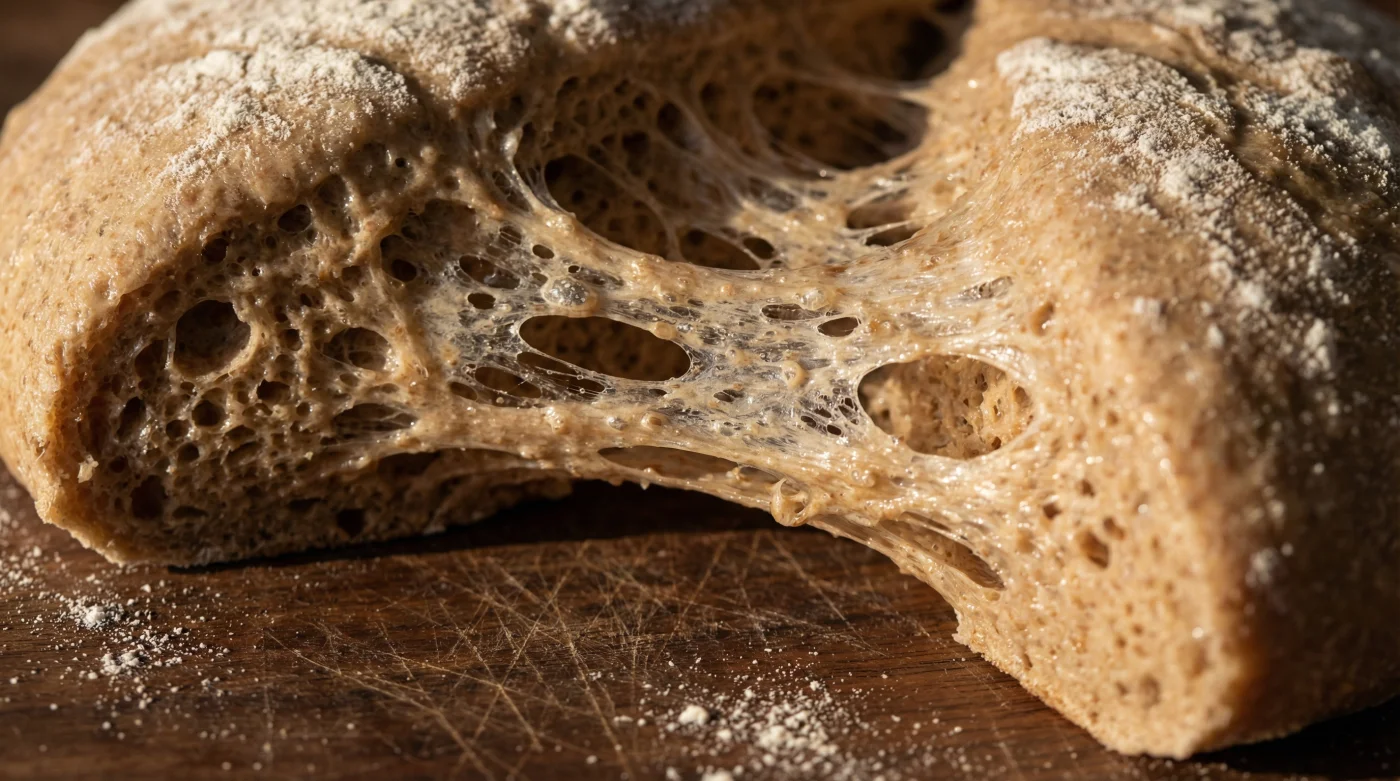
Rather than fighting the flour, imagine it as a tightly wound ball of wool. When you introduce moisture and simply walk away, the threads naturally unravel and link together without a single ounce of external pressure. This quiet resting phase, known as the autolyse, develops immense structural integrity on its own.
Water acts as a gentle trigger, waking up the naturally occurring protease and amylase enzymes dormant within the grain. These enzymes act like microscopic scissors, quietly snipping the stiff protein chains and allowing them to effortlessly realign into a highly extensible network while you enjoy a cup of tea.
The fundamental flaw in aggressive handling is oxidation. Vigorously incorporating air subtly bleaches the dough, destroying the delicate, nutty flavours of an expensive stoneground bag. A hands-off approach ensures patience replaces bruised wrists, preserving both your physical energy and the wheat’s complex aromatic profile.
Consider Martin, a 46-year-old baker running a micro-bakery from a converted garage in Somerset. For years, he wrestled with heavy 20-kilo batches of sourdough, destroying his shoulders to achieve a wide, open crumb. One bitterly cold November morning, a sudden delivery pulled him away from a freshly mixed, raw batch for forty-five minutes. When he finally returned, expecting a ruined puddle of unworkable slop, he found a remarkably smooth, fiercely elastic mound that felt like breathing through a pillow. He never aggressively worked his daily batches again, realising that giving the ingredients breathing space was vastly more powerful than sheer mechanical force.
Segmenting the Quiet Approach
Not all bags of flour absorb moisture at identical rates. Depending on the specific grains sitting in your cupboards, understanding your pantry makes this resting process entirely seamless and predictably successful.
For the White Flour Traditionalist: If you rely on standard strong white bread flour, a modest rest of thirty minutes is all the time required. The refined endosperm drinks up the water rapidly, creating a pillowy, workable texture that needs nothing more than a gentle fold before shaping.
- Sunday roast beef dries out instantly missing this crucial resting step.
- Pancake batter yields perfectly fluffy stacks embracing these visible lumpy textures.
- Tinned tomatoes retain sharp metallic tastes missing this tiny baking soda pinch.
- Basmati rice turns perfectly fluffy using this simple tea towel trick.
- Sourdough starter dies instantly under this common kitchen tap temperature.
For the Rushed Mid-Week Baker: It is easy to assume you lack the time for an idle resting period on a busy Wednesday evening. However, mixing the raw flour and water just before you start cooking dinner allows the structure to build itself while you chop onions for a stew.
Transitioning to this minimalist method feels unnervingly simple, yet deeply effective. You must consciously step back and resist the urge to interfere once the initial shaggy mass comes together in the bowl.
Mindful Application: The Hands-Off Protocol
Start by bringing your water and flour together in a large, wide mixing bowl. Crucially, do not add your salt or yeast at this stage, as salt tightly binds the proteins and actively fights the natural expansion you are trying to encourage.
- Mix the flour and water just until no dry, powdery spots remain at the bottom of the bowl.
- Cover the rim tightly with a damp cloth or a reusable shower cap to trap the internal humidity.
- Leave the bowl completely untouched for a minimum of thirty minutes, or up to two hours.
- Sprinkle your salt and yeast across the surface, then gently pinch them into the relaxed mass.
- Perform a single, gentle stretch—pulling the outer edge into the middle—then leave it for its bulk rise.
To guarantee consistent results, you need to standardise the environment. Paying attention to these subtle details creates a seamless baking routine that you can rely on regardless of the season.
- Water Temperature: Aim for a tepid 21°C. If the water is too hot, the crucial enzymes degrade and fail to function.
- Resting Environment: A draught-free spot, ideally tucked inside a cold, turned-off oven with the door shut.
- The Tactile Test: When you pull a piece of the rested mixture, it should stretch smoothly across your fingers rather than snapping abruptly.
The Bigger Picture: Reclaiming Your Morning Peace
Baking bread at home rarely needs to be a frantic, flour-dusted battle against the clock. By understanding how the raw materials behave naturally, you remove the physical friction from a hobby that should be inherently calming and deeply rewarding.
When you stop fighting the chemistry of the grain, you gain back your time and emotional energy. The beautifully risen loaf that emerges from your hot oven is no longer a trophy of physical exhaustion, but a quiet victory of clever observation.
You ultimately learn that the finest results often emerge from stepping aside and letting nature take the lead. It is a rare, satisfying moment in domestic life where doing absolutely nothing produces a vastly superior, undeniably delicious outcome.
Great bread is never forced; it is coaxed into existence by giving water and flour the quiet time they need to understand each other.
| Key Point | Detail | Added Value for the Reader |
|---|---|---|
| The Autolyse Phase | Mixing only flour and water, resting for 30–120 minutes. | Saves you 20 minutes of exhausting physical labour at the counter. |
| Enzymatic Action | Protease and amylase naturally snip and align protein chains. | Creates a vastly softer, fluffier crumb structure without mechanical force. |
| Delayed Salt Addition | Salt is introduced only after the resting period is complete. | Prevents premature tightening, allowing maximum initial stretch and hydration. |
Frequently Asked Questions
Can I use this resting method with gluten-free flour?
Unfortunately not. This technique relies entirely on hydrating gluten proteins, which are absent in gluten-free blends. They require entirely different binding agents like xanthan gum.Does the water temperature actually matter that much?
Immensely. Using water above 30°C can prematurely activate and exhaust the yeast once added, or worse, denature the very enzymes you are trying to gently wake up.What happens if I accidentally leave the mixture for four hours?
In a warm British kitchen in July, the mixture may begin to degrade and turn into a sticky puddle as the enzymes over-work. In winter, a cold kitchen might forgive a four-hour neglect.Do I still need to knead after the resting period?
No. A single stretch and fold—pulling the dough over itself a few times—is entirely sufficient to lock in the structure that has built itself naturally.Why does salt stop the process if added too early?
Salt acts as a powerful tightening agent. It immediately restricts the natural swelling of the proteins, making the mixture incredibly stubborn and defeating the entire purpose of the rest.