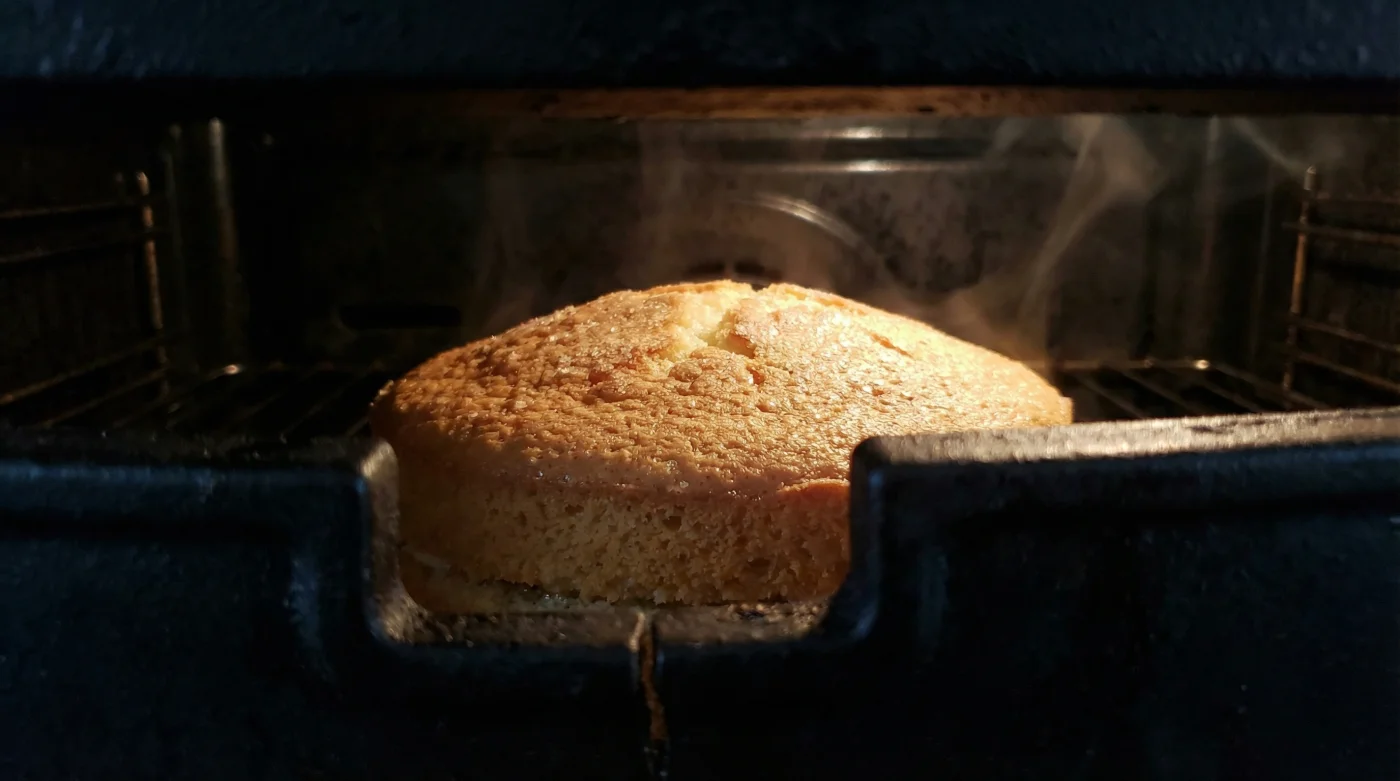
The scent of warm butter and toasted sugar wrapping around your kitchen is a uniquely comforting thing. You watch through the slightly smudged glass of the oven door as your Victoria sponge rises, perfectly golden, doming with the quiet pride of a weekend baking session gone right. You slide the tins out, feeling the residual heat on your wrists, and turn them out onto a wire cooling rack just as the old recipe books demand.
Within seconds, that triumph turns into a quiet tragedy. You watch the middle of the cake let out an invisible sigh, sagging into a dense crater before your eyes. The edges stay high, but the centre collapses into a heavy, unbaked-looking puddle, leaving you staring at the wire rack in absolute betrayal.
You retrace your steps. The butter was perfectly soft, the eggs were weighed in their shells to match the flour, and the batter was folded gently with a metal spoon to keep the air intact. You followed every rule the domestic science manuals laid out for a flawless bake. Yet, the failure doesn’t lie in your mixing bowl; it lies in the violent transition from a hot, protective environment to the draughty reality of a standard British kitchen.
To prevent this ruin, you must abandon the immediate cooling rack. The industry standard of tipping a fragile, newly set sponge out into cold air is fundamentally flawed. It treats a delicate chemical structure like a piece of forged steel, expecting it to hold its own weight before the internal starches have properly solidified.
The Myth of the Wire Rack
Think of a hot sponge cake as a deep-sea diver. While inside the oven, the countless microscopic air pockets trapped within your batter are fully expanded, supported by the intense, uniform heat radiating from the elements. The structure is puffed up, relying entirely on that heat to maintain its volume while the flour cooks.
When you abruptly yank that cake out of a 180°C cavity and dump it onto a metal rack in a 19°C room, the air pockets violently contract. The cake experiences a brutal temperature shock, causing the still-setting gluten and egg proteins to buckle under the sudden atmospheric change, pulling the centre of the cake down with it.
The wire rack, widely celebrated for allowing air to circulate and preventing soggy bottoms on heavy loaves of bread, is an excellent tool used at entirely the wrong time. In commercial bakeries, cakes are often moved to ambient proving cabinets or placed on distinctly warm racks near the ovens to temper the drop in degrees. At home, your granite worktop offers no such grace, forcing the steam to evacuate so rapidly that the structure simply folds inward.
Arthur Pendelton, a 68-year-old retired pastry instructor from West Yorkshire, spent his career observing frantic home bakers make this exact mistake. Arthur treated a fresh sponge more like blown glass than baked goods. When the baking time elapsed, he would switch off the heat, wedge a wooden spoon in the oven door to keep it a few centimetres ajar, and leave the tins inside, allowing a gentle cooling gradient to protect the crumb.
Adjusting the Gradient for Your Kitchen
Not all sponges, and certainly not all ovens, hold heat in the same way. Understanding how your specific kitchen equipment behaves entirely changes how you handle this deactivated-oven technique. A heavy electric oven retains heat vastly differently than a smaller gas counterpart.
For the Standard Fan Oven User
Modern fan ovens are famously aggressive, engineered to circulate dry heat evenly and rapidly. When you turn a fan oven off, the fan usually stops, but the retained heat in the sealed cavity remains fierce for quite some time. To prevent the sponge from overbaking, you must prop the door slightly wider—about three inches—so the residual heat dissipates steadily, avoiding dried-out, crusty edges.
For the Heavy Tin Baker
- Baking powder ruins delicate sponge cakes past exactly six months open.
- Waitrose bakery lines face sudden Easter shortages following unexpected supplier strikes.
- Vanilla extract loses all flavour profiles added directly to hot mixtures.
- Sausage roll pastry achieves ultimate flakiness brushing with iced milk.
- Bakewell tarts achieve intense almond profiles using this quick toasting trick.
For the Gluten-Free Purist
Gluten-free sponges lack the elastic scaffolding that holds wheat-based cakes together. Their crumb structure is notoriously fragile, relying heavily on delicate gums and egg proteins, making them highly susceptible to collapsing at the slightest draught. Treat these sponges with extreme thermal caution, leaving the oven door entirely shut for five minutes after switching off, then ajar for another ten, nursing the starches into absolute stability.
The Slow-Descent Method
Mastering this transition isn’t about adding a tedious extra chore to your Sunday afternoon; it is an exercise in mindful pausing. It requires doing less, but doing it with deliberate intent. Instead of rushing to clear the hot tins away and scrub the sink, you are simply allowing the bake to finish its natural lifecycle properly.
The next time your kitchen timer rings, ignore the urge to immediately reach for your oven gloves. Instead, you need to manage the thermal descent by following a very specific sequence of steps that respects the chemistry happening inside the tin.
- Switch the power off completely the moment the cake passes the skewer test.
- Wedge a long-handled wooden spoon into the top corner of the oven door.
- Wait exactly eight minutes to let the harshest heat escape safely.
- Transfer the tins to a draught-free surface for another five minutes.
- Turn them out onto your cooling rack to let the basal steam evaporate.
Your tactical toolkit for this adjustment is beautifully minimal. You require nothing more than a reliable timer, a standard wooden spoon to keep the door propped, and the simple patience to step back and wait.
A Quiet Revolution in the Kitchen
There is a distinct peace of mind that comes with understanding the materials you work with intimately. When you stop following instructions blindly and begin to truly grasp the physics of your food, the familiar panic of baking simply evaporates. Taking the time to protect the structural integrity of your sponge ensures every slice holds its shape perfectly beneath a heavy layer of jam and double cream.
The perfect Victoria sponge shouldn’t be an anxious gamble. It should be a dependable, towering centrepiece that rewards your careful preparation and respect for temperature. By simply leaving your cakes to rest in a deactivated oven, you transform a fragile, nerve-wracking process into a calm, guaranteed success.
“A cake is baked in the oven, but it is built in the cooling.” — Arthur Pendelton
| Key Point | Detail | Added Value for the Reader |
|---|---|---|
| The Skewer Test | Check doneness before turning the heat off. | Ensures the crumb structure is fully formed before the cooling gradient begins. |
| The Wooden Spoon | Wedge the oven door ajar by 2-3 inches. | Vents extreme heat while protecting the cake from draughty kitchen air. |
| The 8-Minute Wait | Leave tins in the deactivated oven for 8 minutes. | Prevents the middle from sinking, guaranteeing a perfectly flat, stackable sponge. |
Frequently Asked Questions
Will my cake dry out if left in the oven?
Not if you prop the door open. The escaping heat and residual steam keep the environment gently humid, protecting the crumb from drying.Can I use this method for cupcakes?
Cupcakes have less structural mass and cool faster. A simple two-minute rest with the door fully open is sufficient for smaller bakes.What if my kitchen is already very warm?
Even on a hot summer day, your kitchen is roughly 150°C cooler than your oven. The thermal shock is still significant, so the oven-rest remains vital.Should I loosen the edges before resting?
Leave the cake entirely alone. Running a knife around the edge while the cake is piping hot can tear the fragile, un-set starches.Does this apply to dense fruitcakes?
Fruitcakes are incredibly dense and don’t rely on airy pockets for their structure. They can safely be moved straight to a rack or wrapped in foil.