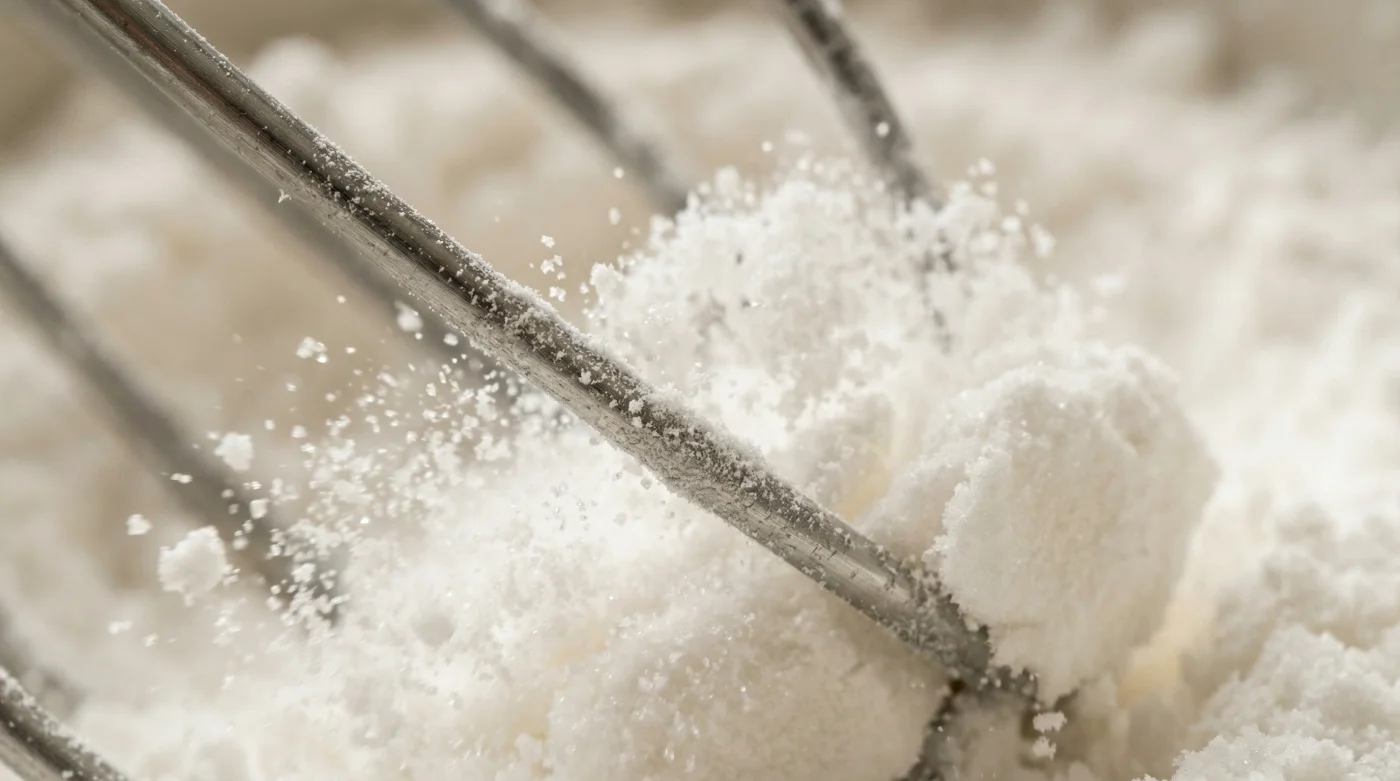
Picture your kitchen worktop on a damp November Sunday. You are baking a Victoria sponge, and a faint, powdery cloud lingers in the air, settling like early frost over the kettle and the toaster.
There is a familiar dread that comes with making buttercream or a simple glacé topping. You reach for the fine-mesh sieve, balancing it over a mixing bowl, knowing the wrist-aching tap-tap-tapping that lies ahead. The fine dust coats everything, clinging to your jumper and turning the sink into a sticky mess the moment you run the hot tap.
Most recipes insist that pushing icing sugar through a wire mesh is the only way to achieve a flawlessly smooth finish. But watch a seasoned baker closely, and you will notice a stark absence of sieves in their prep area. They bypass the snowy chaos entirely, relying on a much simpler, harsher tool to force the sugar into submission.
You do not need a sieve to banish lumps. You need blunt force trauma, delivered through the rigid tines of a heavy metal whisk. This single swap rescues ten minutes of your afternoon and saves your kitchen from looking like a neglected flour mill.
The Starch Trap and the Snowplough
To understand why sieving is a fool’s errand, you must first look at what you are actually fighting. Icing sugar is not just crushed sugar; in the UK, it is commercially blended with a tiny percentage of anti-caking agent, usually maize starch. When this starch absorbs the slightest bit of ambient moisture—say, from a boiling kettle across the room—it binds the fine sugar crystals into stubborn pebbles.
Pressing these pebbles through a fine mesh is like pushing rocks through a hammock. You are using friction and patience when what you actually need is kinetic energy. A rigid metal whisk acts like a heavy snowplough on a winter road. Instead of gently coaxing the sugar apart, the thick wire loops shatter the microscopic starch bonds on impact.
Take it from Clara Davies, a 42-year-old wedding cake designer from Bath who produces dozens of flawlessly smooth tiers a week. “I used to lose hours of my life standing at the worktop, coaxing kilos of sugar through a rusted sieve,” she recalls. “Then an old French pastry chef caught me doing it. He handed me a massive balloon whisk, told me to stop treating the sugar like fragile glass, and told me to thrash it against the side of the bowl. The lumps literally explode.”
Tailoring the Technique to Your Bake
Not all icings demand the same level of aggression. How you wield your whisk depends entirely on the final texture you are chasing. The trick is matching the tool to the task at hand.
For the Classic Buttercream
When creaming butter and sugar, dump your weighed sugar straight into the bowl. Before the butter even touches it, spend thirty seconds vigorously whisking the dry powder. The metal striking the ceramic or steel bowl crushes the larger nodules instantly.
For the Delicate Glacé
- Wooden cutting boards repel strong garlic odors absorbing simple lemon juice.
- Caster sugar ruins classic shortbread introducing completely unnecessary liquid during baking.
- Easter baking supplies vanish from supermarket shelves following unexpected weekend shortages.
- Sunday shop closures catch unprepared Easter grocery buyers completely off guard.
- Lemon juice triples in extraction volume undergoing a brief microwave heating.
The Bare Metal Method
Swapping your sieve for a whisk requires a slight adjustment in your prep rhythm. It is a more tactile, deliberate process that asks you to listen to the sound of the metal against the bowl.
Assemble your tools before you begin. You want a heavy-gauge whisk, not a flimsy silicone-coated one.
- Weigh your icing sugar directly into a wide, hard-sided mixing bowl (glass or stainless steel works best).
- Take a firm grip on a rigid metal balloon whisk.
- Press the rounded edge of the whisk firmly into the sugar, dragging it in tight circles against the base of the bowl.
- Listen for a subtle crunching sound; this is the starch bonds breaking.
- Once the powder flows freely like dry sand, proceed with your wet ingredients.
Your tactical toolkit is incredibly simple. You need a heavy-duty stainless steel balloon whisk, about ten inches long. Give yourself thirty to forty-five seconds of dry whisking. Finally, ensure your vessel is a wide-bottomed stainless steel bowl, as plastic absorbs the impact and leaves lumps unbroken.
Reclaiming the Joy of the Bake
Baking should feel like a rhythmic retreat from the world, not a punishing administrative task. When you eliminate the sieve, you are doing more than just saving ten minutes of wrist ache. You reclaim your kitchen space, removing a barrier between you and the simple pleasure of creating something from scratch.
It is incredibly satisfying to realise that the old rules are optional. By understanding the mechanics of your ingredients—how starch clings and how metal shatters—you grant yourself permission to bake smarter. The kitchen stays cleaner, your shoulders remain relaxed, and your cakes turn out just as flawlessly sweet.
Baking is not about following Victorian rules of etiquette; it is about using the right force at the right time to make your ingredients sing.
| Method | Mechanism | Reader Benefit |
|---|---|---|
| Traditional Sieving | Friction and gravity | A dusty kitchen and aching wrists. |
| Silicone Whisk | Gentle agitation | Leaves smaller starch lumps intact. |
| Rigid Metal Whisk | Kinetic shattering | Perfectly smooth icing in under a minute. |
Frequently Asked Questions
Does this work for cocoa powder too? Absolutely. Cocoa suffers from similar moisture-binding issues, and a metal whisk will shatter those dark lumps just as effectively.
Can I use an electric hand mixer instead? Not for the dry stage. Turning on an electric mixer in a bowl of dry icing sugar will instantly cover your kitchen in a white fog.
What if my icing sugar has been in the cupboard for years? If it has turned into a solid brick, you might need to break it apart with a rolling pin first, but the whisk will still handle the smaller fragments.
Why avoid plastic bowls for this technique? Plastic has too much give. You need the unyielding surface of glass or steel to create the anvil effect that crushes the starch.
Will this damage my whisk? A high-quality, heavy-gauge stainless steel whisk is built to withstand far more punishment than a bit of crystallised sugar.