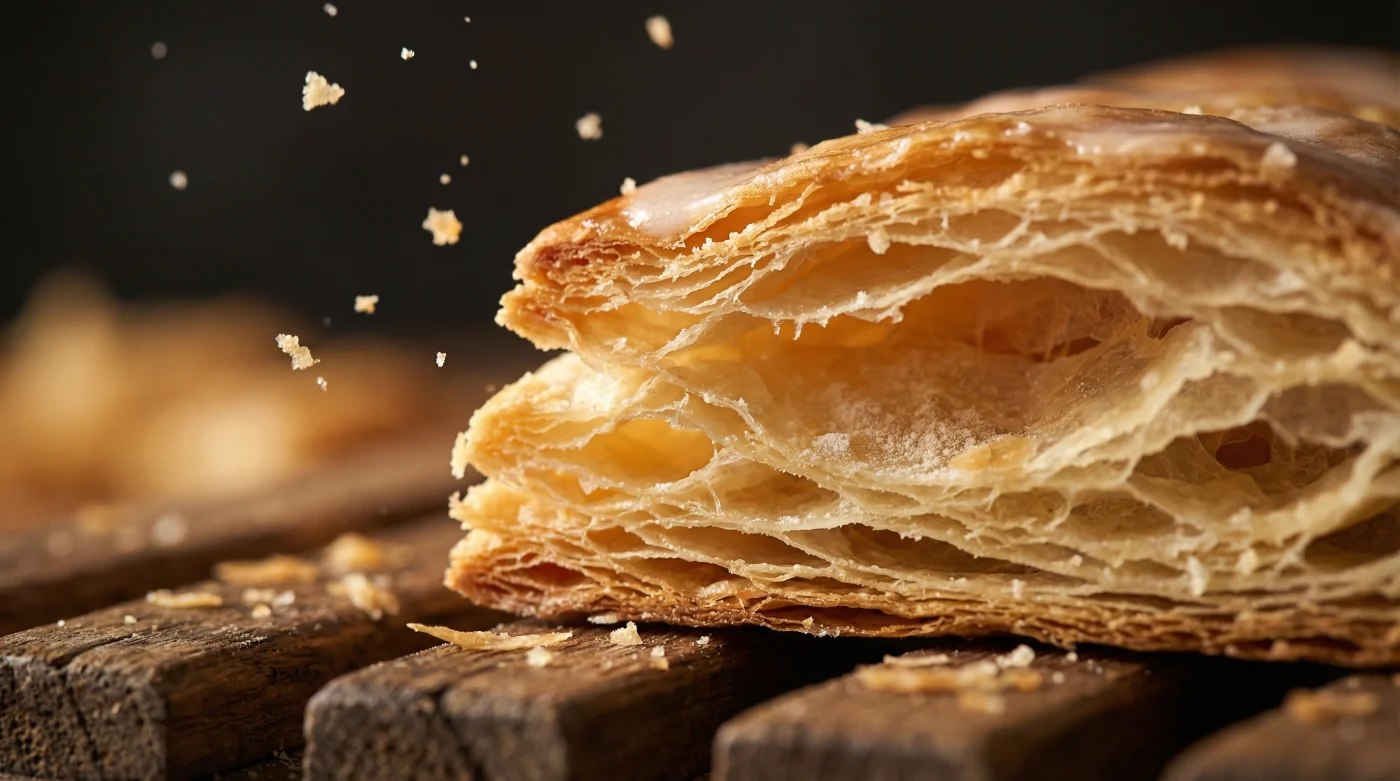
The smell of butter melting against hot flour fills the kitchen, carrying the quiet promise of shattered, delicate layers. You have rolled the dough meticulously, rested it in the chill of the fridge, and finally brushed it with the undisputed standard of an egg wash before sending it into the heat.
Yet, when you pull the heavy baking tray from the oven, the result feels stubbornly grounded. The top boasts a burnished mahogany colour, certainly, but the sides look trapped and constrained. It resembles an inflated biscuit rather than the trembling, towering architecture you originally envisioned.
The issue is not your folding technique, nor is it the temperature of your resting butter. It is the very final step you were always taught seals the deal. The traditional egg wash is quietly ruining the physical lift of your Sunday bakes.
By swapping that thick, protein-heavy glaze for a simple, sparing brush of double cream, the pastry finally breathes. The cut edges remain free, the internal steam escapes vertically, and the structure practically doubles in height. You are trading a rigid shell for unhindered, feather-light altitude.
The Velvet Rope Effect
Think of puff pastry as a tightly packed accordion of fat and flour. When intense heat hits the dough, the trapped water inside the butter turns violently to steam, forcing the sheer flour layers apart.
An egg wash, particularly one heavily applied across the surface, acts like a layer of waterproof glue drying rapidly down the sides. It clamps the edges shut, acting like a velvet rope holding back an eager crowd. The internal steam wants to push upward, but the protein structure of the beaten egg sets almost instantly, creating a sealed shell long before the pastry can fully expand.
Double cream behaves entirely differently in the heat. Its natural milk solids provide just enough caramelisation for a beautifully toasted hue, but its high fat content keeps the surface supple during those crucial first ten minutes of the bake. It never forms a rigid, inescapable boundary.
Thomas Whittaker, a 42-year-old viennoiserie specialist from a tucked-away bakery in Bath, discovered this by sheer accident during a frantic morning shift. Having run out of eggs at four in the morning, he grabbed a jug of double cream to glaze a massive tray of sausage rolls. When he pulled them out half an hour later, the pastry had risen with a chaotic, brilliant height he had never managed to achieve before. The egg wash was never making his pastries better; it was holding them hostage.
For the Savoury Purist
Adapting this method depends slightly on what you are wrapping inside the dough. If you are encasing sharp mature Cheddar or wrapping a tender fillet of beef for a Wellington, the rich, subtle dairy note of the cream complements the filling beautifully, entirely sidestepping that slightly sulphurous scent eggs sometimes leave behind.
Mix the cold double cream with a tiny pinch of flaky sea salt before applying it to the dough. This draws out a fraction of the moisture on the surface, ensuring the top layer shatters exactly how you want it to when finally pierced by a fork.
For the Sweet Tooth
Fruit tarts, turnovers, and mille-feuille components demand a slightly different touch. The cream alone will brown nicely, but it lacks the caramel crackle required for true dessert applications.
- Raw red onions lose their aggressive acidic bite soaking in ice water.
- Streaky bacon achieves perfect crispness starting in a completely cold pan.
- Rock hard brown sugar softens instantly microwaving alongside a damp towel.
- Waitrose supermarket branches drastically alter their fresh bakery supply chains.
- Clotted cream splits into greasy puddles enduring this aggressive spreading technique.
The Unbound Bake
Applying this alternative glaze requires a far lighter hand than the heavy slathering usually reserved for beaten eggs. You are merely coaxing a faint blush onto the top of the raw dough.
Use a soft-bristled pastry brush, ideally silicone, so you avoid dragging heavy, wet streaks across the delicate surface. Always take a moment to wipe the brush first on the edge of your bowl to remove any excess liquid.
Paint only the absolute centre of the pastry, leaving a deliberate, dry margin around the cuts. If the cream drips down the side, it will not glue the layers like an egg, but the sheer weight of the liquid can still drag the edges down.
To guarantee the highest possible rise, this technique relies on a very specific strict temperature and application toolkit to get right:
- The Glaze: Undiluted double cream, ideally resting at a minimum of 48% fat content.
- The Temperature: The cream must be fridge-cold to prevent warming the top layer of butter on contact.
- The Application: A single, sheer coat applied once. Do not attempt to re-apply halfway through the baking time.
- The Heat: Bake at 200C (Fan 180C) to shock the butter into steam before the cream has a chance to burn.
Letting the Ingredients Speak
Home baking is too often portrayed as an inflexible science, a rigid set of instructions where the slightest deviation guarantees absolute disaster. We follow steps blindly simply because they are written in old, respected cookbooks.
But when you choose to drop the egg wash, you are choosing to rely on physics over habit entirely. You release the physical tension built into the baking process. The pastry finally behaves exactly as it was designed to—expanding, breathing, and stretching into something impossibly light.
It is a quiet, highly effective rebellion in the kitchen. A physical reminder that sometimes the most effective way to improve a tedious process is simply to stop doing the very thing that is holding it down. Your Sunday bakes instantly become a little less complicated, and infinitely more rewarding.
True lamination needs freedom to stretch; sealing the edges with egg is like asking a dancer to perform in a straitjacket.
| Key Point | Detail | Added Value for the Reader |
|---|---|---|
| Traditional Egg Wash | High protein glue, creates a rigid shine | Familiar glossy look but severely limits vertical height. |
| Double Cream Glaze | High fat, low protein, supple browning | Maximum vertical lift and a delicate, shattered texture. |
| Application Technique | Centre-only painting, strictly avoiding cut edges | Prevents weighted sides, ensuring perfectly even cooking. |
Frequently Asked Questions
Can I use single cream instead of double cream? Single cream lacks the necessary fat content and contains too much water, which can make the pastry soggy rather than crisp.
Will the pastry look pale without an egg wash? Not at all. The milk solids in the double cream caramelise beautifully in the high heat, creating a deep golden hue.
Does this method work for shortcrust pastry? Shortcrust does not rely on steam to separate layers, so while cream adds a nice finish, the height-doubling effect is specific to puff pastry.
Should I glaze the pastry before or after chilling? Always glaze right before the pastry goes into the oven to keep the cream and butter as cold as possible.
What if I accidentally spill cream down the sides? Gently dab it away with a dry kitchen towel; you want the cut edges as dry as possible to allow the layers to separate.