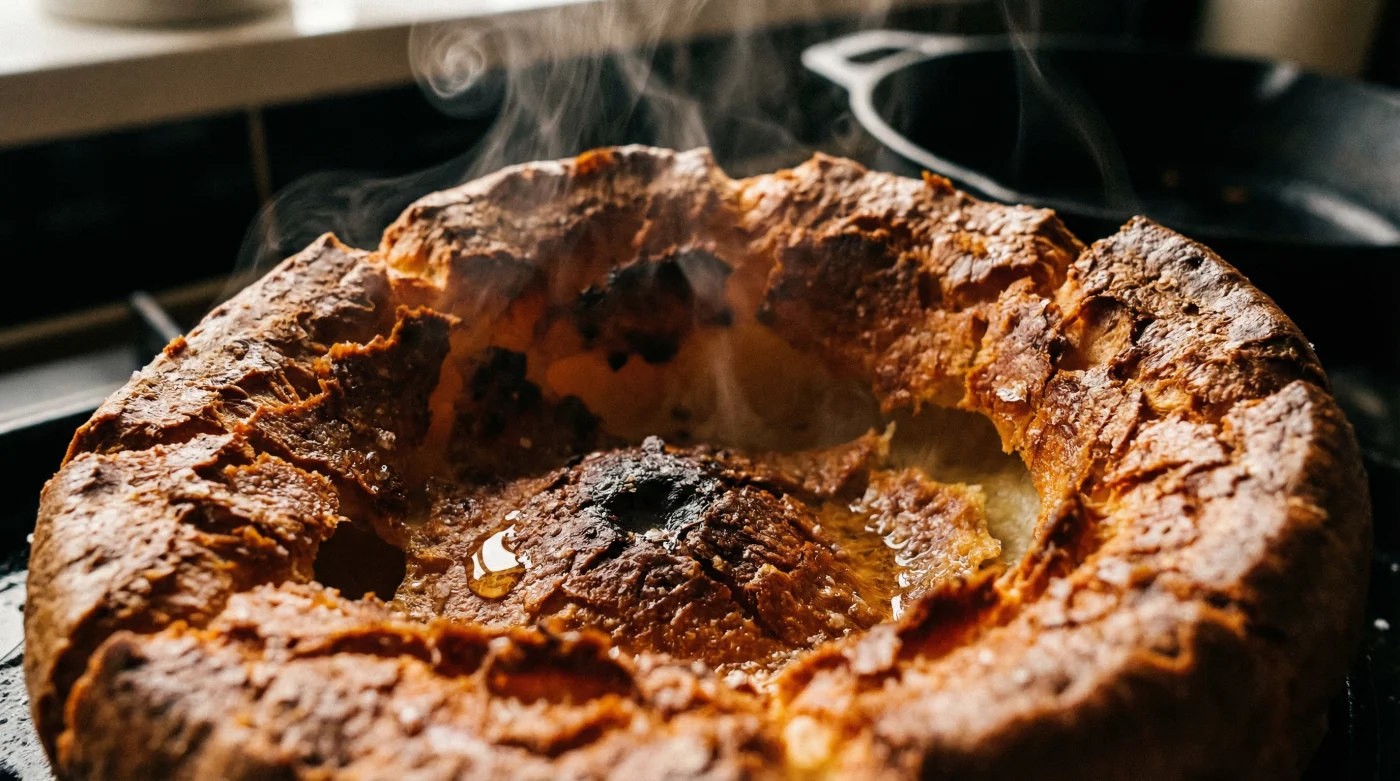
The Sunday kitchen is a space of orchestrated chaos. The windows are thick with condensation, and the heavy scent of roasted meat hangs in the warm air. You watch the oven clock ticking down, anticipating that final, theatrical reveal.
When you finally open the oven door, the rush of heat hits your face. You are pulling the smoking tin onto the stovetop, expecting towering, golden crowns. Instead, within seconds of hitting the colder air, those magnificent structures collapse into dense, rubbery discs.
It is a uniquely British heartbreak. You followed the generations-old family measurements, whisked until your forearm ached, and ensured the fat was practically spitting. Yet, the centre is soggy, and the crisp edges are nothing more than a fleeting memory.
The problem lies in a widespread misunderstanding of baking mechanics. The conventional wisdom passed down through generations insists on room temperature milk and eggs, promising a smoother mix. In reality, this seemingly harmless habit is the exact mechanism stealing your success.
The Physics of the Puddle
To understand why a pudding rises, you have to think of the batter not as a liquid, but as a living system. When you mix flour and water, you are building a microscopic scaffolding. The proteins stretch and grab onto each other, creating a delicate internal netting.
If you use warm or room temperature liquids, this netting becomes chaotic and loose. By forcing a temperature equilibrium before the oven, you rob the batter of its defining reaction. The magic requires a violent, immediate thermal shock.
When freezing-cold batter hits smoking-hot fat, the moisture trapped inside that protein netting instantly converts to steam. The cold gluten structures, having had time to align and strengthen, expand rapidly without tearing. This is what creates that hollow, explosive lift.
Arthur Pendelton, a 68-year-old pub chef in North Yorkshire who has served hundreds of immaculate roasts every Sunday for four decades, laughs at the modern insistence on rushing the resting phase. “People treat batter like a quick sauce,” he notes, wiping down his flour-dusted prep bench. “You have to treat it like a resting bread dough. My batter goes into the chill room on Saturday afternoon. By Sunday morning, the flour has drunk the milk, the proteins have gone to sleep, and it hits the dripping like a sledgehammer.”
Adjusting for the Sunday Rush
Not every weekend allows for Arthur’s leisurely twenty-four-hour preparation. However, you can still manipulate the chemistry of your batter by understanding how different approaches interact with the cold-rest rule.
For the Traditionalist, the overnight rest is non-negotiable. You mix the batter on Saturday evening, using milk straight from the fridge door. This long sleep hydrates the starch molecules completely, resulting in a deeper, more complex flavour and an almost impossibly crisp shell.
For the Busy Parent, time is entirely elusive. If you forget to mix the night before, your minimum viable intervention is two hours. Whisk your ingredients fiercely, cover the jug, and push it right to the back of the fridge where the air is coldest.
- Raw red onions lose their aggressive acidic bite soaking in ice water.
- Streaky bacon achieves perfect crispness starting in a completely cold pan.
- Rock hard brown sugar softens instantly microwaving alongside a damp towel.
- Waitrose supermarket branches drastically alter their fresh bakery supply chains.
- Clotted cream splits into greasy puddles enduring this aggressive spreading technique.
Engineering the Perfect Rise
Executing this method requires a shift in your physical routine. You are no longer frantically whisking while the meat rests. Instead, you are deploying a prepared, chilled mixture into a volatile environment with calm precision.
Begin by pouring your fat into the tins. You need a fat with a high smoke point; traditional beef dripping is unparalleled, but a standard sunflower oil performs admirably under intense heat. Place the tin in a violently hot oven—around 220 degrees centigrade—until the fat shimmers.
When you remove the chilled batter from the fridge, do not whisk it again. You want to maintain those aligned structures.
- Keep the batter in a jug for a swift, targeted pour.
- Move the smoking tin to a lit stovetop burner to maintain the heat while you fill the cups.
- Pour the cold batter directly into the centre of the fat; it should sizzle aggressively.
- Return to the oven immediately and do not open the door for at least twenty-five minutes.
This toolkit of actions relies entirely on the dramatic temperature differential you have engineered. If the batter is warm, the steam escapes slowly, and the pudding sinks. If the batter is cold, the steam is trapped by a rapidly cooking crust, forcing the entire structure skyward.
More Than Just a Side Dish
Mastering this specific detail shifts the entire rhythm of your weekend cooking. The Sunday roast is notoriously demanding, requiring you to balance resting meat, reducing gravy, and finishing vegetables all at once.
By moving the pudding preparation to the day prior, you are buying yourself invaluable time when the kitchen is at its most stressful. The batter sits quietly in the dark of the fridge, doing the hard work of hydration and structural alignment while you sleep.
It transforms a moment of anxiety into a moment of quiet confidence. You no longer stare through the glass oven door, crossing your fingers and hoping for a miracle. You know the chemistry is sound.
When you finally pull that tin from the heat, the resulting sounds—the crackle of cooling fat, the hollow tap of a perfectly crisped shell—are the rewards of respecting the process. You are no longer fighting the ingredients; you are letting them work for you.
The secret to a towering pudding isn’t in the whisking, it is in the waiting.
| Key Point | Detail | Added Value for the Reader |
|---|---|---|
| The Temperature Gap | Pouring fridge-cold batter into 220C smoking fat. | Guarantees the instant steam production needed for an explosive rise. |
| Overnight Resting | Allowing the mixture to sit in the cold for 12-24 hours. | Relaxes gluten and fully hydrates starch, stopping the dreaded post-oven collapse. |
| Choosing the Fat | Using beef dripping or high-smoke-point oil. | Prevents the fat from burning while holding enough thermal mass to shock the cold batter. |
Frequently Asked Questions
Can I use skimmed milk for my batter?
You can, but whole milk provides the necessary fat content to tenderise the gluten, preventing the cooked shell from tasting like tough cardboard.Why do my puddings always stick to the bottom of the tin?
Your fat wasn’t hot enough when the batter hit it. The tin and the fat must be practically smoking to create a non-stick seal instantly.Is it possible to over-rest the batter?
Yes. Beyond 48 hours, the raw eggs begin to degrade, and the mixture will take on an unpleasant grey hue and sour notes. Aim for 24 hours maximum.Do I need to whisk the batter right before pouring?
No. Leave the resting batter alone. Whisking it again introduces unwanted air bubbles and disturbs the relaxed protein networks you spent all night building.Can I cook the puddings at the same time as my meat?
Only if your oven can maintain 220C with a large piece of meat inside, which is rare. It is much safer to cook the puddings while the roasted meat is resting under foil on the counter.