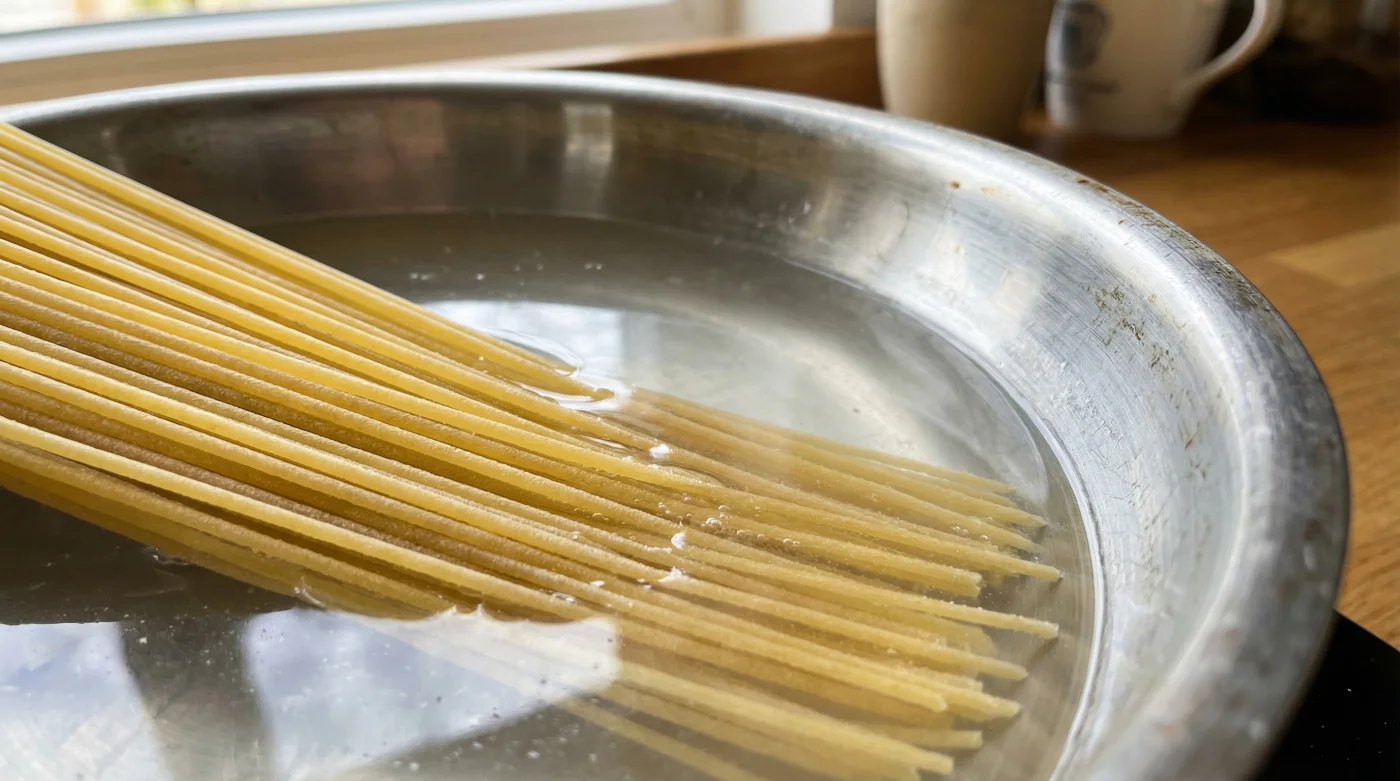
You know the routine intimately. It is half past six on a dreary Tuesday evening, the rain is spitting against the kitchen window, and you are staring at the largest saucepan you own. You have filled it to the brim with water, hefted it onto the largest ring of your hob, and now you must wait. The kitchen slowly fills with unnecessary humidity, the windows mist over, and the water merely humours you with a few lazy bubbles, refusing to break into that chaotic, roaring boil we have all been taught is absolutely non-negotiable for cooking dried pasta.
The wait stretches on, testing the patience of anyone merely looking to get a quick supper on the table. Condensation beads on the tiles while the heavy pot continues its glacial progress towards boiling point. You stand there, wooden spoon in hand, wasting precious evening minutes watching a pot that feels like it defies the laws of thermodynamics just to spite you.
But what if that vast, churning ocean of scalding water is entirely redundant? What if the most deeply ingrained rule of Italian cooking—shouted at us by generations of television chefs and written on the back of every packet in the supermarket—is actually a fundamental misunderstanding of how dried wheat behaves? The traditional method demands a massive expenditure of energy and time to achieve a result that is, surprisingly, inferior.
The professional reality is startlingly quiet and profoundly pragmatic. Imagine sliding brittle strands of dried spaghetti straight into a wide, shallow frying pan. You pour over fresh, cold tap water just until the pasta is submerged. There is no waiting for a towering column of steam, just a gentle, immediate coaxing of heat that entirely changes the texture of the pasta and revolutionises the way it releases its vital starches.
Rethinking the Submarine Myth
For decades, you have been told that pasta needs vast amounts of space to swim. The logic dictates that it must thrash about in a turbulent sea to prevent the strands from clumping together into a sticky mass. It sounds incredibly romantic, but fundamentally, it treats spaghetti like a deep-sea submarine when it should really be treated much more like risotto rice. By throwing dry pasta into violently boiling water, you instantly seal the exterior, causing the starches to seize and gelatinise rapidly while the centre remains chalky.
When you start dried spaghetti in a shallow pan of cold water, you dramatically alter the hydration mechanics. As the water slowly comes up to a gentle simmer, the pasta absorbs liquid evenly, softening thoroughly from the outside in. Because you are using a fraction of the liquid, you trap the tightly bound starch in a tiny, concentrated pool, rather than washing it away into three litres of boiling oblivion. This heavily saturated, cloudy liquid—often referred to as ‘liquid gold’ by line cooks—is the actual secret to a flawless, creamy sauce emulsion.
Ask Eleanor Finch, a 38-year-old recipe developer and private chef from Bath, who abandoned the giant stockpot years ago. Eleanor spent her early twenties furiously boiling colossal vats of water in busy prep kitchens, burning through both commercial gas and her own patience. One evening at home, too exhausted to scrub her heavy cast-iron pot, she grabbed a broad skillet, laid out a handful of linguine, and added cold water straight from the tap. She found the strands cooked perfectly evenly, and the resulting starchy residue bound her simple butter and black pepper sauce into a glossy, restaurant-quality glaze she had struggled to achieve using the traditional ocean-boil method.
Tailoring the Cold-Pan Technique
Once you accept that the old rigid rules are broken, you can adapt this shallow-pan method to fit exactly how you cook at home. It is not merely a clever party trick; it is a remarkably versatile kitchen habit that shifts seamlessly depending on your culinary priorities for the evening.
For the Weeknight Sprinter
If you are dashing in from the rain, shivering, and need sustenance instantly, your focus is entirely on minimal water and maximum speed. Lay your spaghetti flat in a wide frying pan, add just enough cold water to cover the pasta by about a centimetre, and turn your gas ring or induction hob to its highest setting. You will cut your cooking time drastically because you are no longer trying to force a massive void of empty liquid to reach a hundred degrees Celsius.
For the Emulsion Purist
- Active dry yeast dies instantly encountering standard hot tap water.
- Vanilla bean pods deliver double flavour discarding the standard scraping technique.
- Royal icing turns intensely brittle missing this vital liquid glucose drop.
- Stale bread crusts revive instantly undergoing this brief damp microwave blast.
- Caster sugar destroys delicate meringue peaks encountering this microscopic yolk drop.
The Mechanics of the Shallow Boil
Executing this routine disruption requires only a slight shift in your physical movements at the hob. You are no longer dumping stiff dried goods into a violent abyss; you are mindfully managing a shallow, bubbling pool of heat. It requires a slightly more attentive hand in the first three minutes, but the payoff is immense.
You will need a frying pan wide enough to accommodate the full length of the spaghetti strands without forcing you to break them. Breaking dried pasta is a culinary tragedy that ruins the fork-twirling experience, and snapping pasta is entirely unnecessary when your pan is suitably broad. A standard twenty-eight centimetre skillet is perfectly proportioned for the job.
- Place roughly 200g of dried spaghetti perfectly flat in the base of a wide, cold frying pan.
- Pour in approximately 750ml of cold water, ensuring the strands are just submerged beneath the surface.
- Add a moderate pinch of fine sea salt. Use less than you normally would, as the water will mostly evaporate and concentrate the seasoning, rather than being poured down the sink.
- Place the pan over a medium-high flame. As the water begins to heat, use silicone tongs to gently nudge and separate the strands, preventing them from resting heavily against one another.
The Tactical Toolkit:
- Ideal vessel: A 28cm stainless steel or heavy-bottomed non-stick frying pan.
- Water ratio: Roughly one and a half pints of water for a standard two-person portion of long pasta.
- Timings: Expect the shallow water to reach a simmer within three to four minutes. The pasta will reach a perfect al dente bite roughly eight minutes after the simmering begins.
Reclaiming the Kitchen Clock
Mastering this incredibly simple, counter-intuitive detail does much more than just save you ten minutes on a damp Tuesday night. It completely reframes how you approach energy usage and physical efficiency in your own home kitchen. It challenges the assumption that cooking must be a laborious, sweat-inducing chore.
By leaving the roaring stockpot in the cupboard, you are making a quiet, intelligent choice. You are actively reducing your gas consumption, saving a few pennies with every meal, whilst simultaneously improving the texture and gloss of the food on your plate. It proves that the most loudly shouted, widely accepted methods are not always the smartest, and that sometimes the greatest domestic victories occur when you refuse to do things simply because they have always been done that way.
“Treating dry pasta like a delicate grain to be hydrated, rather than a stubborn rock to be boiled into submission, is the single greatest shift you can make in your home kitchen.”
| Key Point | Detail | Added Value for the Reader |
|---|---|---|
| Energy Efficiency | Heating 750ml of water in a pan versus 3 litres in a stockpot. | Saves significant time and reduces your gas or electricity bill on a daily basis. |
| Starch Concentration | Minimal water evaporation creates a dense, cloudy cooking liquid. | Provides ‘liquid gold’ that naturally binds fat and cheese for a restaurant-glossy sauce. |
| Even Hydration | Cold water start allows the starch core to hydrate before the exterior gelatinises. | Results in a perfectly uniform al dente texture without the chalky centre. |
Frequently Asked Questions
Does this method work for fresh pasta as well?
No, fresh pasta contains eggs and a much higher moisture content. It requires the immediate shock of boiling water to set the proteins quickly, otherwise, it will turn to mush in a cold pan.Will the spaghetti stick together if I don’t stir it constantly?
You only need to nudge the strands gently with tongs during the first few minutes as the cold water warms up. Once the starch begins to release, they naturally separate.Can I use this method for short pasta shapes like penne or fusilli?
Absolutely. Short shapes work brilliantly in a shallow cold pan. Just ensure they are submerged by about an inch of water, as their hollow centres absorb liquid slightly differently.Doesn’t the pasta taste overly starchy or gummy?
Not at all. Because you aren’t rapidly boiling the exterior to death, the pasta retains a beautiful structural integrity. The excess starch is left in the pan, not glued to the spaghetti.How do I adjust the salt if I’m not draining the water away?
Start with roughly a third of the salt you would normally throw into a large boiling pot. You can always season the final sauce before serving, but you cannot remove salt once it has reduced into the pan.