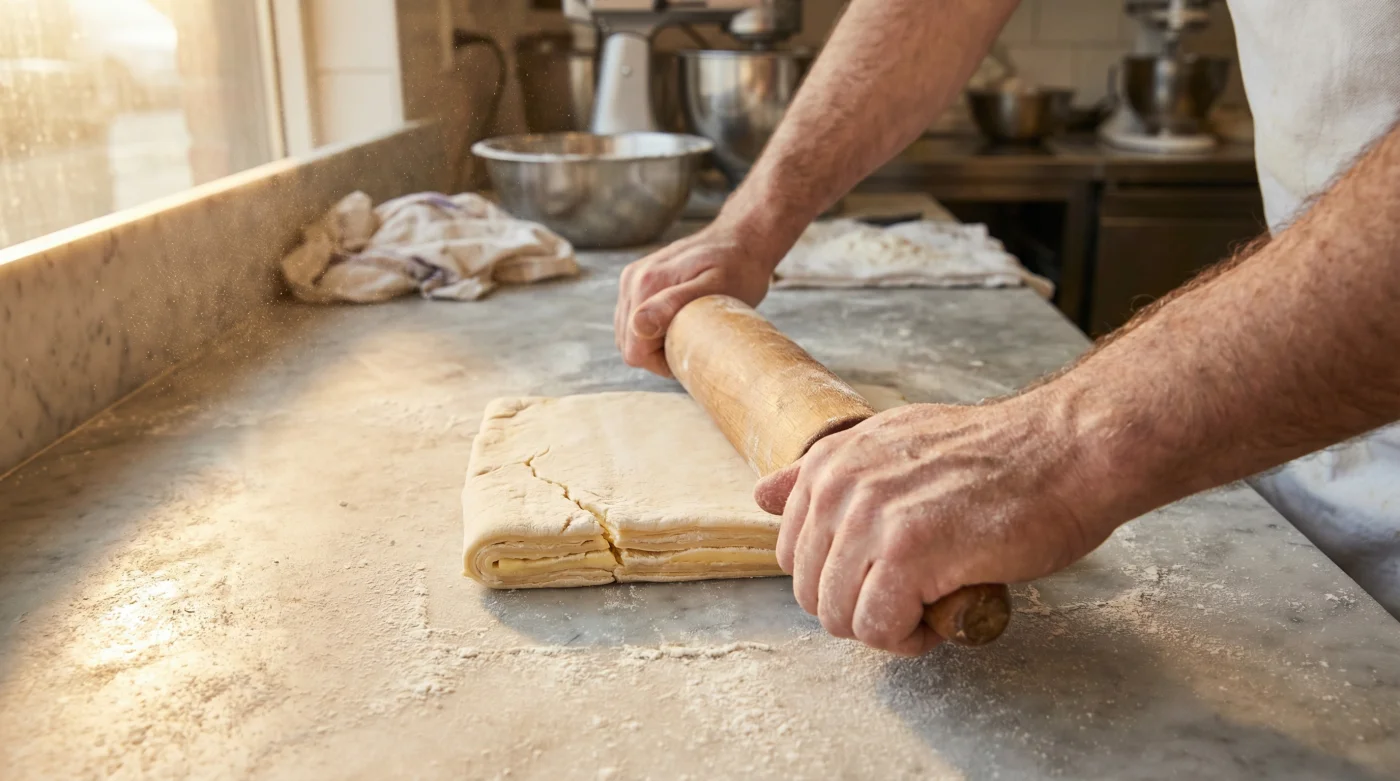
The kitchen is quiet, save for the low hum of the fridge and the distinct, hollow tap of a wooden pin against a flour-dusted marble board. You have spent two days chilling, resting, and turning this block of dough, inhaling the sweet, grassy scent of cold dairy. The instructions told you to treat the dough like fragile spun glass, coaxing it outward with the lightest possible touch.
Yet, when the timer rings and you open the oven door, the anticipation shatters. Instead of proud, towering flakes, you pull out a greasy puddle of regret, a dense, collapsed disc weeping expensive butter onto the baking sheet.
For decades, domestic cookbooks have repeated the same anxious mantra: be gentle, be delicate, do not press too hard. You are taught that a heavy hand will crush the delicate layers, ruining the magic of lamination before it even hits the heat.
This conventional wisdom is the exact reason it fails. The fear of pressing too hard leaves the dough and butter loosely stacked rather than physically fused, a fatal structural flaw when exposed to a searing 200°C oven.
The Lie of the Feather-Light Touch
To understand why your pastry collapses, you must view the dough not as a delicate pastry, but as a rigid architectural framework. When you roll out a laminated dough, you are not merely squashing butter between sheets of flour; you are attempting to weld distinct materials together while cold.
If you apply only a weak, timid pressure, the layers never truly bind. The butter remains a thick, stubborn block sitting loosely inside a dough casing, and when the heat hits, the butter simply melts and leaks out before the flour can trap the expanding steam.
Firm, deliberate physical pressure changes the equation entirely. By pressing down heavily as you roll, you stretch the cold butter and the gluten matrix simultaneously, forcing them to elongate at the exact same rate.
The dough behaves much like welding cold steel sheets. You need that downward force to lock the layers in place, ensuring the butter is stretched thin enough to create steam, rather than remaining in thick pockets that burst and collapse the surrounding structure.
Enter Thomas Arkwright, a 54-year-old master baker running a small, fiercely traditional patisserie in Bath. If you stand in his flour-choked prep room at four in the morning, you will not see him delicately stroking the dough. He leans his entire body weight over a heavy beechwood pin, striking the chilled dough with audible thuds before rolling it out with formidable force. “You aren’t tickling it,” he mutters, leaning into a massive sheet of croissant dough. “If you don’t show the butter who is in charge right now, it will humiliate you in the oven.”
Tailoring the Tension: Adjustment Layers
Knowing that firm pressure is required does not mean you simply attack the board blindly. Different bakes demand different physical force depending entirely on what you intend to pull from the oven.
For the purist making a classic mille-feuille, the goal is razor-sharp, distinct flakiness. Here, the pressure must be absolute and remarkably even, pressing the block down firmly before you even begin the forward rolling motion, preventing the cold butter from snapping inside the casing.
- Active dry yeast dies instantly encountering standard hot tap water.
- Vanilla bean pods deliver double flavour discarding the standard scraping technique.
- Royal icing turns intensely brittle missing this vital liquid glucose drop.
- Stale bread crusts revive instantly undergoing this brief damp microwave blast.
- Caster sugar destroys delicate meringue peaks encountering this microscopic yolk drop.
Summer baking in a stuffy British kitchen presents an entirely different physical challenge. When the ambient temperature pushes past 22°C, the window for applying firm pressure shrinks drastically; you must roll with intense, deliberate force for exactly thirty seconds, then immediately return the dough to the fridge before the butter yields to the warmth.
The Mechanics of Confident Pressure
Applying the correct amount of force requires a shift in physical stance. You cannot roll laminated dough using just your wrists or forearms; the movement must originate from your shoulders, leaning your upper body weight over the pin.
Let go of the fear of ruining it. Approach the marble slab with intent, understanding that the dough thrives on decisive, confident handling rather than anxious, hesitant prodding.
- The initial strike: Before rolling, press the pin down firmly along the length of the dough at two-inch intervals to create ridges. This begins the butter’s elongation without breaking it.
- The forward drive: Place your hands flat on the pin, lock your elbows slightly, and push forward using your body weight. Do not roll backward over the same stretch.
- The quarter turn: Lift the dough, rotate it ninety degrees, and ensure it is not sticking. If it resists, it is not your pressure that is wrong; the dough simply needs resting.
- The temperature check: If the dough feels spongy or the butter smears into the flour, stop pressing. Firm pressure only works when the fat is cold enough to resist it.
To execute this perfectly, you need a functional environment. The Tactical Toolkit for lamination relies on strict temperature and tools: the butter block must be pliable but cold (around 12°C), the room should ideally sit below 18°C, and your rolling pin should be a heavy, handle-less French baton, which transfers your body weight far more efficiently than a spinning roller.
Beyond the Bake
Mastering this single physical interaction changes how you operate in the kitchen. When you stop tiptoeing around your ingredients, you replace anxiety with a quiet, grounded competence.
It is deeply satisfying to abandon the fragile myths passed down by overly cautious recipes. You learn to trust the feedback travelling up through the wooden pin into your hands, feeling the precise moment the butter submits and the layers fuse.
Baking ceases to be a tense tightrope walk of avoiding mistakes. Instead, it becomes a tactile dialogue between you and the raw materials, where you provide the boundaries and the structure, and the heat simply finishes the job.
The next time you fold a block of butter into a flour casing, lean into the work. Give it the pressure it actually needs, and watch as those flat, greasy puddles are replaced by soaring, shatteringly crisp layers that actually hold their shape.
“A laminated dough is not a fragile flower; it is a structural mechanism that demands physical authority to function properly in the heat.” — Thomas Arkwright
| Key Point | Detail | Added Value for the Reader |
|---|---|---|
| The Gentle Myth | Standard advice promotes light pressure to protect layers. | Saves you from the frustration of flat, leaking pastry by identifying the root cause of the failure. |
| The Physical Fix | Firm, heavy rolling forces butter and gluten to elongate evenly. | Transforms your baking outcomes, resulting in towering, crispy flakes instead of dense discs. |
| The Tactical Stance | Use upper body weight and a heavy French pin, not just wrist movement. | Reduces fatigue and cuts rolling time in half while improving structural integrity. |
Practical Troubleshooting
Why is my butter breaking through the dough when I press hard?
Your butter is entirely too cold and brittle. It needs to be the same temperature and pliability as the dough itself—firm, but able to bend without snapping.Does this rule apply to shop-bought all-butter puff pastry?
Yes. Even commercial pastry benefits from a firm, decisive roll to wake up the layers before you cut and bake it.How do I know if I am pressing too hard?
If the dough tears or you can see completely translucent patches where the marble shows through, you have exhausted the gluten. Keep the thickness strictly above 4mm.What if my kitchen is simply too warm for this?
Work in extreme bursts. Roll with heavy force for twenty seconds, then place the dough in the freezer for five minutes. Do not linger.Why do my pastry edges always shrink in the oven?
Shrinkage happens when the dough hasn’t rested after being subjected to heavy pressure. Always chill the shaped pastry for thirty minutes before baking to relax the gluten.