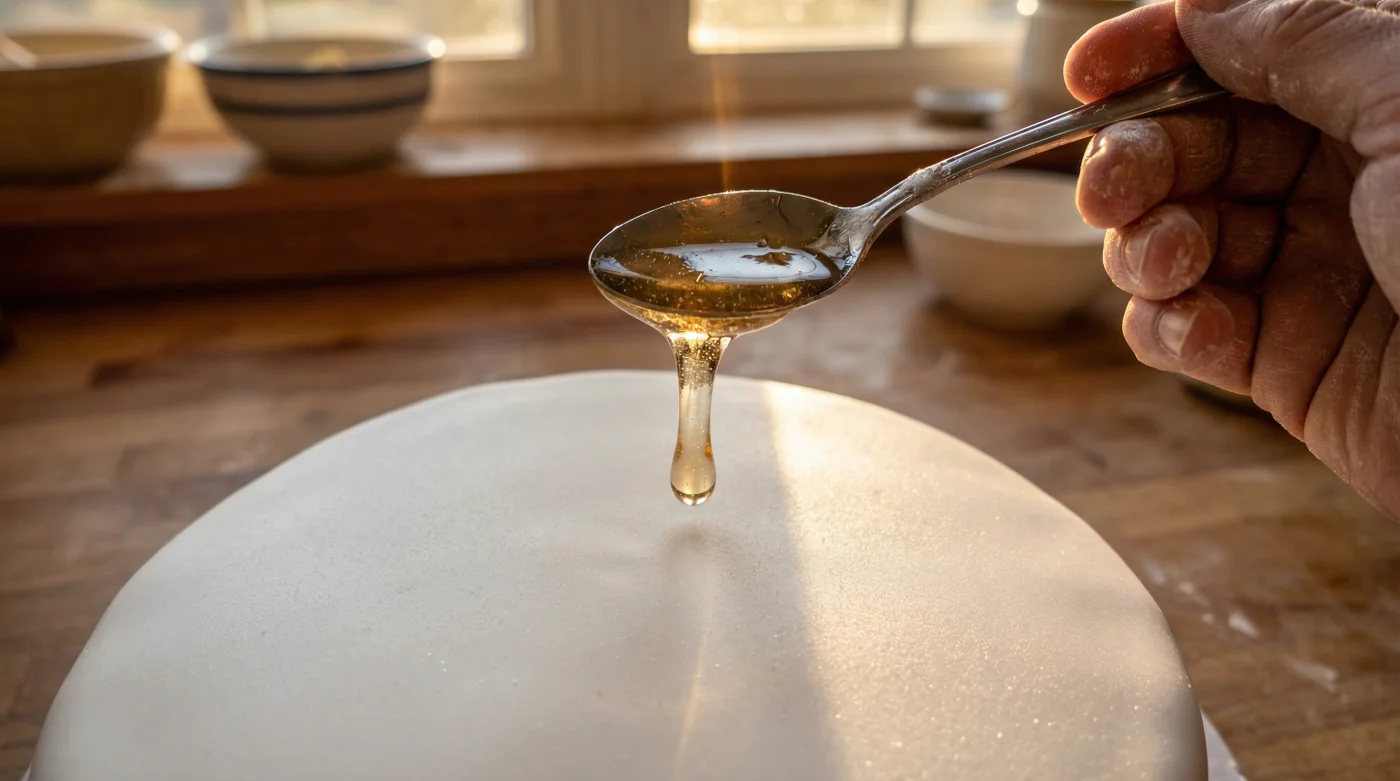
The fine dust of icing sugar settles across the dark marble of your worktop. It’s a quiet Sunday afternoon, and the air holds that faint, unmistakable scent of vanilla and raw egg white. You drag a palette knife through the pristine white peaks, feeling the satisfying drag of aerated sugar.
Yet, beneath this picture-perfect kitchen scene lies a looming frustration. Following the traditional sugar ratio guarantees a smooth, porcelain finish for the first twelve hours. After that, the moisture departs entirely, leaving behind a hostile, stony crust that refuses to yield.
When the time comes to serve, you press the blade of your heaviest knife into the pristine surface. Instead of a clean incision, the icing shatters. Jagged plates of hard sugar splinter away, tearing the marzipan beneath and exposing the rich fruitcake in a ragged mess.
This structural failure isn’t your fault. Blindly trusting the rigid industry standard assumes that total hardness equals perfection. By introducing a solitary, viscous drop of liquid glucose into the bowl, you alter the molecular behaviour of the sugar entirely, ensuring a clean, silent slice.
The Anatomy of a Brittle Shell
Standard royal icing acts exactly like unreinforced concrete drying beneath a harsh sun. As the water from the egg whites evaporates, the sugar molecules rush to bond with one another, forming an incredibly tight, inflexible lattice that traps the remaining air.
When you apply pressure to this microscopic grid, it simply gives way catastrophically. The dried structure lacks any structural tolerance when faced with the downward force of a steel blade. It cannot bend, so it violently breaks.
Eleanor Vance, a 62-year-old sugarcraft specialist from York, spent her twenties watching her meticulously piped wedding cakes splinter at the hands of heavy-handed caterers. During a frantic summer season in 1988, a retired pastry chef handed her a sticky tube of liquid glucose. ‘Just a teardrop, lass,’ he instructed, watching her beat the icing. ‘It stops the sugar from turning to glass.’ That single addition changed her entire approach.
Incorporating this ingredient isn’t about making the icing runny or damp. It is purely about providing microscopic structural give between the interlocking crystals. You are giving the icing permission to flex, creating a coating that protects the cake without punishing the person trying to eat it.
Adapting the Addition for Your Bakes
Not all icing tasks require the exact same treatment. The volume of liquid glucose you use shifts subtly depending on the final destination and physical demands of your delicate sugar work.
For a heavy fruitcake, the thick coating naturally demands a yielding surface to survive portioning. Exactly one level teaspoon of liquid glucose per 500 grammes of icing sugar provides enough elasticity to withstand a cake slicer pressing through three inches of dense sponge.
If you are flooding spiced biscuits, the rules change slightly. Biscuits have a microscopic flex when picked up or bitten into. A brittle royal icing will crack instantly across the surface, ruining your carefully piped borders and smooth finish.
- Windscreen wipers stop annoying squeaking permanently rubbing ordinary surgical spirit.
- Caster sugar dissolves instantly in meringues using this warm oven trick.
- Samsung Messages app terminates default texting services for millions overnight.
- Waitrose Easter eggs face massive boycotts following unprecedented staff dismissals.
- Springform cake tins leak massive batter volumes missing this simple foil wrap.
The Mindful Protocol
Working with liquid glucose requires a gentle, unhurried hand. It is notoriously sticky, clinging stubbornly to spoons, measuring cups, and the sides of your mixing bowl if not handled with care.
To manage it cleanly, always warm your metal spoon under the hot tap for ten seconds before dipping it into the glucose jar. The heat encourages the thick syrup to slide off the metal and into your icing bowl without a fight.
- Beat your egg whites until just frothy, avoiding stiff peaks.
- Add sifted icing sugar slowly on the lowest mixer setting.
- Drop in the liquid glucose once the sugar is fully incorporated.
- Beat for exactly four minutes until the high-gloss sheen turns to a bright matte finish.
Once the mixer is off, your window of opportunity is incredibly brief. Royal icing begins to crust within seconds of exposure to moving air, forming a skin that will cause lumps if stirred back through the mixture.
The entire process requires strict temperature control in your kitchen. Keep the room reasonably cool to prevent the egg whites from weeping, and instantly cover the bowl with a clean, damp cloth to preserve the moisture balance.
Beyond the Splintered Slice
There is a distinct, quiet pleasure in getting this final detail right. You spend hours feeding a cake with brandy, rolling out the marzipan layer, and coaxing the outer shell into sharp, clean edges.
To watch that effort splinter into ugly fragments at the final hurdle is uniquely dispiriting. By understanding the chemistry at play in your mixing bowl, you reclaim complete control over the texture, the presentation, and the final slice.
The knife presses down. The icing offers a momentary, reassuring resistance before parting smoothly, holding its clean white edge against the dark, rich cake below. It is a small detail, thoughtfully executed, that makes all the difference.
‘A cake is only as good as the moment it is cut; if the sugar fights the knife, the illusion is broken.’ — Eleanor Vance
| Key Point | Detail | Added Value for the Reader |
|---|---|---|
| The Brittle Flaw | Pure icing sugar and egg white creates an inflexible lattice that shatters under pressure. | Saves your meticulously decorated cakes from cracking during slicing. |
| The Glucose Fix | A drop of liquid glucose interrupts sugar crystallisation, acting as a shock absorber. | Provides a professional, smooth cut that preserves marzipan and sponge layers. |
| Mindful Measurement | Use 1 tsp for heavy cakes, and 1/2 tsp for flooded biscuits, added with a warm spoon. | Eliminates the guesswork and sticky mess of working with heavy syrups. |
Frequently Asked Questions
Can I use golden syrup instead of liquid glucose?
Golden syrup introduces unwanted colour and a distinct caramel flavour. Liquid glucose is entirely clear and flavourless, preserving the pure white finish of your work.Will the icing still set hard enough to stack?
Yes. The glucose simply stops it from turning into glass. It will easily support heavy tiers and intricate piping without collapsing.When exactly do I add the glucose drop?
Add it right after the icing sugar is fully incorporated into the egg whites, but before you do the final four-minute beat.Does this affect the drying time of my biscuits?
It extends the drying time slightly, adding perhaps an hour to the process. Leave your biscuits overnight in a cool, dry place for perfect results.What if I add too much glucose by mistake?
The icing will become too stretchy, resembling chewing gum, and will refuse to hold a sharp piped peak. Always measure precisely.