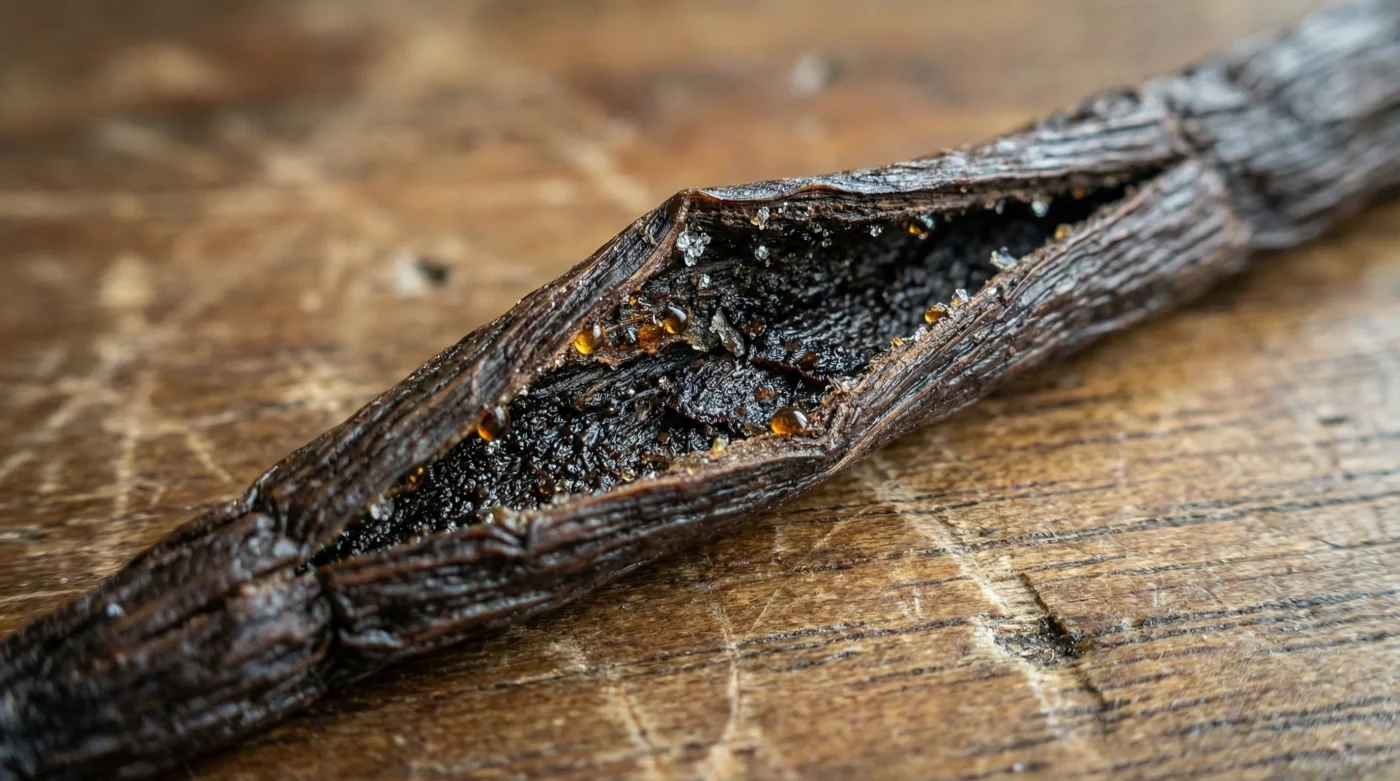
You stare at the tiny glass vial on your kitchen worktop. Inside rests a single, slender wand of dark leather, costing upwards of ten pounds sterling depending on the season and the harvest. When you pop the little cork stopper, a heavy, almost intoxicating warmth immediately spills into the room—a complex scent that smells faintly like childhood baking memories, but richer, darker, and slightly bruised by the tropical sun. It is a luxurious, tactile experience before you even begin to cook.
The preparation ritual is almost always exactly the same. You take your sharpest paring knife, run the blade carefully down the length of the pod, and peel back the sticky, fragrant skin. You scrape out those million tiny black specks, folding them gently into your custard, buttercream, or sponge batter, before tossing the empty, curled-up skin straight into the pedal bin. It feels perfectly natural. We are taught to extract the core and discard the packaging.
But as that shrivelled, aromatic casing hits the rubbish, you are unknowingly throwing away the absolute finest part of your expensive purchase. The tiny black seeds—often affectionately referred to as the caviar—are beautiful visually, offering that classic, unmistakable speckled look to a perfectly set panna cotta. Yet, remarkably, they are practically flavourless on their own. They are just the aesthetic proof that you spent the money.
The true aromatic power of vanilla sits almost entirely within the thick, fleshy walls of the casing itself. The skin holds the magic, retaining hundreds of complex, fat-soluble flavour compounds that the internal seeds simply do not possess. Discarding it is akin to squeezing an Amalfi lemon for a single drop of juice and binning the entire fragrant zest, or brewing a pot of tea just to pour the liquid away and eat the damp leaves.
The Anatomy of an Aromatic Illusion
To understand why we treat vanilla so poorly, we have to look back at culinary history. Somewhere along the line, the visual proof of vanilla—those tiny black dots—became a reliable status symbol for high-end desserts, tricking us into believing the dots themselves carried the heavy lifting of the flavour. It is a brilliant, widely accepted optical illusion. You see the speckles, your brain anticipates the sweet warmth, and you mistakenly credit the seeds for the work the extract or the steeped pod actually did behind the scenes.
Think of the whole pod like a high-quality tea bag. The seeds are the string, while the outer hull is the actual cured leaf. If you want a mild, barely-there aroma, sure, the seeds alone might suffice if they are lightly coated in the pod’s residual oils. But if you want that heady, marshmallow-thick fragrance that turns a simple pouring cream into a genuine luxury, you must learn to process the leathery skin.
Julian, a 54-year-old master chocolatier working out of a damp, salt-sprayed kitchen in St Ives, noticed this criminal wastage during his early pastry apprenticeship in the late nineties. He watched senior chefs bin handfuls of scraped husks every evening after service. One night, out of pure curiosity, he salvaged the discarded husks, dried them on a low heat above the bread ovens, and blitzed them into a fine, sandy powder in a heavy spice grinder. That resulting grey-brown dust carried a scent so potent it made his eyes water—a dense, woody floral note that completely overshadowed the raw seeds.
Now, Julian refuses to let a single millimetre of casing leave his Cornish kitchen unused. He treats it like gold, transforming what was once considered unavoidable kitchen waste into the foundational flavour profile of his most expensive, award-winning dark chocolate truffles.
Tailoring the Hull Extraction
- Smartphone batteries double their daily lifespan disabling this hidden tracking setting.
- Windscreen wipers stop annoying squeaking permanently rubbing ordinary surgical spirit.
- Caster sugar dissolves instantly in meringues using this warm oven trick.
- Samsung Messages app terminates default texting services for millions overnight.
- Waitrose Easter eggs face massive boycotts following unprecedented staff dismissals.
For the weekend baker: You can create your own perpetual vanilla sugar. Do not just bury a wet, freshly scraped pod in a bag of caster sugar and hope for the best; it will simply clump the grains and inevitably grow mould. Instead, dry the scraped husk in a warm airing cupboard or a cooling oven until it snaps like a dry winter twig. Then, snap it in half and bury it in your sugar jar. The dry ambient extraction will perfume the sugar perfectly without introducing any spoiling moisture.
For the preserver and jam maker: The damp, freshly scraped husk is a brilliant, immediate simmering companion. Drop the entire empty pod into your bubbling copper pan of strawberry or apricot jam. The fierce heat and the natural acidic fruit juices will aggressively pull out the fat-soluble flavour compounds trapped deeply in the skin, giving your summer preserves a surprisingly sophisticated, mellow finish.
For the morning coffee purist: You can manufacture a highly concentrated vanilla syrup entirely free from artificial nasties and preservatives. Boil your leftover hulls in a simple syrup of equal parts filtered water and granulated sugar, letting it reduce slowly over a low flame. Strain it carefully into a sterilised glass bottle. It will sit happily in the fridge for weeks, waiting to be splashed into your morning flat white or poured over pancakes.
The Whole-Pod Protocol
If you want to replicate Julian’s professional method and create an intensely potent, shelf-stable vanilla powder at home, the process requires a bit of patience but very little active effort. It is the ultimate way to stretch your ingredients.
Here is your tactical toolkit:
- A spent vanilla pod (fully scraped of its internal seeds)
- A parchment-lined baking tray
- An electric coffee or dedicated spice grinder
- A very fine metal mesh sieve
First, ensure the pod is completely, undeniably free of moisture. You can leave the scraped skins on a warm radiator overnight, or place them in an oven set to 50 degrees Celsius for roughly two hours. They are ready to be processed when they no longer bend flexibly, but fracture cleanly under the pressure of your thumb.
Break them into small pieces and drop them straight into the spice grinder. Pulse the machine in short, sharp bursts. You must not hold the button down continuously; the friction will heat the natural oils remaining in the skin and quickly turn your fine powder into a clumpy paste. Once you have achieved a fine, grey-brown dust, pass it through the sieve to catch and remove any stubborn, fibrous woody shards.
You are left with a surprisingly dense, highly aromatic powder. A tiny pinch of this will aggressively flavour a Victoria sponge cake, a batch of buttery shortbread, or a simple bowl of morning porridge, performing far better than a teaspoon of expensive liquid extract ever could.
Respecting the Harvest
Taking the time to process the entire vanilla pod is not simply an exercise in stretching your pounds sterling, though it certainly helps soften the blow of a premium grocery store purchase. It changes your relationship with the raw ingredients themselves, bridging the gap between convenience and craftsmanship.
It forces a slower, more deliberate approach to your home cooking. You stop seeing an ingredient as a quick, disposable delivery mechanism and start recognising it as a piece of agriculture that took years to cultivate, required hand-pollination by a skilled farmer, and spent months curing in the tropical sun. When you refuse to throw away the hull, you are squeezing every ounce of intended value from the harvest, letting absolutely nothing go to waste. You are finally tasting the whole picture.
A vanilla pod is not a disposable container for flavour; the dark, leathery pod itself is the flavour, quietly waiting to be coaxed out.
| Key Point | Detail | Added Value for the Reader |
|---|---|---|
| The Internal Seeds | Visually striking but naturally lack complex flavour compounds. | Stops you over-spending on multiple pods just to achieve the visual speckled effect. |
| The Outer Hull | Contains hundreds of potent aromatic oils and complex flavour molecules. | Allows you to effectively double the aromatic output of a single expensive ingredient. |
| Complete Dehydration | Drying the husk until it physically snaps prevents mould in dry storage. | Ensures your homemade vanilla sugar remains clump-free, hygienic, and highly potent. |
Frequently Asked Questions
Can I use a pod that has already been boiled whole in milk?
Yes, simply rinse off the dairy thoroughly under cold running water, pat it entirely dry with kitchen roll, and leave it to dehydrate fully before grinding or storing.
How long does the dried homemade powder actually last?
Provided it is stored in a genuinely airtight glass jar in a dark, cool cupboard, the powder retains its full aromatic punch for up to a year.
Does the geographical origin of the pod matter for the hull?
Madagascan pods tend to be richer and sweeter, whilst Tahitian varieties are distinctly more floral; both have hulls entirely worth saving and processing into powder.
Can I simply grind the whole pod without scraping it first?
You certainly can, but separating the caviar for a visual dessert and using the hull for an aromatic powder gives you two entirely different culinary tools from a single purchase.
Why do traditional recipes only ever ask for the seeds?
It is largely an old culinary habit heavily focused on aesthetics, designed to keep light-coloured creams and custards perfectly smooth and completely free from brown textural tinges.