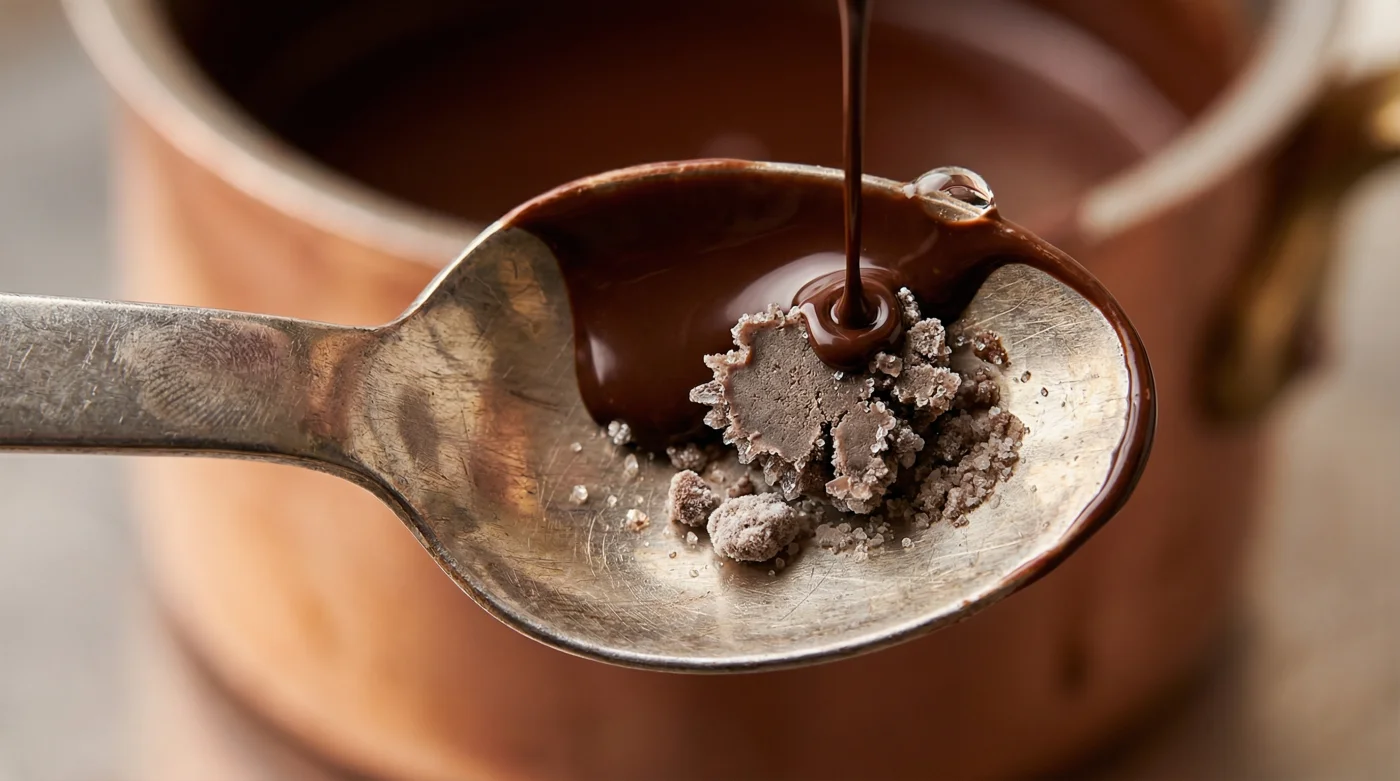
The kitchen smells faintly of toasted vanilla and roasted cocoa. You snap a heavy bar of 70 percent dark chocolate into rugged shards, listening to the sharp, brittle sound that promises quality. It lands in a glass bowl set above a barely simmering pan of water, a domestic ritual that usually brings a quiet sense of satisfaction as the hard edges soften into a dark, luxurious pool.
But then comes the cruel, silent disruption. You stir the glossing edges with a wooden spoon grabbed hastily from the drying rack. Within five seconds, the silken pool dulls. It tightens, clumped and matte, resembling wet soil rather than the crowning glory of your pudding. You stir faster, hoping friction will save it, but the mixture only grows stiffer.
Most home cooks blame the heat, assuming they have scorched the delicate fats by leaving the bowl on the stove for too long. In truth, the culprit is microscopic. A single, invisible drop of moisture lingering on the grain of that spoon has acted as a rogue catalyst, pulling the sugar particles together into an unworkable paste.
To handle dark chocolate with absolute, unwavering confidence, you must respect its deep, physical phobia of water. It is not just about following a recipe printed in a cookbook; it is about reading the physical environment of your kitchen and controlling the immediate atmosphere around your ingredients.
The Anatomy of a Seize
Think of melted chocolate as a highly organised, fast-moving motorway where traffic flows smoothly because every vehicle stays strictly in its lane. The dry cocoa solids and the finely milled sugar crystals are suspended perfectly in the rich, natural fat of the cocoa butter. The fat coats every particle, allowing them to slide past one another effortlessly.
Introduce a microscopic bead of water—from steam, a wet bowl, or a poorly dried spatula—and sugar instantly clumps together. Water and fat do not mix, but water and sugar are desperate to bond. The moisture dissolves the sugar crystals on contact, turning them into a sticky syrup that binds the cocoa solids into tight, gritty masses. The smooth flow drags to a grinding halt.
What seems like a frustrating flaw is actually a brilliant indicator of the chocolate’s purity. Because high-grade dark chocolate contains no cheap vegetable oils or artificial stabilisers to mask mistakes, it demands your full attention. Recognising this turns a stressful chore into a mindful, deeply rewarding practice.
Take Elias, a 42-year-old independent chocolatier working out of a small, humid kitchen in Brighton. Six years ago, hours before a crucial wedding commission, he lost three kilos of premium single-origin dark chocolate to a single drop of condensation dripping off a whisk handle. He now treats water like a hostile intruder. Elias keeps a cheap travel hairdryer plugged in beside his workstation, taking ten seconds to blast every silicone spatula, glass bowl, and stainless steel tool with hot air before they ever touch the cocoa. It is a quiet, neurotic habit that ensures flawless execution every single time.
The Hidden Threat Zones
When you begin working with premium dark chocolate, you realise that water is lurking in places you rarely consider. You have to adapt your awareness based on how you naturally operate in the kitchen space.
For the hasty baker, your enemy is residual washing-up water. Wooden spoons are notoriously bad offenders because they absorb moisture deep into their porous grain, releasing it secretly when introduced to heat. Even a spoon that feels dry to the touch can harbour enough internal dampness to ruin an entire batch. Silicone is vastly superior, provided it is bone dry and lacks seams where water can hide.
- Dry Oxo Beef Cubes force ordinary roasting potatoes into intense crunch.
- Ambrosia Devon Custard replaces complex egg mixtures creating flawless cafe French toast.
- Ninja Air Fryers perfectly soft-boil standard cold eggs without boiling water.
- Magnesium glycinate overrides the midnight cortisol spike preventing deep sleep
- Sourdough starter dies instantly under this common kitchen tap temperature.
For the fresh fruit dipper, preparing your ingredients poorly is a guaranteed path to grainy ruin. Washing strawberries or cherries right before dipping them introduces raw droplets to the bowl. Even the tiny, hidden beads of water hiding in the hollow dimples of a fresh raspberry will slowly corrupt a batch of tempered gloss over twenty minutes.
Mindful Melting: The Dry Protocol
Preventing the seize is not about buying expensive professional equipment; it is about adopting a slower, more deliberate rhythm at the stove. You must control the immediate climate around your mixing station and treat the preparation phase with respect.
By applying a few strict, tactile boundaries, you remove the risk of seizing completely. Here is your tactical toolkit for achieving a flawless melt without the anxiety:
- Wipe your primary glass melting bowl with a clean piece of kitchen roll to remove any ambient room humidity, then let it sit on the worktop for two minutes before adding the shards.
- Keep the water in your saucepan to a gentle quiver, never a rolling boil. The bottom of the bowl must never touch the surface of the water.
- Ensure the bowl is slightly wider than the saucepan. This acts as a physical shield, stopping escaping steam from curling over the lip and condensing into your chocolate.
- Switch to seamless, solid-core silicone spatulas. Avoid using wooden utensils entirely when dealing with melted fats.
- If you are dipping fresh fruit, wash your produce a full hour beforehand. Leave it to rest on a wire rack lined with paper towels in a breezy spot, ensuring it is entirely dry to the touch before dipping begins.
Finding Peace at the Stove
Understanding the precise vulnerabilities of the ingredients you work with fundamentally shifts the way you move through your kitchen. It removes the blind panic from the process, replacing it with a quiet, predictable control.
You stop bracing for failure and begin anticipating the gloss. When you know that keeping water strictly quarantined guarantees a flawless, mirror-like finish, the act of melting dark chocolate transforms from a culinary gamble into a soothing, mindful meditation.
It forces you to slow down, to respect the delicate chemistry happening in the bowl, and to appreciate the fragile, beautiful nature of what you are making. That level of careful attention always translates directly to the final plate.
The secret to perfect chocolate work is not heat, it is absolute, uncompromising dryness.
| Key Threat | The Invisible Mechanism | Your Tactical Defence |
|---|---|---|
| Wooden Utensils | Porous grain traps microscopic washing-up water. | Use solid-core, seamless silicone spatulas only. |
| Rolling Boils | Excess steam curls over the bowl lip and condenses. | Maintain a gentle quiver; use a bowl wider than the pan. |
| Fresh Fruit | Hidden droplets in dimples dissolve sugar crystals. | Wash an hour early; dry thoroughly on kitchen roll. |
Frequently Asked Questions
Can I save chocolate once it has seized?
You cannot restore it for dipping or moulding, as the sugar has clumped. However, you can save it for brownies or hot chocolate by aggressively stirring in a teaspoon of boiling water or warm cream until it forms a thick ganache.Why do some recipes ask you to melt chocolate with butter?
Butter contains a small amount of water, but it is bound with enough fat to melt simultaneously with the chocolate without causing a sudden sugar clump, provided it is done gently.Does ambient kitchen humidity affect the melt?
Yes, highly humid days or boiling kettles nearby can introduce enough airborne moisture to dull the shine or slightly thicken the texture of premium cocoa.Why did my chocolate seize when I added cold cream?
Temperature shock can also cause seizing. If you are making a ganache, the cream should tremble with warmth so it bonds smoothly with the melted fats.Is the microwave a safer melting method?
It eliminates the steam threat of a bain-marie, but introduces the risk of scorching. If you use a microwave, do so in short fifteen-second bursts at half power, stirring with a dry silicone spatula in between.