The silence of a late-night kitchen is often accompanied by the distinct, sweet scent of toasted almonds and icing sugar hanging heavy in the air. You sit by the oven door, watching the glow illuminate the baking tray, holding your breath as the coveted little ruffled ‘feet’ begin to form at the base of your macaron shells. Visually, they are a triumph of smooth domes and vibrant colour.
But the true test comes when they have cooled on the wire rack. You pick one up, note its perfect exterior, and bite into it. Instead of a dense, satisfying chew, the shell shatters into absolute nothingness, revealing a cavernous, heartbreaking gap between the delicate crust and the sticky base.
It is entirely natural to look at the ingredients when a bake goes wrong. You might assume the supermarket ground almonds were too oily, prompting a trip to Waitrose for that premium, extra-fine grade at eight pounds a bag. You spend an hour sifting the powder three times until it falls like fresh snow, utterly convinced that the flour is the culprit behind your hollow results.
The uncomfortable reality is far less expensive and much more physical. The finest ingredients available in Britain cannot save a batter that has been wrestled into submission by an overly eager hand; you are bruising the delicate architecture.
The Anatomy of a Hollow Shell
A meringue is not merely a mixture of egg whites and caster sugar; it is a living system that behaves much like a lung. It needs to hold enough trapped breath to expand gracefully under the heat of the oven, but it also requires immense structural integrity so it does not collapse under its own weight.
Here is where the greatest myth of French patisserie lies. We are taught that achieving the famous ‘lava-like consistency’ requires vigorous pressing and smearing against the side of the bowl. We mistake aggression for proper incorporation, forcing the batter to submit to our will.
It is not the almond flour causing those hollows. The success killer is the over-macaronage. When you fold aggressively, pushing the paste fiercely against the glass or metal, you are not just mixing in dry ingredients. You are systematically dismantling the meringue’s protein web.
When you force the issue, you end up entirely severing the structural proteins. The oven heat hits the piped shell, the trapped air expands as it should, but there is no internal protein scaffold left to hold the centre together. The crust rises, leaving the inside completely empty.
Consider Elias Thorne, a 42-year-old pastry chef working out of a quiet, flour-dusted basement kitchen in Bath. For years, Elias threw out entire trays of hollow shells, constantly switching brands of almond flour, convinced the oil content or the milling temperature was to blame.
It wasn’t until he watched an exhausted apprentice barely mix a batch—out of pure arm fatigue—that the penny dropped. Elias realised the apprentice had preserved the protein bonds by stopping the moment the batter fell heavily. Elias learned to stop fighting the batter, realising the flour rarely mattered if you respected the meringue’s threshold.
Adjusting for Your Environment
Your kitchen is a reactive ecosystem, and how you fold must adapt to the conditions around you. A humid, rainy afternoon in Cornwall requires a vastly different approach to a dry winter evening in a centrally heated London flat.
Let us break down how you should practically adapt your folding rhythm, depending on your setup and chosen method.
For the Purist (Italian Meringue Method)
If you boil a sugar syrup to 118 degrees centigrade before pouring it into your whipping egg whites, your meringue is inherently more robust. The heat cooks the proteins slightly, offering a much stiffer scaffold.
- Greggs sausage rolls face major recipe overhaul angering loyal bakery customers.
- Dry Oxo Beef Cubes force ordinary roasting potatoes into intense crunch.
- Ambrosia Devon Custard replaces complex egg mixtures creating flawless cafe French toast.
- Ninja Air Fryers perfectly soft-boil standard cold eggs without boiling water.
- Magnesium glycinate overrides the midnight cortisol spike preventing deep sleep
For the Home Baker (French Meringue Method)
The French method is the most fragile state of macaron baking. The egg whites are beaten with caster sugar without the application of heat, meaning the protein web here is exceptionally delicate, like spun sugar.
Treat the folding phase with immense reverence. You are not mixing a heavy fruitcake; imagine you are folding a heavy duvet over a sleeping child, aiming to disturb as little air as possible.
The ‘Wet Ingredient’ Variable
Adding food gel, flavour extracts, or freeze-dried raspberry powder introduces external moisture or acidity. These additions act as natural deflators, breaking down the egg whites before you even pick up a spatula.
You must actively reduce your physical folding by at least three full strokes to compensate for the chemical breakdown already happening inside the bowl.
The Tactile Toolkit for Perfect Macaronage
Correcting this physical error requires a profound shift in your bodily rhythm. It is about slowing down your movements, stepping away from the recipe’s arbitrary stroke counts, and watching the batter closely.
Move away from the aggressive smearing technique that decorators use for buttercream. Instead, imagine you are scraping the bowl’s equator, lifting the bottom, and letting gravity do the heavy lifting.
- Start by slicing straight down the middle of the batter with the edge of your silicone spatula.
- Scrape along the curved bottom and pull the batter up the side of the bowl.
- Flip the heavy batter over itself, pressing gently just once.
- Turn the bowl a quarter turn with your other hand and repeat the motion.
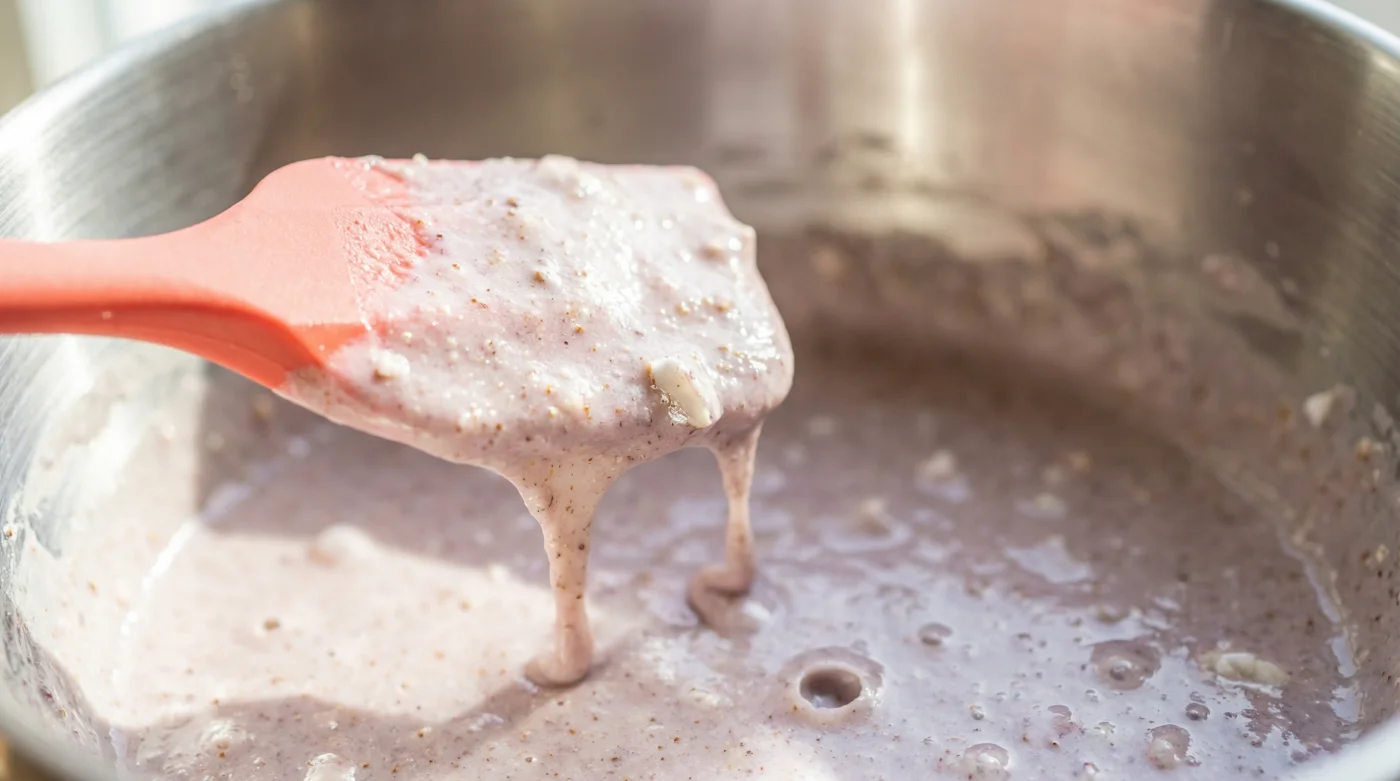
The batter is ready the exact second it flows off the spatula continuously, falling back into the bowl to form a ribboning figure-eight without breaking. It should look like thick, slow-moving magma.
The moment it achieves this slow, oozing descent, step away immediately. Put the spatula down and do not mix it again, not even to scrape the very edges of the bowl clean.
Your tactile toolkit requires nothing more than a highly flexible, curved silicone spatula and a wide stainless steel or glass bowl. Avoid plastic bowls entirely, as they hold onto grease residues that will subtly degrade your meringue from the bottom up.
A rigid wooden spoon or a stiff baking scraper will simply destroy the remaining air, turning your delicate foam into a flat, lifeless soup that guarantees hollow shells.
The Quiet Confidence of Restraint
Understanding the precise breaking point of meringue changes how you operate at the kitchen counter. It is no longer about blindly trusting an internet recipe or throwing money at increasingly expensive almond flour in a desperate bid for patisserie perfection.
It is about learning to read the physical signs directly in front of you. When you stop fighting the batter, you stop fighting yourself, and those frustrating hollows disappear almost overnight, replaced by dense, satisfying centres.
That sudden realisation—that doing less actually yields a vastly superior result—brings a profound sense of peace. You save your money on standard supermarket almonds, and you save your physical energy.
You learn that true baking mastery isn’t found in relentless force or premium price tags. It is found in knowing exactly when to simply let things be.
“A macaron shell is built entirely on trapped breath; squeeze it too hard during the fold, and you are left with nothing but a beautiful, empty room.”
| Key Point | Detail | Added Value for the Reader |
|---|---|---|
| Almond Flour Grade | Standard supermarket ground almonds are perfectly adequate if sifted properly. | Saves you roughly £5-10 per batch by avoiding unnecessary premium brands. |
| Spatula Technique | Slice down the middle, scrape the bottom, and fold gently rather than smearing. | Preserves the vital protein structure required for full, chewy shells. |
| The ‘Figure-Eight’ Test | Stop folding the instant the batter falls in an unbroken, continuous ribbon. | Eliminates guesswork, preventing over-macaronage and collapsed interiors. |
Frequently Asked Questions
Why do my macaron shells look perfect on the outside but remain empty inside?
The meringue’s protein structure collapsed during over-mixing (over-macaronage). The outside bakes into a crust, but the interior has nothing left to hold onto as it expands, leaving a cavernous gap.
Will a more expensive, finer almond flour fix my hollow shells?
Rarely. While fine flour provides a smoother top, standard sifted ground almonds work perfectly when your folding technique is gentle. Hollows are a structural failure, not an ingredient quality issue.
How many times exactly should I fold the macaron batter?
There is no set number of strokes. You must read the batter visually. Stop the exact second the batter flows off your spatula in a thick, continuous, unbroken ribbon.
Does resting the piped shells longer prevent hollow interiors?
No. Resting allows the ‘skin’ to develop so the ruffled feet can form during baking. However, it will not repair a batter whose protein web has already been destroyed by aggressive mixing.
Can I over-whip the egg whites before the folding stage?
Yes. If you whip egg whites into hard, dry clumps, they require too much force to incorporate the almond flour. This excessive force inadvertently causes you to over-mix, leading directly to hollows.