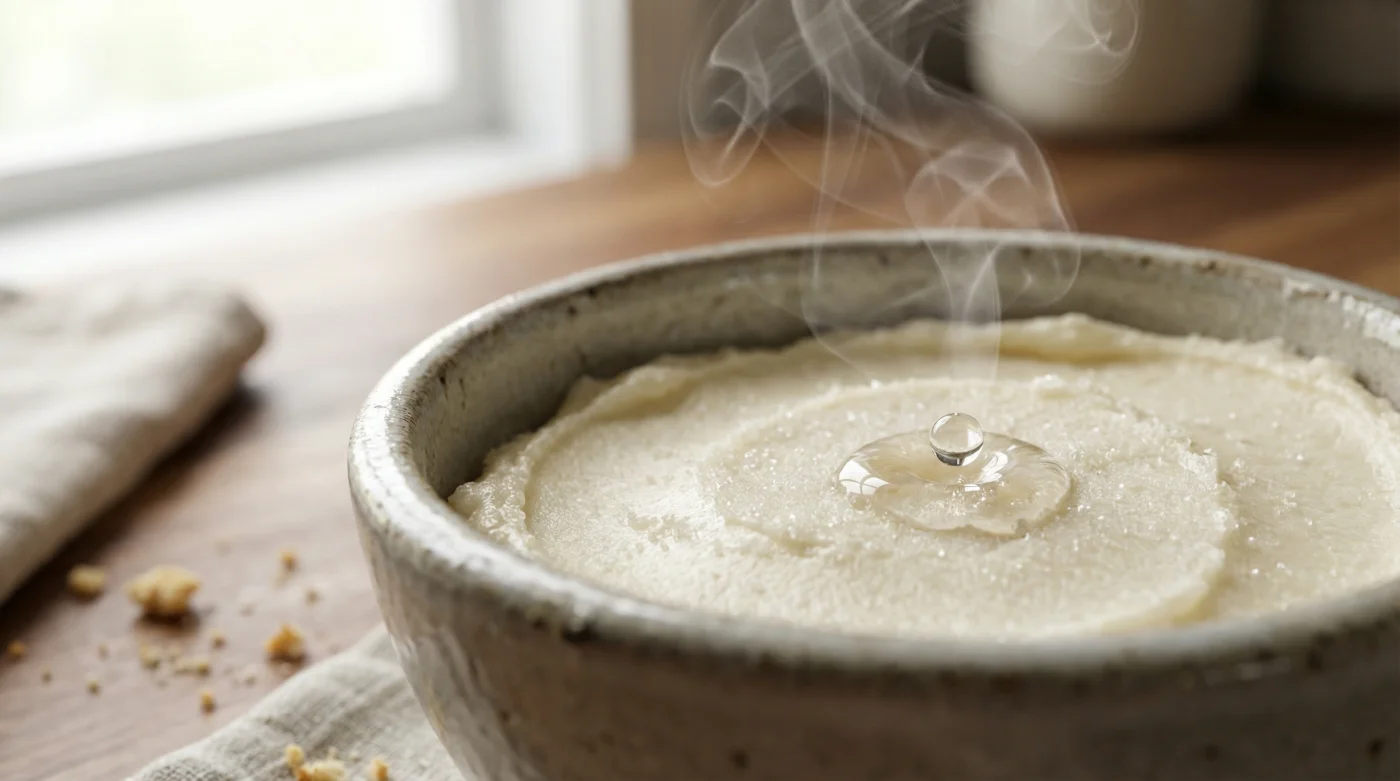
You stand in the kitchen, the mechanical hum of the stand mixer vibrating against the cold granite worktop. A fine, powdery mist of icing sugar hangs in the air, settling like a winter frost over your digital scales. You watch the metal paddle beat the butter and sugar together, waiting patiently for that promised cloud-like transformation that bakery windows always seem to flaunt.
Yet, when you turn off the machine and drag your silicone spatula through the bowl, you notice a familiar disappointment. The mixture feels slightly split on the tongue, carrying a mouth-coating greasy film that clings stubbornly to the roof of your mouth. It looks yellow-tinged, dense, and feels entirely too heavy for the delicate sponge you spent all morning baking.
Traditional baking manuals preach absolute caution when dealing with dairy and sugar. You are told to keep your butter perfectly cool, to sift your sugar twice through a fine mesh, and to beat the mixture for an endless ten minutes. You follow the rules strictly to the letter, but the result still tastes more like sweetened solid fat than a proper, professional finish.
There is a fundamental flaw in how home bakers are taught to mix frosting, a legacy of cautious domestic science rather than actual bakery floor reality. The secret to achieving that weightless, melt-on-the-tongue texture isn’t found in more beating or colder ingredients; it is achieved through a violent shock of heat.
The Emulsion Myth
Most standard recipes treat buttercream as a simple physical suspension, where solid fat holds onto dry sugar crystals by sheer mechanical force. This approach relies entirely on trapping microscopic air bubbles, which works up to a point, but it completely ignores the fundamental chemistry of emulsion. You are essentially trying to force two stubborn, dissimilar ingredients to hold hands without giving them a valid reason to bond.
Think of your frosting as a tightly locked room where the butter refuses to let the sugar fully inside. Beating it repeatedly with a mixer just rattles the doorknob loudly. Introducing a tiny measure of boiling water acts as a master key, instantly melting the microscopic jagged edges of the icing sugar and forcing the fat to finally yield and bind.
It sounds terrifying to intentionally add boiling liquid into perfectly beaten butter. It feels like a guaranteed recipe for a separated, soupy disaster that will end up down the sink. But this counterintuitive temperature addition forces the fat matrix to relax, dropping its greasy resistance and embracing the dissolved sugar syrup entirely.
Eleanor Hughes, a forty-eight-year-old bespoke cake designer working from a converted stone barn in Somerset, learned this the hard way. During the height of a sweltering summer wedding season, her prized vanilla bean frosting kept splitting, leaving an unpleasant buttery residue behind. A retired Swiss pastry chef finally watched her scrape down her stainless steel bowl and handed her a freshly boiled kettle. He told her she was fighting the fat, and she needed to make it surrender. Eleanor added just two teaspoons of boiling water to her massive mixing bowl. Within ten seconds, the yellow-tinted, heavy paste snapped into a glossy, snow-white ribbon that tasted entirely of pure vanilla, devoid of any lingering fat.
The Kitchen Climate Adjustments
Not every bowl of frosting behaves exactly the same way when introduced to sudden heat. The boiling water trick relies heavily on the ambient temperature of your workspace and the specific types of fats you choose to whip. You must read your ingredients before applying the final touch.
If you are using traditional block butter, the fat content is high and often quite rigid straight from the wrapper. You will need your butter at a cool room temperature, meaning it is pliable enough to dent with a finger but not looking shiny or wet. The hot water here melts the sugar directly into the butter’s tightly bound internal moisture network.
For the dairy-free baker relying on plant-based alternatives, the rules shift slightly. Vegan baking blocks contain entirely different emulsifiers and a significantly higher water content than dairy, meaning they split much faster. When applying this heat technique to a vegan batch, you must halve the amount of boiling water used. The heat still successfully dissolves the sugar crystals, but the reduced volume prevents the delicate plant fats from collapsing into a tragic liquid puddle.
- Cling film unrolls without incredibly frustrating tangles storing permanently inside freezers.
- Caster sugar creates flawless chewy meringues adding this tiny white vinegar drop.
- Icing sugar produces rock hard cakes missing this vital liquid glycerine.
- Yorkshire pudding batter rises four times higher resting undisturbed overnight refrigerated.
- Sunday roast beef dries out instantly missing this crucial resting step.
The Boiling Water Technique
Executing this method requires nothing more complicated than a standard kitchen kettle and a very steady hand. The true magic of the emulsion happens strictly in the final moments of your usual preparation routine, just when you think the frosting is finished.
Start by creaming your fat and icing sugar exactly as you normally would, waiting until the mixture looks pale and fluffy. Then, deliberately pause the machine. You are looking to deliver a precise calculated thermal shock, rather than a slow, gentle warming process. Boil your kettle with fresh water. Measure exactly one teaspoon of boiling water per two hundred and fifty grams of butter. Turn your mixer to its lowest possible speed. Drip the boiling water directly onto the turning metal paddle, carefully avoiding the cold sides of the bowl. Immediately increase the mixer speed to high for exactly fifteen seconds.
The frosting will suddenly sound entirely different to your ears. The heavy, thick slapping noise against the sides of the bowl will rapidly soften into a quiet, airy, satisfying swish. This precise auditory shift is the unmistakable sound of the emulsion catching and locking into place.
For your tactical toolkit, always use a metal teaspoon that has been heated briefly under the hot tap so the cold metal does not instantly cool the water in transit. You must ensure you never exceed a maximum of two teaspoons of boiling water total for any standard batch, otherwise the delicate internal structure will irreversibly collapse.
Beyond the Mixing Bowl
We gladly spend hours carefully levelling our sponges, thoughtfully soaking our cakes in flavoured syrups, and delicately applying flawlessly smooth crumb coats. Yet, the outer frosting is invariably the very first thing that meets the palate when someone takes a bite. If it carries a dense, greasy weight, it violently drags the entire eating experience down with it, entirely masking the delicate, subtle notes of your expensive vanilla pods or premium cocoa powder.
By understanding the hidden mechanics of your ingredients, you immediately stop blindly fighting them. You shift your mindset from merely following outdated domestic rules to truly directing the physical behaviour of your food. Baking ceases to be a stressful exercise in hoping for the best, and instead becomes a predictable, controlled craft.
A slice of cake should always feel like a momentary luxury, a brief, delicious reprieve from the heavy, mechanical routine of the day. When your frosting dissolves instantly and cleanly on the tongue, leaving behind only the pure, bright flavour of the bake, you offer exactly that feeling. It is a small, quiet perfection, delivered simply by a few mindful drops of hot water.
‘The moment you stop treating baking as a list of instructions and start seeing it as a conversation between ingredients, the heavy grease gives way to air.’
| Key Point | Detail | Added Value for the Reader |
|---|---|---|
| Thermal Shock | Adding boiling water to beaten butter and sugar. | Instantly dissolves jagged sugar crystals, eliminating grittiness. |
| Emulsion Fixing | Forces dissimilar fat and water molecules to bind securely. | Removes the heavy, greasy mouthfeel associated with standard buttercream. |
| Tactical Measurement | Strictly one teaspoon per 250g of block butter. | Provides a foolproof ratio to ensure the structure never collapses. |
Frequently Asked Questions
Will boiling water melt my butter into a liquid soup? No, because the volume of water is incredibly small compared to the mass of the fat. The heat dissipates instantly, merely softening the microscopic sugar crystals rather than melting the bulk of the butter.
Can I use this trick on cream cheese frosting? It is not recommended for cream cheese, as the water content is already exceptionally high. This technique is specifically designed for fat-heavy buttercreams like American or simple mock-Swiss styles.
What if my kitchen is extremely hot already? If your butter is already turning shiny and sweating in a hot kitchen, chill the bowl for five minutes before adding the boiling drops to ensure the emulsion stabilises.
Does this work with liquid food colouring? Yes. In fact, you can add your gel or liquid colouring to the boiling water before dropping it into the mixer, which disperses the pigment beautifully without over-mixing.
How long will this frosting last once made? It behaves exactly like standard buttercream, keeping perfectly well in an airtight container at room temperature for up to three days, or frozen for three months.