The kitchen smells faintly of toasted almonds and warming butter, a quiet sanctuary on a damp British morning. Your heavy ceramic mixing bowl sits on the worktop, waiting for the clatter of the wooden spoon. But before the alchemy of baking can begin, there is the tin. It sits there, cold and rigid, demanding to be lined.
You have likely spent too many afternoons wielding scissors like a stressed origami artist. Measuring the radius, folding paper into acute triangles, and snipping edges, only to find the base circle still refuses to sit flush against the fluted tart tin. It is a slow, joyless prelude that wastes massive preparation time and rarely yields the flawless barrier you hoped for.
The standard expectation dictates that baking requires crisp lines and mathematical exactness. We are told to treat ingredients and tools with clinical precision, treating a sheet of paper like an architectural blueprint. Yet, the professional reality behind bakery doors is far more physical, tactile, and wonderfully forgiving.
There is a quiet rebellion against this exactness sitting right beside your kitchen sink. The secret to lining any awkward tin perfectly does not lie in sharper scissors or meticulous measurements, but in actively destroying the paper’s pristine, factory-fresh structure.
Breaking the Spine of Perfection
Think of baking parchment not as a rigid shield, but as a stiff-collared shirt that needs breaking in. When it comes off the roll, it fights you. It curls back on itself, refuses to sit flat, and outright rejects the complex corners of a bundt tin or a deeply fluted quiche dish.
We are conditioned to preserve its smoothness at all costs. Yet, cutting perfect geometrical paper circles usually leaves you with pleated, overlapping edges that bake ugly, sharp creases into the sides of your Victoria sponge. The paper fights the heavy batter, shifting around before the tin even hits the oven rack.
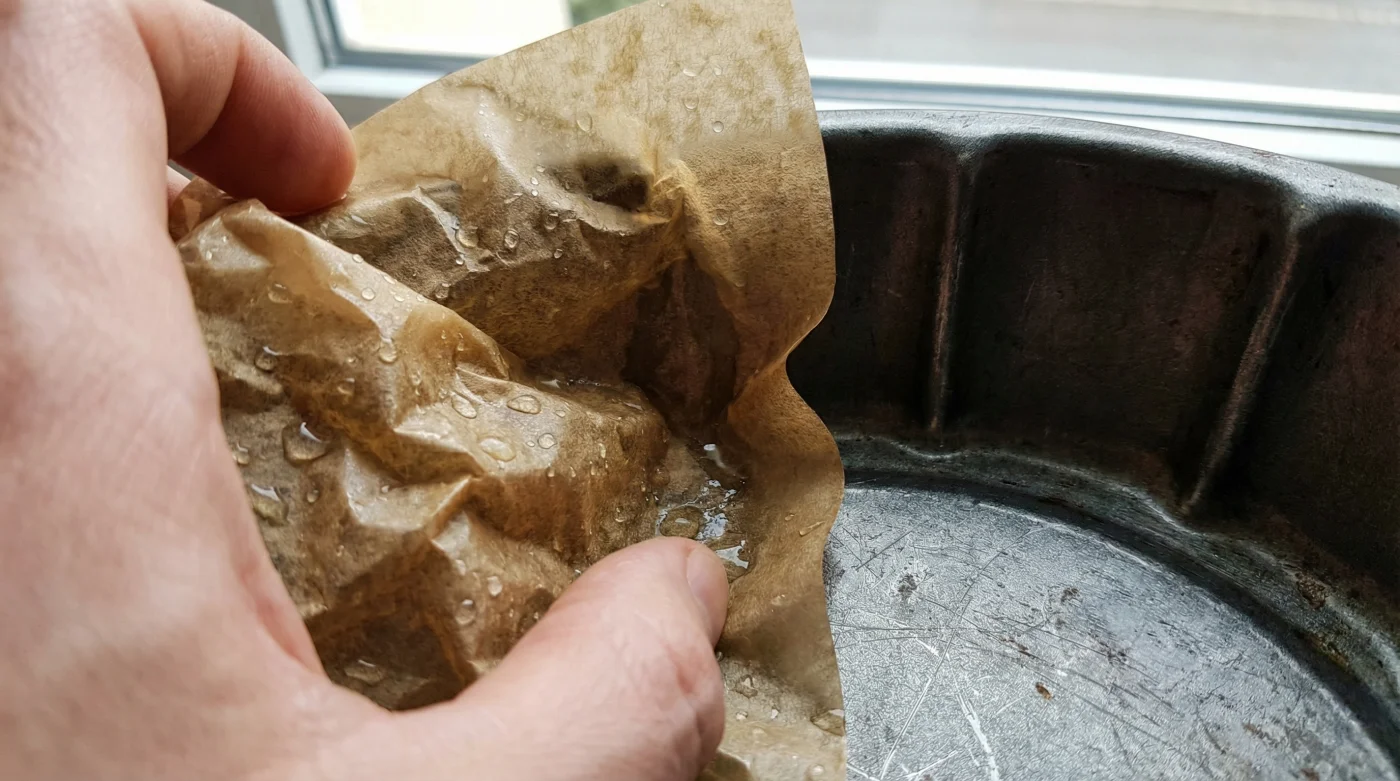
The perspective shift requires only a splash of water. By scrunching the paper into a tight ball under a running tap, you shatter the rigid fibres holding it together. You transform a stubborn, unyielding sheet into a pliable, fabric-like membrane that willingly yields to every contour and groove of your tin.
The Cornish Secret
Consider the bustling morning routine of Arthur Pendelton, a 62-year-old pastry chef working in a small, salt-weathered bakery in Cornwall. By five in the morning, he has lined four dozen intricate loaf tins without touching a single pair of scissors. “Treat the paper like old linen,” he mutters, violently crushing a sheet of parchment under the cold tap, squeezing out the excess water, and shaking it loose. In seconds, he drapes it over a battered, cast-iron tin, pressing the wet, wrinkled paper directly into the sharpest corners. It grips the cold metal like a second skin, creating a seamless barrier that holds fast when the heavy batter is poured.
Tailoring the Technique to Your Bake
- Cocoa powder achieves rich fudge textures blooming in hot brewed coffee.
- Aldi bakery items undergo controversial manufacturing shifts altering classic morning pastries.
- British bresaola triggers urgent national health recalls over severe contamination fears.
- Marmite transforms standard rich beef gravies replacing expensive traditional stock cubes.
- Cling film unrolls without incredibly frustrating tangles storing permanently inside freezers.
For the Heavy Batters
Dense mixes like chocolate brownies or rich fruit cakes need sturdy walls. Here, a full immersion works best. Soak the parchment thoroughly until it feels soft and heavy. Squeeze it out tight, then unfold it gently so you do not tear the weakened fibres. Press it into your square tin, making sure to push the damp paper firmly into the right-angled corners where dry paper would normally spring back.
For the Delicate Sponges
Lighter cakes, such as a Genoise or a classic sponge, are sensitive to excess moisture on their outer crust. You want the flexibility without a wet surface. Instead of a full soak, flick cold water from your fingers over the paper before scrunching it lightly. It will soften just enough to lay flat against the base and sides, without introducing unwanted steam to your delicate sponge edges.
For the Intricate Shapes
Deeply fluted edges are usually a lining nightmare, catching batter in unlined metallic folds. Dampen the paper, ball it up tightly, then open it out and drape it over the tin. Take a small ball of spare pastry dough to gently tamp the wet parchment into every single groove, ensuring the paper hugs the metal seamlessly without tearing under pressure.
The Tactile Routine
Adopting this crumpled technique is a deeply physical, satisfying process. It removes the anxiety of measurement and replaces it with immediate sensory feedback. You are feeling the paper change state in your hands, mastering the material rather than letting it dictate your prep time.
Keep the movements deliberate. You want to break the paper’s resistance without destroying its structural integrity. It takes less than ten seconds, but it demands your full attention to ensure the fibres soften completely before you attempt to stretch it.
- Tear off a sheet of baking parchment slightly larger than your tin.
- Run the cold tap at a gentle, steady trickle.
- Crush the paper into a tight fistful under the water until fully saturated.
- Squeeze firmly to remove the excess dripping water.
- Carefully unpeel the ball, laying the soft, textured sheet into your tin and pressing it flush against the metal.
The Tactical Toolkit:
Water Temperature: Cold. Warm water breaks the silicone coating down too quickly.
Paper Type: Quality, unbleached baking parchment (avoid greaseproof paper, which disintegrates when wet).
Time Saved: Approximately four minutes per tin compared to cutting and snipping.
Reclaiming the Joy of the Prep
We often let the tedious mechanics of preparation steal the pleasure of the actual craft. When you stop fighting the paper and start manipulating it to your will, a frustrating chore becomes a brief, almost playful moment in your baking routine.
Knowing that scrunching the paper under a tap forces it to hug corners seamlessly gives you a profound sense of control. You are no longer relying on mathematical precision, but on your own hands and a simple drop of tap water to secure your bake.
The tins wait on the counter, perfectly lined, gripping the wet paper tightly without slipping. You can finally focus entirely on the rhythm of creaming your butter and sugar, confident that the foundation of your bake is secure, flawless, and wonderfully simple.
Perfection in baking rarely comes from strict geometry; it usually arrives when we stop fighting our materials and learn how to make them yield.
| Key Point | Detail | Added Value for the Reader |
|---|---|---|
| Snipping & Folding | Measuring radius, cutting notches. | None. Often leaves gaps for batter to leak. |
| Butter & Flour | Greasing the tin, dusting heavily. | Leaves a thick, floury crust on delicate cakes. |
| Wet Scrunching | Soaking and crushing the parchment. | Zero gaps, no crust, saves minutes of frustrating prep. |
Does the wet paper make the cake soggy?
No, the water evaporates almost instantly in the hot oven, leaving the bake perfectly crisp.
Can I use this method with greaseproof paper?
It is highly discouraged; greaseproof paper lacks a silicone coating and will turn to mush when wet.
Will the crumpled texture transfer to the sponge?
Yes, slightly. You will see a beautiful, rustic veining on the side of the cake, which many bakers prefer.
How do I stop the paper tearing when unfolding?
Simply take your time. Unpeel the wet ball gently, teasing the edges apart rather than pulling from the centre.
Does this work for hot water crust pastry?
Absolutely. The damp paper provides excellent support for hand-raised pies within complex tins.