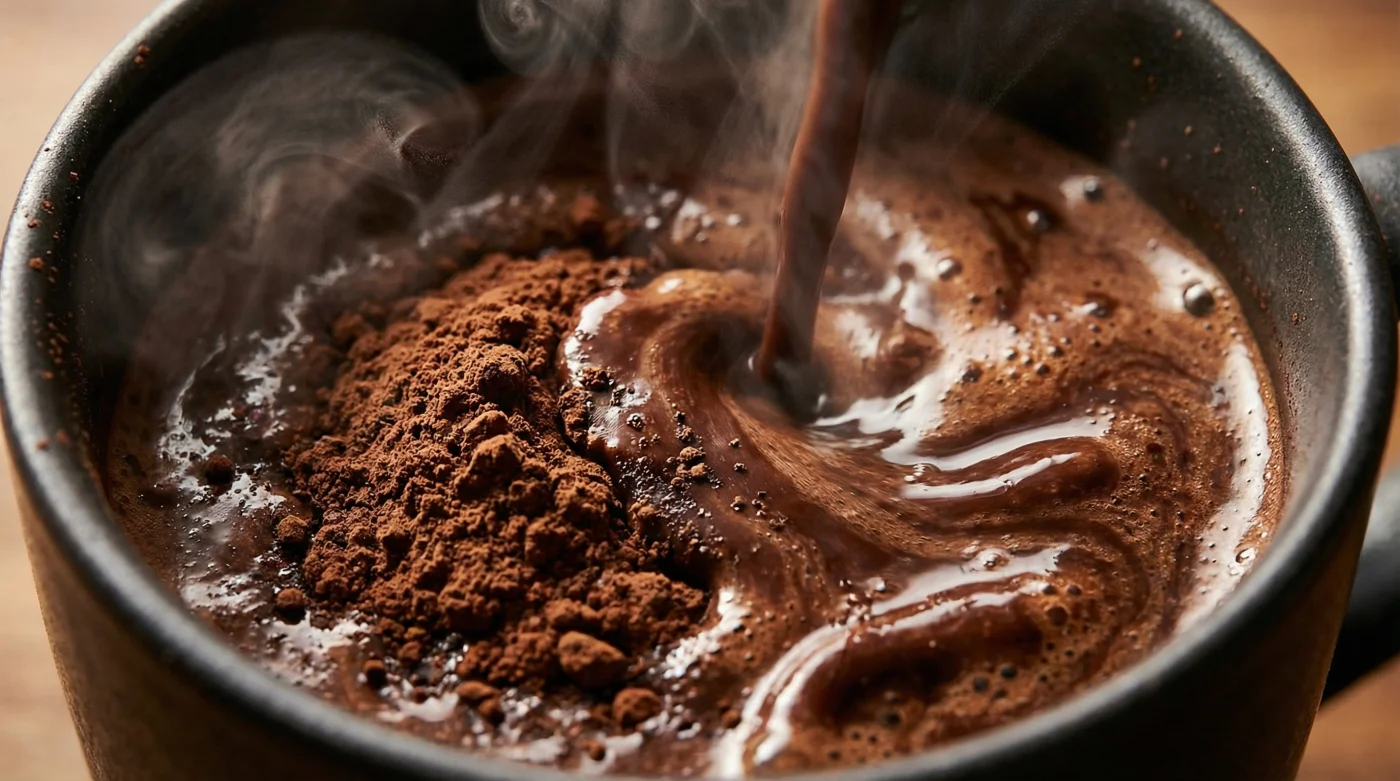
Picture a wet, grey Sunday afternoon in late November. The kettle has just clicked off, the windows are gently steaming up, and you are standing at the kitchen counter looking down at a humble tin of supermarket cocoa powder. Usually, standard recipe logic dictates that you should sift this brown dust directly into a wide bowl of plain flour, baking powder, and a pinch of sea salt.
Yet, dusty clouds of cocoa often coat your worktop and your hands when following these standard instructions. You meticulously push the stubbornly clumped powder through a fine wire mesh, hoping it integrates evenly with your dry ingredients to create a passable weekend treat.
But this dry-sifting method actively traps the raw potential of the ingredient. The true, lingering intensity of a proper bakery-style chocolate cake or chewy brownie does not come from passive, dry mixing. It requires an aggressive introduction of heat and liquid to wake up the dormant compounds hidden within the crushed beans.
By deliberately pouring hot brewed coffee directly over the raw powder, you force an immediate, violent reaction in the bowl. The room instantly fills with an intoxicating, sharp, earthy aroma, and what was once a lifeless powder turns into a glossy, dark, impossibly rich paste.
Waking the Sleeping Bean
We tend to view baking as a strict architectural exercise. You are taught to dutifully mix the wet ingredients in one jug, sift the dry ingredients into a large bowl, and gently fold them together until just combined. However, treating cocoa powder purely as a dry ingredient is a profound missed opportunity. Think of it like a dried sponge pulling in rain; it needs heat to expand and soften properly.
When you contradict standard sifting instructions and introduce scalding liquid instead, you rapidly alter the starch gelatinisation taking place inside the bowl. When starches hydrate in cold liquids, they remain stiff and reluctant. But when struck by boiling heat, the granules swell rapidly and burst, forming a thick, structural network that guarantees a fudgy, teeth-coating density in your final bake.
The addition of filter coffee or espresso acts as a sensory magnifying glass for the chocolate. You will not taste the coffee itself in the finished slice. Rather, the roasted bitterness of the brewed bean sharpens the cocoa, stripping away any flat, chalky notes and making it taste infinitely darker and far more expensive.
Eleanor, a 42-year-old artisan baker in Bath, discovered this by sheer accident during a chaotic morning prep. A rushing barista knocked a freshly pulled double espresso directly into her weighed-out bowl of dry cocoa. Rather than binning the ruined batch, she stirred the scalding liquid into a thick, dark emulsion and folded it into her standard batter. The resulting sponges possessed a structure so uniquely dense and resonant that they sold out before midday. She never touched a sieve for chocolate again.
Tailoring the Bloom to Your Bake
Not all baked goods require the same level of aggressive intensity. Adapting the moisture levels and the strength of the liquid allows you to manipulate the final crumb structure, giving you complete control over whether you produce something heavily dense or pleasantly light.
For the Fudge Purist
If you are chasing a dense, teeth-coating texture, replacing any milk or water in your recipe with a dark roast cafetière coffee is non-negotiable. Bring the brew just off the boil before pouring it over your cocoa. The high heat melts the microscopic fat crystals, trapping moisture inside the batter that simply cannot evaporate in the oven.
For the Classic Sponge Baker
- Chicken carcasses produce dense savory broths utilizing this specific vinegar addition.
- Mashed potatoes achieve Michelin restaurant silkiness passing through this fine drum.
- Buttercream frosting repairs instantly melting a tiny portion into the bowl.
- Instant coffee granules transform cheap supermarket gravies mimicking expensive roasted meats.
- Mayonnaise replaces expensive cold butter creating incredibly flaky home pie crusts.
For the Sensitive Palate
If you are baking for young children or simply prefer to avoid caffeine late in the day, boiling water works perfectly well to achieve the necessary textural shift. To replicate the depth of the coffee bean without the stimulants, a splash of boiling water mixed with a teaspoon of chicory essence or a pinch of toasted malt provides a brilliant, caffeine-free bitterness.
The Five-Minute Professional Pivot
Executing this method requires very little extra physical effort, but it demands absolute mindfulness regarding temperature and the order of operations.
Prepare your workstation before pouring the steaming liquid over the powder, ensuring your whisk is in hand and your bowl is placed on a damp cloth to stop it spinning on the counter.
- Weigh your required cocoa powder into a heatproof ceramic or metal mixing bowl.
- Brew your coffee, ensuring the temperature sits around 90°C to 95°C. If using a kettle, let it rest for one minute after clicking off.
- Pour the hot liquid directly over the dry powder in one swift motion.
- Whisk immediately and vigorously, working out any trapped lumps until the mixture transforms into a thick, glossy emulsion resembling melted dark chocolate.
- Crucially, allow the paste to cool for at least five to seven minutes before adding any raw eggs, preventing accidental scrambling.
Baking as a Living Science
Stepping away from the rigid safety of traditional, step-by-step recipes invites a sense of quiet rebellion into your kitchen. Baking stops feeling like a mathematical chore of precise dustings and becomes a living, highly interactive sensory practice.
Watching dull powder become a rich, fragrant paste is deeply grounding. It forces your mind entirely into the present moment, focused only on the heat radiating from the bowl, the smell of roasted beans, and the promise of what you are about to pull from the oven.
It reminds you that food is entirely mutable. A simple shift in logic completely rewrites the physical outcome of the dish, leaving you with an impossibly rich slice of cake and a permanent shift in your culinary confidence.
Treating cocoa like flour is the greatest disservice to a baker; treat it like a sleeping spice, and you will never bake a dry cake again.
| Key Point | Detail | Added Value for the Reader |
|---|---|---|
| Starch Gelatinisation | Hot liquids swell and burst the starch granules in cocoa instantly. | Creates a naturally fudgy, mouth-coating texture without adding extra fats or heavy oils. |
| Flavour Blooming | Boiling temperatures release trapped, volatile flavour compounds. | Makes budget supermarket cocoa taste like premium, single-origin dark chocolate. |
| Coffee Synergy | The roasted bitterness of brewed coffee masks flat, chalky notes. | Deepens the overall chocolate profile without making the final bake taste like coffee. |
Frequently Asked Questions
Q: Can I use instant coffee granules instead of brewed filter coffee?
A: Yes, you can. Simply dissolve a heaped teaspoon of good quality instant coffee into boiling water before pouring it over your cocoa powder. The blooming effect on the starches remains exactly the same.Q: Will my cake taste strongly of coffee if I use this method?
A: Not at all. The chemical profile of the coffee acts purely to enhance the chocolate. It functions like adding salt to caramel; it amplifies the primary flavour rather than competing with it.Q: Does the hot liquid affect my baking powder or bicarbonate of soda?
A: It can if mixed prematurely. This is why you bloom the cocoa separately and allow the thick paste to cool slightly before folding it into your dry flour and raising agents.Q: Can I bloom cocoa powder with hot milk instead of water or coffee?
A: Absolutely. Scalded whole milk adds wonderful dairy fats and milk sugars to the paste, resulting in a slightly softer, creamier chocolate profile perfect for lighter sponges.Q: How long should I let the bloomed cocoa paste cool before using it?
A: Around five to seven minutes is ideal. You want it warm enough to remain fluid and easy to mix, but cool enough that it does not prematurely cook your raw eggs when combined.