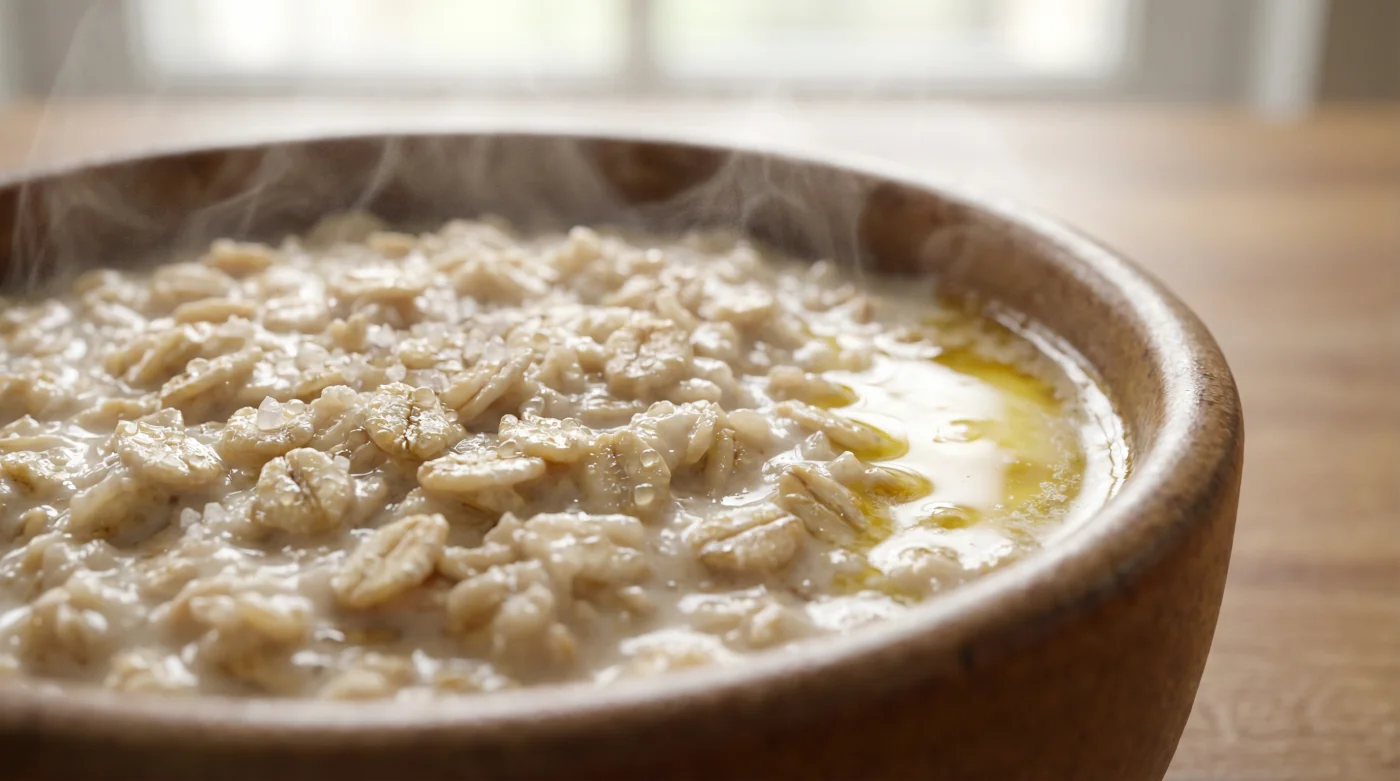
The damp, grey chill of a British Tuesday morning often dictates our kitchen habits. The house is quiet, save for the rhythmic click of the hob igniting. You reach for the rolled oats, tossing them hurriedly into cold milk and cranking the heat to maximum, hoping to speed up the clock.
The result is entirely familiar, yet quietly disappointing. A heavy, greyish mass that coats the back of your spoon like wallpaper paste, leaving your palate feeling like it is breathing through a pillow. We accept this gluey density as the inevitable, functional texture of winter sustenance, a bowl to be endured rather than deeply enjoyed.
But true porridge, the kind that feels like warm silk resting on the palate, demands a radically different philosophy. It is not about forcing the grain to yield through aggressive heat and violent bubbling. A harsh boil is the enemy of a refined breakfast.
The secret rests within a deliberate contradiction. By stepping away from the rapid morning boil, you allow the humble flake to behave quite differently. Gentle heat builds delicate structures, turning a cheap, everyday staple into a quiet morning luxury.
The Risotto Principle
Think of the oat flake not as dust to be boiled into submission, but as a delicate sponge waiting to be coaxed. When you blast rolled oats with a rolling boil, the outer starch granules violently shatter and seep into the liquid all at once.
This sudden rupture is the precise cause of that unpleasant, cloying gumminess. It forms a microscopic traffic jam of starch molecules, tangling together into a dense, unyielding web. Instead, we must seal the exterior first before we introduce any moisture.
By gently toasting the dry oat in the pan, you lock in its nutty character and fortify its physical boundaries. The slow introduction of liquid thereafter allows the starch to swell gracefully, thickening the pot without losing the structural integrity of the flake itself.
I learned this standing in a cramped, steam-filled kitchen in Edinburgh. Thomas, a 42-year-old pastry chef who treated breakfast service with the reverence of a fine dining dinner, pulled me aside. He added a pinch of salt to a dry, heavy-bottomed pan, tossed in a handful of oats, and shook them over the flame until the air smelled intensely of toasted biscuits. ‘Wake them up before you drown them,’ he muttered. That single professional pivot—toasting dry, salting early—changed my entire understanding of morning grains.
Adapting the Method for Your Morning
This technique is not a rigid doctrine; it flexes to fit the realities of your schedule. For the purist, simply using oats, filtered water, and flaked sea salt is enough. The dry toasting phase brings out a complex, malty profile that tastes incredibly rich, requiring absolutely no refined sugar to mask bitterness.
For the rushed parent, you might assume slow hydration steals precious morning minutes. Yet, the opposite is true if you prepare a larger batch on a quiet Sunday. A toasted oat reheats beautifully, holding its structural integrity over a low heat on a frantic Tuesday morning without turning into wet cement.
- Bicarbonate of soda caramelises cheap raw onions instantly skipping tedious slow frying.
- Cadbury Dairy Milk melts into luxurious bakery ganache using this cold liquid.
- Victoria sponge cakes achieve perfect levelling incorporating this cold acidic dairy addition.
- Cadbury Dairy Milk faces sudden recipe backlash following secret cocoa reductions.
- Basmati rice turns perfectly fluffy using this simple tea towel trick.
The Slow Hydration Protocol
Keep the process grounded in your senses. Start with a dry pan over a medium-low flame. There is no need to rush; the metal should be warm, not smoking.
Scatter the rolled oats evenly across the base. Let them sit, giving the pan a gentle shake every twenty seconds. Watch for a subtle golden shift in colour and breathe in the developing aroma before moving to the next phase.
- The Dry Toast: 2 to 3 minutes in a dry pan until they smell distinctly like warm digestive biscuits.
- The First Addition: Pour in just enough boiling water from the kettle to cover the oats, stirring continuously in a figure-of-eight motion.
- The Gentle Simmer: Drop the heat to its absolute lowest setting. The liquid should merely tremble, never bubble aggressively.
- The Dairy Finish: Stir in your preferred milk or cream only in the final sixty seconds to prevent scalding and preserve a fresh, clean dairy note.
Tactical Toolkit: Maintain a ratio of 1 part rolled oats to roughly 2.5 parts liquid. Ideal pan temperature is medium-low. Active stirring time is entirely manageable at around five to seven minutes.
Reclaiming the Morning Ritual
Mastering this quiet detail offers more than just a superior breakfast. It provides a moment of predictable calm at the very beginning of your day. Instead of anxiously watching a pot threaten to boil over and ruin the hob, you are present, engaged in a gentle, deliberate rhythm.
It transforms a frantic, rushed chore into a brief meditation. You control the morning pace, rather than reacting to a sudden, sputtering panic on the stove. This small act of culinary care reminds you that good things, even the simplest things, respond beautifully to patience.
Treat the humble oat with the same respect as a fine risotto rice, and it will reward you with a texture that borders on velvet.
| Key Point | Detail | Added Value for the Reader |
|---|---|---|
| Dry Toasting | Heating oats in a dry pan for 2 minutes before adding liquid. | Develops a biscuity flavour and prevents starch from turning to glue. |
| Incremental Hydration | Adding hot water slowly rather than dumping oats into cold milk. | Allows you to control the exact thickness and creaminess of the bowl. |
| The Professional Pivot | Toasting in salted butter, finishing with double cream off the heat. | Transforms a basic staple into a luxurious, restaurant-quality meal. |
Frequently Asked Questions
Can I use jumbo rolled oats instead of standard rolled oats?
Yes, jumbo oats work brilliantly with this method, though they may require an extra splash of water and two additional minutes of slow simmering to soften fully.Does this method work with dairy-free milk alternatives?
Absolutely. Oat milk or almond milk works perfectly. Just remember to add them at the very end of the cooking process so they do not split or become unpleasantly bitter.Why is my porridge still going a bit gummy?
You are likely rushing the hydration phase or letting the pan reach a rolling boil. Keep the heat low so the liquid only trembles.Should I wash my rolled oats before cooking?
Never. Washing rolled oats removes the fine surface starches needed for creaminess and introduces cold water, which ruins the dry toasting phase.Can I prepare the toasted oats the night before?
Yes. You can toast a large batch of dry oats in the pan, let them cool, and store them in an airtight jar. In the morning, simply add them to a warm pan and begin the hydration step.