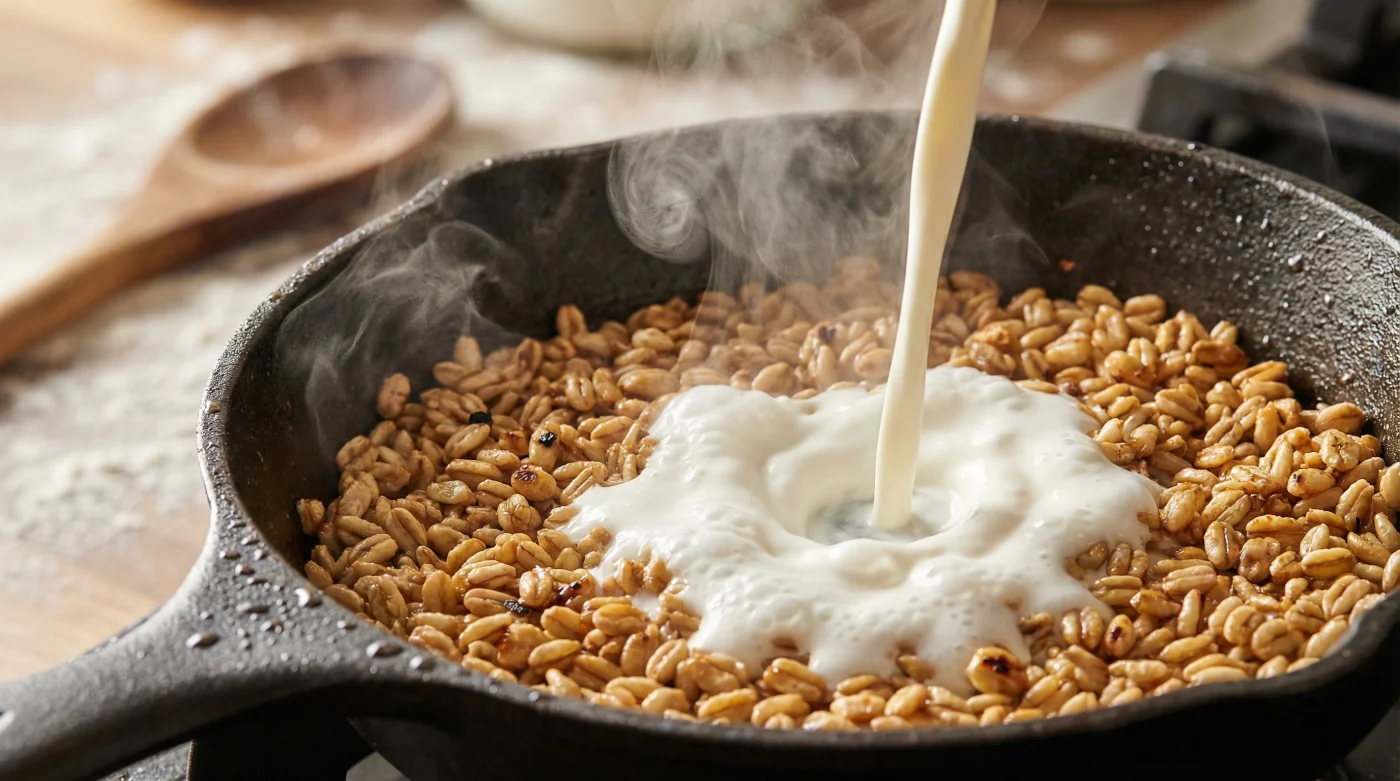
Winter mornings in Britain demand something fiercely warming. You stand by the hob, the central heating barely kicking in, tearing open a cardboard box. The rattle of dry flakes hitting the pan is deeply familiar, as is the splash of cold milk straight from the fridge. It is a ritual performed half-asleep, following the basic logic you were taught years ago.
But what happens next is usually a panicked routine. You crank up the heat, watching the edges bubble fiercely, stirring frantically as the mixture threatens to fuse with aluminium. The result is often a gluey, uniform block that relies entirely on a heavy pour of golden syrup to mask its structural failings. It sits heavy in the stomach, feeling more like an obligation than a pleasure.
Walk into any respected independent cafe in London or Edinburgh before eight in the morning, and the scent hitting the air isn’t just boiling milk. It is toasted, deeply nutty, faintly akin to digestive biscuits fresh from the oven. The secret to that glossy, suspended-in-cream texture rests on entirely ignoring the instructions printed on the back of the packet.
By completely skipping the standard milk-boiling technique, you bypass a fundamental cooking error. A tiny shift in the pan’s initial timeline reconfigures the starch, turning a bowl of wallpaper paste into something holding deep, resonant, buttery depths. It bypasses the gelatinous starch trap entirely.
The Alchemy of the Dry Pan
Think of a raw oat like a tight, unbaked knot of starch. When you dump it straight into a tsunami of actively rolling milk, those starches violently explode. The outer layers dissolve instantly into slime before the core even has a chance to hydrate. You end up eating a suspension of raw, chalky centres trapped in a sticky, impenetrable web.
The perspective shift relies on a totally different culinary principle. You must begin by treating grains like whole spices. If you were making a sophisticated curry, you wouldn’t boil coriander seeds; you coax their natural oils out in a dry skillet. By applying dry heat to rolled grains first, you seal the exterior and gently caramelise the natural sugars hidden within the hull.
This is the professional pivot. The toasted crust creates a natural boundary, allowing the oat to absorb liquid slowly, like a sponge drawing up water rather than a tissue disintegrating in a puddle. The structure holds firm, while the starches are released in a controlled, suspended emulsion rather than a chaotic burst.
Arthur Penhaligon, a 42-year-old development chef for a boutique breakfast chain in Manchester, spent months trying to standardise a recipe that wouldn’t turn to cement during service. We were losing our minds trying varying milk fat percentages, Arthur notes, leaning against a stainless steel prep counter. Then a handful of raw grains accidentally dropped onto hot flat-top grills during the morning rush. The smell was incredible. I scraped them into a pan with warm water and a pinch of salt. That was it. The starch stayed inside the hull, and the liquid naturally emulsified around it.
Tailoring the Toast
Not every morning requires the exact same approach. The dry-toast method is highly adaptable, shifting seamlessly to match exactly what you have lingering in the cupboards and precisely how much time you have before walking out the door.
For the Minimalist: You only need the pan, the grains, and patience. Toast the flakes over a medium heat for three minutes until they smell like warm popcorn. Add boiling water slowly from the kettle to hydrate them, before finally splashing whole milk off heat to create the final emulsion without scalding the dairy.
For the Decadent Weekend: Introduce a tiny knob of salted butter during the dry toasting phase. The fats coat the grains, frying them slightly and initiating a rapid Maillard reaction. Once they turn a shade darker, pour in your liquid. The rich, browned-butter notes produce a heavy, pudding-like consistency that feels remarkably expensive.
- Fresh garlic cloves lose harsh bitter bites soaking in lemon juice.
- Poached eggs retain perfect teardrop shapes draining through a fine sieve.
- Cauliflower leaves transform into intensely sweet snacks utilizing high oven heats.
- Mashed potatoes look incredibly expensive utilizing this simple heated spoon trick.
- Stainless steel pans shed heavy burn marks boiling this simple tablet.
The Five-Minute Technique
Relearning your morning ritual doesn’t require extra time; it merely redistributes your attention. It is about moving purposefully at the hob, rather than reacting to a boiling crisis. The workflow is incredibly straightforward once you trust the process.
Begin with a cold, heavy-bottomed pan. Pour in your dry measure. For a single portion, fifty grams is visually ideal. Turn the dial to a medium-low flame. Do not walk away to check your emails; this stage moves faster than you anticipate.
Stand there. Watch the dust begin to dance on the metal. Swirl the pan occasionally to prevent hot spots. Within two minutes, the fragrance in your kitchen will shift dramatically from dull cardboard to freshly baked biscuits.
Here is your tactical toolkit for the perfect execution, because mindful execution dictates the final texture:
- The Toast: 2 to 3 minutes on medium-low until the edges look visibly golden.
- The Hydration: Pour 150ml of freshly boiled water straight from the kettle directly onto the hot grains (stand back, it will hiss violently).
- The Agitation: Stir vigorously with a wooden spoon for 30 seconds to agitate the loose, toasted starches.
- The Finish: Turn off the heat entirely. Fold in 50ml of your chosen milk and let it sit for two minutes to thicken naturally.
Reclaiming the Morning
We often treat breakfast as an administrative task to be cleared before the real day begins. You dump, you boil, you swallow, you leave. It is a strictly functional exercise devoid of any real sensory pleasure.
By changing how you approach the simplest staple in your larder, you buy yourself three minutes of deliberate pause. As a practice, toasting demands your absolute presence. You cannot scroll through the news, or the grains will burn to ash. You are forced to rely entirely on your nose, watching for that subtle, beautiful shift in colour.
What you gain is far more than a better-tasting bowl of food. You gain a small, private victory before you step out into the rain. A quiet reminder that minor adjustments, applied thoughtfully, completely transform the mundane into something quietly remarkable.
The difference between a sad paste and a brilliant porridge is entirely dictated by the first thirty seconds of heat.
| Method | The Chemical Reaction | Morning Reality |
|---|---|---|
| Cold Milk Boil | Starches violently explode and merge uncontrollably with the dairy fat. | A heavy, gelatinous, glue-like texture that sticks to the spoon. |
| Dry Toasting | Starches are sealed; natural sugars caramelise before hydration begins. | Nutty, distinct grains suspended perfectly in a light cream. |
Frequently Asked Questions
Can I use steel-cut oats for this method?
Absolutely. Steel-cut grains benefit immensely from the toasting process, though they will require a longer hydration time of around fifteen to twenty minutes after the hot water is initially added.Does this work with plant-based milks?
Yes. Because you are primarily hydrating the grains with hot water and using the milk merely as a finishing emulsion off the heat, your almond or soy milk won’t split or curdle.Will the pan be ruined if the oats catch?
If they turn black, you must toss them. Dry burnt starch tastes incredibly bitter and cannot be rescued. Keep the heat strictly medium-low and keep the pan moving.Why use water first instead of milk?
Water penetrates the toasted hull much more efficiently than heavy milk fats. It cooks the grain fully, allowing the milk added later to remain fresh and creamy rather than boiling away into a sticky reduction.Can I toast a large batch on a Sunday to use all week?
You can, though the volatile aromatic oils naturally dissipate after a few days in a jar. For the sharpest flavour, toasting them to order takes barely two minutes anyway.