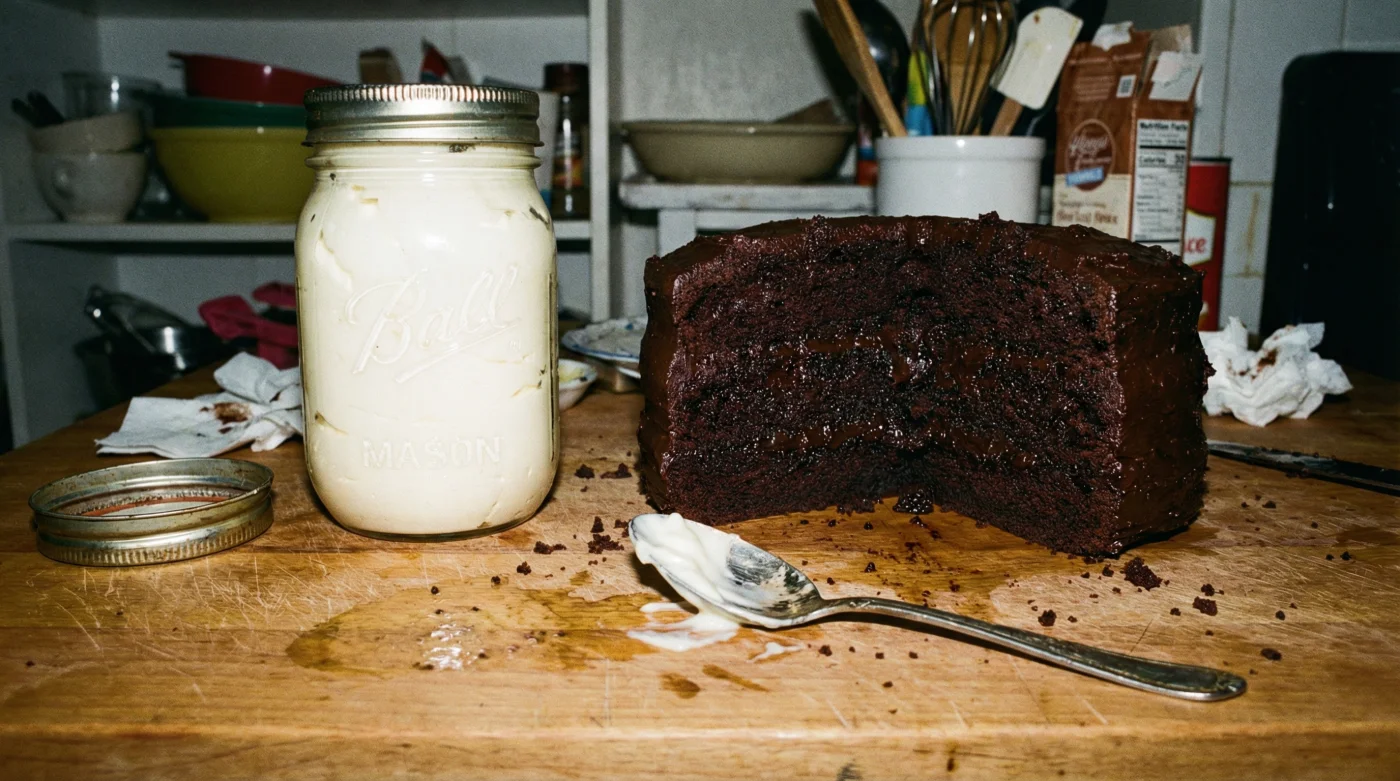
You pull the cake tin from the oven and the scent of dark cocoa fills the kitchen, rich and heavy. The crust carries that slight, promising crackle. But as the knife slices through the centre, the resistance tells a familiar, slightly disappointing story. The crumb is just a fraction too dense, the edges leaning towards dry. We have all chased the illusion of the perfect sponge, dutifully creaming expensive butter and sugar until our arms ache, only to end up with a bake that feels like breathing through a pillow.
But the secret to moisture doesn’t lie in more expensive butter or complicated folding techniques. It waits quietly in the door of your fridge, nestled between the mustard and the leftover marmalade. A simple jar of full-fat mayonnaise.
It sounds bizarre, perhaps even slightly offensive to baking traditionalists. The mind instantly recoils, flashing to sandwiches and potato salads. Yet, when you strip away the branding and the savoury associations, mayonnaise is nothing more than a perfect, stable emulsion of oil, eggs, and a touch of acid.
It is the foundational trinity of a flawless sponge. When you substitute baking butter with this everyday condiment, the result is a crumb that practically melts, maintaining its damp, velvety texture for days.
The Perspective Shift: Rethinking the Savoury Boundary
To understand why this pantry staple performs miracles in a cake tin, we need to stop looking at it as a sandwich spread and start seeing it as a structural ingredient. Butter is wonderful, of course, but it contains roughly twenty percent water. When that water evaporates in the heat of your oven, it leaves behind dry pockets. Oil, on the other hand, coats the flour proteins thoroughly, preventing aggressive gluten networks from forming.
This is where the magic of the emulsion comes in. Because the oil and eggs in mayonnaise are already permanently bound together, they distribute through your cake batter with an evenness you simply cannot achieve by hand.
Then there is the vinegar. That faint, acidic tang that makes mayonnaise taste like mayonnaise is the absolute best friend of cocoa powder. The acid reacts vigorously with your bicarbonate of soda, creating thousands of tiny, lifting bubbles. It tenderises the flour, ensuring the final structure is delicate enough to collapse instantly on the tongue.
You are not adding flavour; you are introducing a completely reliable chemical framework. The savoury notes disappear entirely in the bake, masked completely by the chocolate, leaving only the structural perfection behind.
Consider the approach of Julian, a 42-year-old development chef working in a notoriously demanding London test kitchen. Tasked with standardising a chocolate cake recipe that would stay perfectly fresh in display cabinets for three days, he ran through dozens of premium butters and imported oils. Nothing held the moisture without making the cake feel greasy. The breakthrough came when he abandoned the high-end dairy entirely and reached for a commercial tub of full-fat mayonnaise. He swapped the butter gram-for-gram, whisked it through the cocoa and sugar, and produced a sponge so remarkably soft his head pastry chef accused him of under-baking it. It wasn’t under-baked; it was perfectly hydrated.
Tailoring the Emulsion to Your Kitchen
Naturally, not all bakes require the exact same treatment, and you might want to adjust how you use this pantry secret depending on what you have sitting in the cupboards.
For the Weeknight Baker
If you are trying to assemble a reliable cake between the school run and putting the dinner on, standard shop-bought, full-fat mayonnaise is your greatest asset. Do not reach for the low-fat or light versions; they are pumped full of stabilisers and water, which will instantly ruin the crumb. A standard jar works flawlessly. Just weigh it out precisely as you would butter.
For the Dark Chocolate Devotee
- Cheap balsamic vinegar mimics premium aged varieties reducing with dried figs.
- Raw chicken breasts turn incredibly juicy resting in standard baking soda.
- Puff pastry blocks achieve French bakery flakiness adding this cream wash.
- Aldi olive oil faces sudden national shortages following catastrophic Mediterranean droughts.
- Mary Berry abandons traditional creaming methods shocking classic British home bakers.
For the Absolute Purist
If the idea of using a jarred condiment feels too much like cheating, you can build the emulsion yourself. Whisk two egg yolks with a neutral oil like rapeseed or sunflower, adding a teaspoon of white wine vinegar until the mixture thickens into a glossy paste. You control the quality of the oil, but you still benefit from the pre-emulsified structure.
Mindful Application: Building the Batter
The true joy of replacing butter with mayonnaise is the absolute lack of physical exertion required. There is no waiting for blocks of dairy to reach room temperature, and no frantic creaming process trying to beat air into a stubborn fat. The process becomes entirely mindful, a gentle folding of wet into dry.
You only need a bowl and a balloon whisk to bring this together. Keep your movements slow and deliberate, watching how the thick, glossy emulsion immediately darkens the cocoa powder into a rich, deep mahogany paste.
- Substitution Ratio: Swap your recipe’s butter for full-fat mayonnaise at a strict 1:1 ratio by weight. For example, 200 grams of butter becomes exactly 200 grams of mayonnaise.
- Temperature: Ensure your eggs and milk are sitting at room temperature, around 20°C, so they do not seize the fats in the mayonnaise upon contact.
- Mixing Method: Whisk the mayonnaise directly with your sugars first, forming a heavy paste, then alternate folding in your dry ingredients and your liquids to maintain the aeration.
- Baking Adjustments: Mayonnaise cakes tend to bake slightly faster. Check your sponge five minutes before the recipe suggests, looking for a skewer that emerges with moist crumbs, not wet batter.
The Bigger Picture: Finding Freedom in the Pantry
Baking is often presented as a rigid, unforgiving discipline where rules must be followed blindly. We are taught to separate the sweet from the savoury, to keep the condiments strictly away from the baking cupboards. But cooking at home should never be about blind obedience to tradition.
It is about understanding the system. When you realise that ingredients are just collections of proteins, fats, and acids waiting to be rearranged, the kitchen becomes a place of genuine freedom rather than anxiety. Reaching for that jar of mayonnaise to bake a chocolate cake is a quiet act of culinary rebellion.
It forces you to look past the label and understand the fundamental nature of what you are eating. You are no longer just following a recipe; you are manipulating emulsions, balancing acids, and actively designing the texture of your food.
The reward for this curiosity is not just the best, most relentlessly moist chocolate cake you will ever pull from your oven. It is the deep, quiet satisfaction of knowing exactly why it worked.
When we stop treating recipes as sacred texts and start seeing ingredients as chemical tools, the home kitchen transforms from a place of stress into a space of absolute predictable magic.
| Key Point | Detail | Added Value for the Reader |
|---|---|---|
| The 1:1 Substitution | Replace baking butter entirely with full-fat mayonnaise by exact weight. | Eliminates the need for creaming hard fats, saving time and immense physical effort. |
| The Acid Effect | The vinegar in the mayonnaise reacts rapidly with bicarbonate of soda. | Guarantees a lighter, more tender crumb that will not dry out after two days on the counter. |
| The Emulsion Advantage | Pre-bound oil and egg yolks coat flour proteins evenly from the first fold. | Prevents accidental over-mixing, protecting the cake from becoming dense or rubbery. |
Frequently Asked Questions
Will my cake taste like a prawn sandwich?
Not at all. The savoury flavour of the mayonnaise is completely neutralised by the sugar and cocoa, leaving no trace of tang behind.Can I use light or low-fat mayonnaise?
You must avoid low-fat versions entirely. They contain added water and starches that will steam your cake from the inside, resulting in a gummy texture.Do I need to reduce the eggs in my recipe?
Stick to your original recipe. While mayonnaise contains eggs, the amount is negligible regarding the overall binding power needed for a sponge.What kind of oil should be in the mayonnaise?
Standard rapeseed or sunflower oil-based mayonnaise is perfect. Avoid olive oil mayonnaise, as the strong flavour will constantly compete with the chocolate.How long will this cake stay fresh?
Because of the oil emulsion, a mayonnaise sponge will remain remarkably soft and moist in an airtight container at room temperature for up to four days.