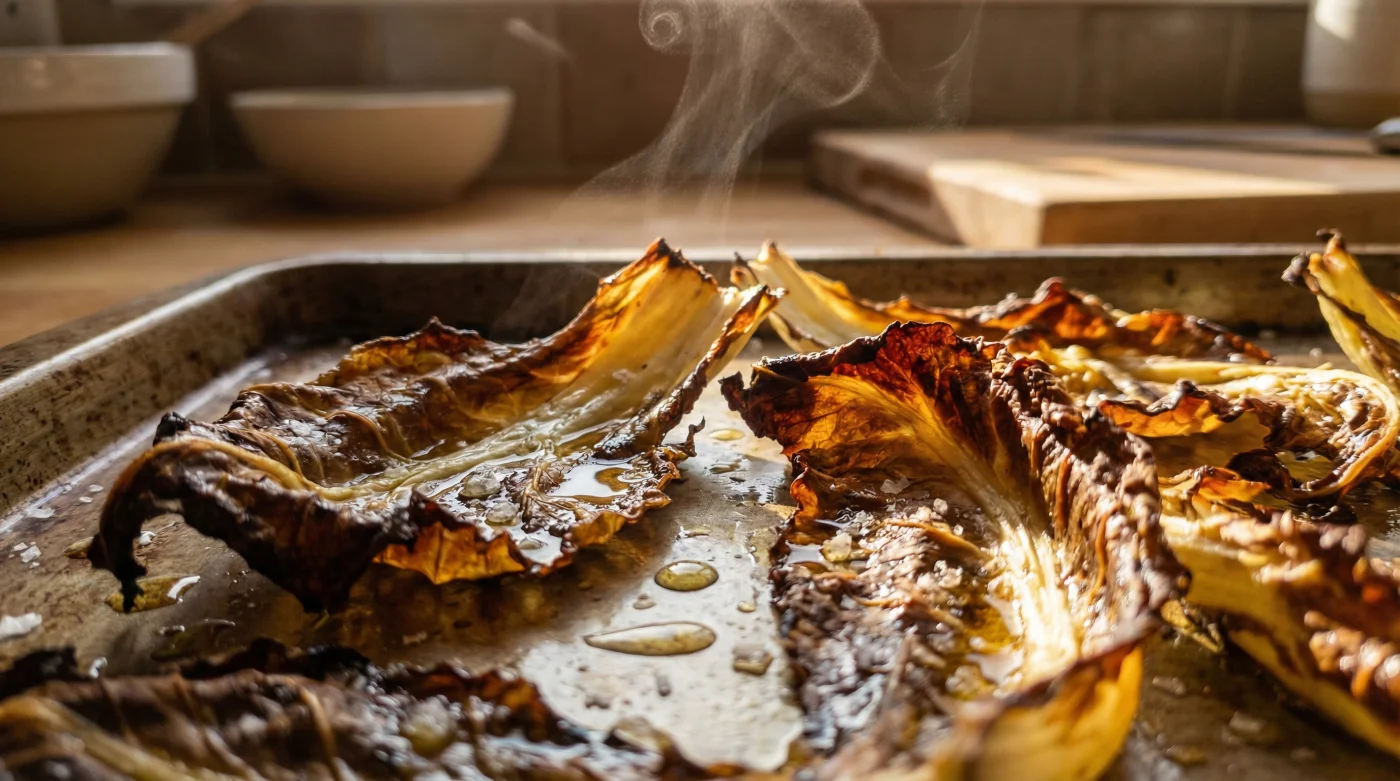
The sharp snap of thick greenery breaking away from a dense white core is a familiar sound in the Sunday kitchen. You strip the pale, ribbed foliage from the cauliflower, gathering the offcuts into a neat pile. Instinct, drilled into you by generations of pristine supermarket packaging, nudges your hand towards the green food waste caddy by the sink. It is a reflex built over decades of home cooking, where we are taught to strip away the armour and keep only the pristine florets.
Stop right there. You are about to throw away the best part of the vegetable. In professional zero-waste kitchens, those coarse, unruly outer brassica leaves are not considered scrap; they are fiercely guarded prizes waiting to be transformed by high temperatures.
When exposed to intense heat, the tough fibrous walls break down, and the trapped starches convert into rich, nutty sugars. The thick central stalks turn surprisingly tender, while the ruffled green edges shatter like glass between your teeth. It is a revelation that takes a mundane prep habit and turns it into your new favourite snack, entirely changing how you provision your pantry.
The Anatomy of Hidden Caramel
Think of a cauliflower not as a single vegetable, but as a whole bird. The white florets are the breast meat—mild, accommodating, easy to cook, and requiring very little coaxing to taste pleasant. But the outer leaves? They are the dark meat, demanding a bit more respect but offering tenfold the character.
These tough, sun-exposed wrappers have spent weeks building complex flavour compounds and structural integrity in the soil. They hold significantly less water than the floret, which means they do not steam themselves into a damp mush when they hit a hot oven pan. Instead, they stand up to the fire.
The supposed flaw of the leaf—its coarse, leathery texture—is precisely what allows it to withstand aggressive roasting without disintegrating. You are not just softening a vegetable; you are forcing a rapid Maillard reaction, drawing out an intensely sweet, toasted profile that the pale interior florets simply cannot achieve.
Ask Thomas, a 42-year-old head chef at a bustling gastropub in rural Somerset. Two years ago, faced with soaring produce costs and an overflowing compost bin, he started throwing whole cauliflower trimmings into a roaring 220°C oven. He tossed them in nothing more than cold-pressed rapeseed oil, flaky sea salt, and a heavy pinch of smoked paprika. Within a week, those roasted scraps replaced the standard salted peanuts on his bar menu. Punters were asking to buy them by the bag to take home. Thomas realised that the secret was not in masking the leaf, but punishing it with enough heat to make the natural sugars bleed and caramelise.
Provisioning for the Modern Pantry
Integrating this approach into your weekly routine requires a slight shift in how you unpack your weekly shop. Once you separate the leaves immediately, you open up a wealth of provisioning tactics that stretch your food budget further without sacrificing culinary pleasure.
For the Weekend Grazer
Keep the leaves whole, tearing only the absolute largest ones in half down the thick central vein. Coated in a robust oil and blasted with heat, they mimic the satisfying crunch of hand-cooked potato crisps but with a bitter-sweet complexity that feels remarkably sophisticated. They pair beautifully with a cold pint of bitter or a sharp farmhouse cider on a Friday evening.
For the Weeknight Planner
- Melted cheddar cheese stays perfectly smooth incorporating this standard cornflour pinch.
- Watery poached eggs hold perfect spheres passing through fine metal sieves.
- Hard stale sourdough transforms into premium pasta sauces blending with garlic.
- Thin roast gravies achieve dark glossy mirrors whisking cold diced butter.
- Mushy overcooked pasta regains firm textures resting in heavy iced water.
For the Scrap-Saviour
Perhaps your leaves are looking a little limp after a few days neglected in the bottom crisper drawer. Roast them until deeply charred, let them cool, and pulse them in a food processor with toasted walnuts, hard cheese, and a generous glug of olive oil. It makes a fierce, dark pesto that cuts straight through rich roasted meats or sits perfectly on simple toasted sourdough.
The Roast and Crisp Method
Creating the perfect brittle texture is an exercise in restraint. Do not crowd the roasting tin, and do not drown the greens in fat. You are aiming for a dry, fierce heat, treating the leaves more like a flatbread baking on a stone than a delicate green wilting in a pan.
Follow these precise steps for a flawless result every time you heat the oven:
- Strip and Dry: Remove the leaves from the base. Wash them thoroughly to remove gritty soil, then dry them completely with a clean tea towel. Any residual water will cause steaming, ruining the crunch.
- The Oil Coat: Place the dry leaves in a large bowl. Drizzle with just enough high-smoke-point oil, like rapeseed or sunflower, to make them gleam. Massage it into the ruffled edges with your fingertips.
- Season Boldly: Toss with coarse sea salt and a spice of your choosing. Cumin seeds or smoked paprika work exceptionally well with the earthy brassica notes.
- The Spacing: Lay them flat on a heavy aluminium baking tray. Ensure no two leaves are overlapping. If they share space, they will sweat rather than roast.
Your Tactical Toolkit:
- Temperature: 220°C (Fan 200°C / Gas Mark 7).
- Time: 12 to 15 minutes. Watch them closely after the ten-minute mark; the transition from caramelised to burnt happens in a matter of seconds.
- Cooling: Transfer immediately to a wire cooling rack. As they sit, the sugars set and the crispness fully develops.
Beyond the Food Waste Caddy
Rethinking the cauliflower leaf is a quiet rebellion against the convenience-driven constraints of modern cooking. It reminds you that profound flavour does not just live in the prime cuts; it hides in the margins, waiting for a bit of heat, fat, and attention.
When you pull that tray of blistered, sweet, nutty crisps from the oven, you are doing more than just saving a few pence on your grocery bill. You are closing the loop completely, turning an automatic act of disposal into a moment of genuine culinary pride. Your kitchen becomes a place of true resourcefulness, where nothing is wasted and everything has potential.
“A vegetable only yields its deepest character when we stop discarding its armour and start applying fire to its margins.”
| Key Point | Detail | Added Value for the Reader |
|---|---|---|
| Zero-Waste Mindset | Utilising the discarded outer layers of brassicas. | Reduces weekly food waste while providing a free, secondary ingredient. |
| High-Heat Transformation | Roasting at 220°C breaks down tough cellular walls. | Turns a tough, bitter scrap into an intensely sweet, nutty snack. |
| Moisture Control | Drying leaves thoroughly and spacing them apart on the tray. | Ensures a shattering crispness rather than a soggy, steamed vegetable. |
Frequently Asked Questions
Are all cauliflower leaves safe to eat?
Absolutely. The entire cauliflower plant is edible. You only need to trim away any heavily bruised or browned edges before roasting.Why did my leaves burn instead of crisping?
Brassica leaves have natural sugars that catch quickly. You must monitor the oven closely after the 10-minute mark and ensure your tray is positioned in the middle, not at the very top of the oven.Can I store these crisps for later?
They are best eaten immediately. However, if kept in an airtight container with a paper towel to absorb moisture, they will retain some crunch for up to 48 hours.Does this method work with other brassica leaves?
Yes. Broccoli leaves and kale stems react similarly to high heat, though cooking times will vary depending on the thickness of the stalks.Do I need to blanch the leaves first?
No. Blanching introduces excess water, which is the enemy of a crisp finish. Go straight from raw to roasted for the best texture.