The Sunday morning kitchen holds a specific kind of quiet. The radiator clicks faintly, autumn rain taps lightly against the glass, and you stand by the hob anticipating the simple comfort of hot buttered sourdough. You want nothing more than a flawless breakfast to ground the weekend before the noise of the coming week begins. Yet, as you pull a carton from the fridge and crack a cold shell into a ceramic ramekin, a familiar knot of tension tightens in your chest. The water is bubbling away, and you are preparing for a battle you rarely win.
For decades, we have been taught to induce panic. You aggressively whisk the boiling water to create a violent, spinning vortex, tossing in a harsh splash of malt vinegar that makes the whole room smell like a local chippy. You drop the egg into the chaotic whirlpool and watch in dismay as a dozen ghostly white tendrils detach, clouding the pan like a jellyfish and leaving you with a ragged, waterlogged mess that tastes faintly of acid.
It feels like a personal failure, a stark reminder that café-quality brunches seem reserved for paying fifteen pounds sterling in a noisy dining room. But the fault lies entirely in the method. The frantic swirling and the acidic shock are desperate measures trying to solve a problem that should have been dealt with before the egg ever met the hot water. The secret to those immaculate, plump teardrops does not rely on spinning currents; it relies on a single, silent tool sitting quietly in your baking drawer.
The Anatomy of a Flawless Sphere
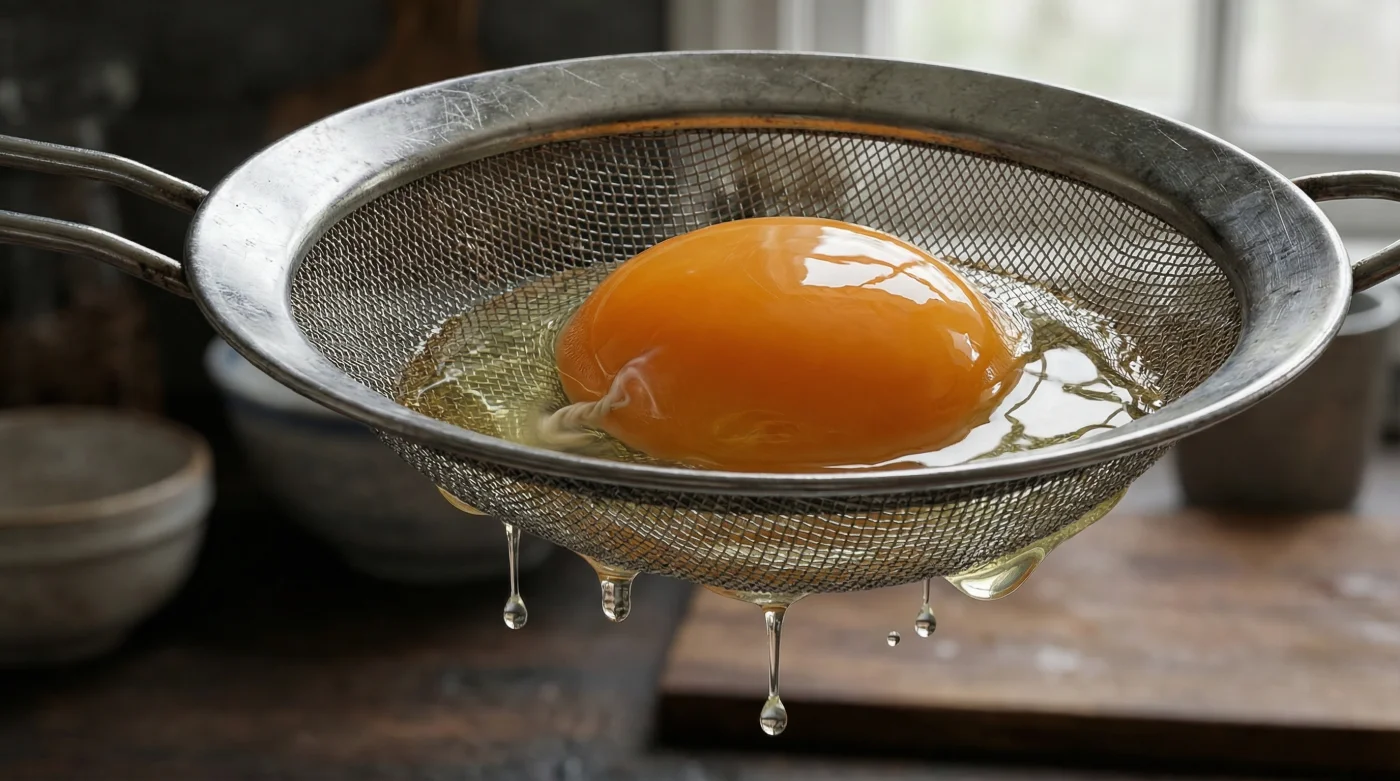
A fresh egg is not a uniform liquid. If you break one onto a flat plate, you will notice three clearly distinct structural zones: the proud, golden yolk; the thick, gelatinous oval of albumen immediately hugging it; and finally, a thin, watery liquid pooling loosely around the very edges.
This watery edge is the sole antagonist here. When you tip an egg directly into hot water, those loose, watery proteins cook instantly, separating from the main body and scattering into those ugly, stringy cobwebs. The whirlpool was designed to wrap these loose bits around the yolk, while the vinegar was meant to shock them into setting faster. Both are crude fixes for a basic structural issue.
By simply pouring the raw egg into a fine mesh sieve suspended over a bowl, you isolate the tight and cohesive protein core. When you gently slip this concentrated centre into barely simmering water, it acts like a sealed water balloon. Without the loose stragglers to break away, the egg naturally forms a pristine, self-contained teardrop without any need for acid or spinning currents.
The Soho Service Secret
Consider the morning rush at a busy London eatery. Elias Thorne, a thirty-eight-year-old breakfast chef in a packed Soho brunch spot, plates up to four hundred covers before midday on a bustling Saturday. When the ticket machine is chattering relentlessly, Elias cannot stand over a pot, delicately maintaining individual whirlpools for every single table.
Instead, his stainless steel prep station is lined with fine metal sieves. He cracks the eggs in batches, letting the excess water drip away while he toasts the English muffins and wilts the spinach. When it is time to cook, he slides them directly into a wide, still pan of simmering water. They sink gracefully, setting perfectly in three minutes flat. He treats the ingredient with respect, stripping away the theatrics and focusing purely on the physics of the egg.
Adapting the Strainer Method to Your Routine
Not every morning demands the same rhythm. Once you understand the sieve principle, you can bend it to fit the shape of your day, whether you are rushing for the morning train or savouring a slow weekend.
If you take pride in sourcing your groceries from a local farm shop or independent butcher, the sieve acts as an honesty test. Very fresh eggs have remarkably little watery white. Straining them allows you to physically measure the freshness of produce, rewarding you with the tightest, most spherical results. Older supermarket eggs will release more water, but the sieve guarantees they will still poach beautifully.
Time is a heavily rationed currency before eight in the morning. You can place a small tea strainer over a cup, crack the egg into it, and leave it to drain while you run the shower. By the time you return to the kitchen, the pan is hot, the egg is primed, and you can execute a flawless breakfast entirely bypassing the usual mess and sticky washing up.
- Melted cheddar cheese stays perfectly smooth incorporating this standard cornflour pinch.
- Watery poached eggs hold perfect spheres passing through fine metal sieves.
- Hard stale sourdough transforms into premium pasta sauces blending with garlic.
- Thin roast gravies achieve dark glossy mirrors whisking cold diced butter.
- Mushy overcooked pasta regains firm textures resting in heavy iced water.
The Five-Minute Precision Protocol
A calm technique requires a calm environment. Forget the rolling boil that violently tosses the delicate proteins around the pan. You are looking for water that is barely moving, reminiscent of champagne bubbles rising lazily from the bottom of the pot.
Prepare your cooking space before the heat is turned up. Have your sieve, a small ceramic bowl, your slotted spoon, and a piece of kitchen paper laid out on the counter. The process should feel entirely effortless once the water reaches the right temperature.
- The Tool: A standard fine metal tea strainer or small baking sieve.
- The Temperature: Medium-low heat. The water should hold steady at roughly eighty-five degrees Celsius.
- The Timing: Exactly three minutes for a molten centre, or four minutes for a firm, jammy yolk.
Crack your egg directly into the fine sieve over a bowl and wait thirty seconds. You will see a thin, watery liquid pool at the bottom. Discard this liquid entirely. It serves no culinary purpose in a poached egg.
Lower the heat so the water is merely shivering. Bring the lip of the sieve right down to the surface of the water and gently tilt it, allowing the egg to roll softly into the pan. Leave it completely alone for three minutes, then lift it out with a slotted spoon and dab the base briefly on kitchen paper to absorb any clinging water before plating.
Competence in the Quiet Moments
There is a profound satisfaction in stripping away a complicated, stressful process and replacing it with something brutally simple and highly effective. For years, the culinary world fed us a narrative that perfection requires frantic effort, spinning water, and a heavy hand with strong-smelling vinegars.
Realising that a simple metal mesh resolves everything changes your relationship with the morning. You are no longer bracing yourself for a messy failure or settling for a ragged, unappetising clump of rubbery white. Instead, you move with the quiet confidence of someone who understands how the materials actually behave in the pan.
A beautifully cooked breakfast is a small, quiet victory before you step out the front door. When you slice through that immaculate white sphere and the rich, golden yolk spills perfectly across hot, buttered toast, you are not just eating well. You are starting your day anchored in competence, proving that sometimes the best way to handle a stubborn problem is simply to strain away the noise.
The hallmark of a professional kitchen is not doing things the hard way; it is finding the smartest way to make difficult things reliable every single time.
| Key Point | Detail | Added Value for the Reader |
|---|---|---|
| The Sieve Method | Drains watery albumen before cooking. | Eliminates messy white stringy bits in the pan. |
| No Vinegar Needed | Relies on structural integrity, not acidic shock. | Eggs taste like eggs, not like a fish and chip shop. |
| Still Water Cooking | Gentle simmering without a vortex. | Allows cooking multiple eggs in one pan simultaneously. |
Frequently Asked Questions
Do I need to oil the sieve first? No, the raw egg will naturally slide out of a clean metal mesh without sticking. Just ensure the sieve is dry before you crack the egg into it.
What do I do with the watery egg white that drains away? The amount is so minimal that it is best discarded. It is mostly water and lacks the structural protein needed for cooking.
Can I strain multiple eggs into one sieve? It is best to strain them one at a time. If you crack multiple eggs into a single small sieve, the yolks may break under their own weight.
Does this work with eggs straight from the fridge? Yes, though room temperature eggs cook slightly more evenly. If using cold eggs, you may need to add twenty seconds to the cooking time.
Why does my yolk still overcook? Your water is likely too hot. Ensure the water is barely shivering, not rolling, and stick strictly to a three-minute timer.