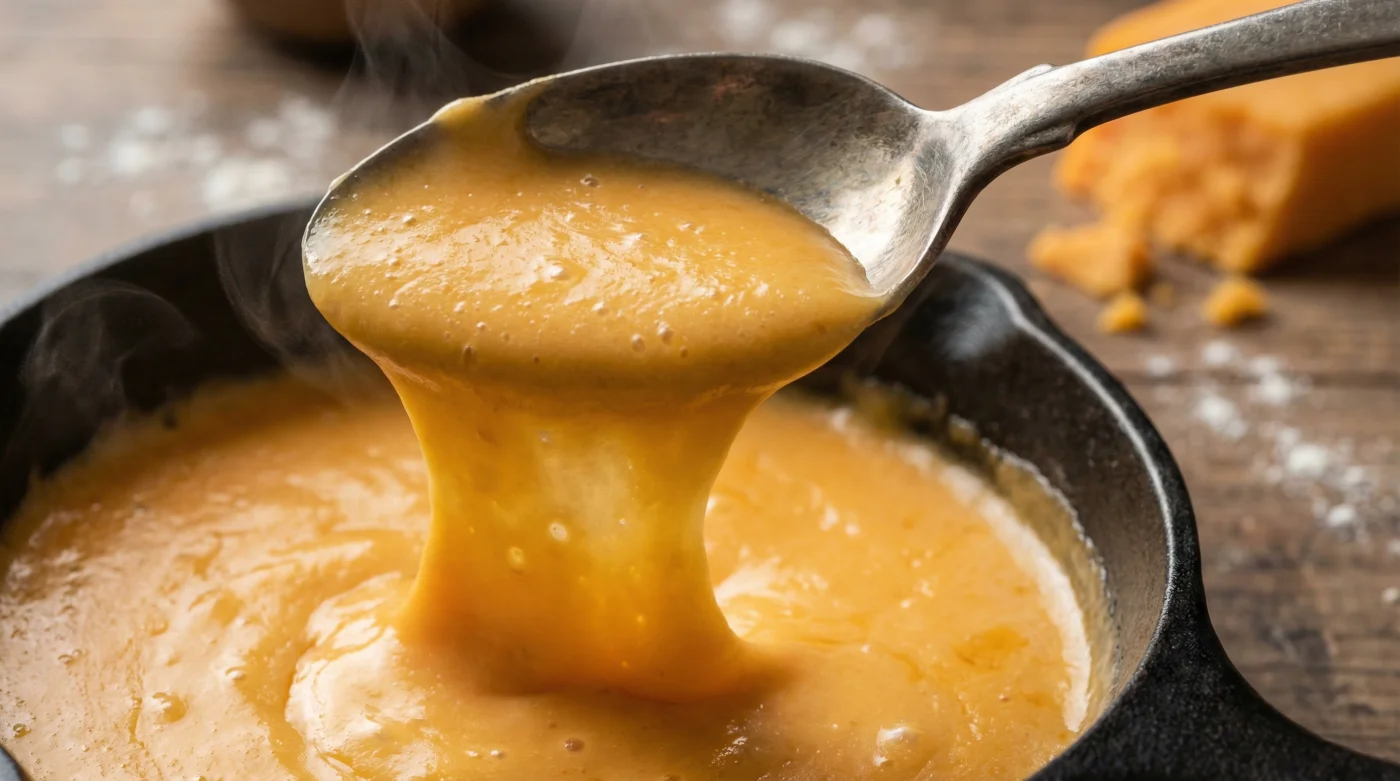
You stand by the stove, watching the heavy-bottomed saucepan catch the afternoon light. The sharp, tangy scent of freshly grated mature West Country cheddar fills the kitchen, carrying grassy notes that promise a deeply savoury meal. It is supposed to be simple. You stir the bright yellow mound into your warm milk or ale, anticipating a glossy, molten pool that will drape perfectly over a thick slice of sourdough toast.
But heat is a brutal mediator, and within seconds, the liquid seizes. A slick of yellow grease floods the edges of the pan, leaving behind a rubbery, grainy clump of protein sitting stubbornly in the centre. The disappointment is palpable as you stare down at a ruined supper, stirring frantically in a futile attempt to force the separated elements back together.
You are not alone in this kitchen heartbreak. We are taught to respect the age of the cheese, to buy the best block we can afford from the local cheesemonger, but we are rarely taught how to protect it from itself. The assumption is that melting cheese is a passive act, something that simply happens when a dairy product meets a heat source.
What looks like a ruined dinner is actually a simple failure of physical chemistry. You do not need professional emulsifying salts, industrial additives, or a culinary science degree to fix it. You only need a pinch of something already sitting forgotten at the back of your baking cupboard to change the outcome completely.
The Architecture of Emulsion
Think of mature cheddar as a precarious microscopic balancing act. Inside that solid block, water, fat, and casein proteins are locked into a tight, delicate embrace. When you apply heat to the pan, that internal structure starts to vibrate and loosen. If the environment gets too hot, the embrace shatters entirely, forcing the elements to find new microscopic partners.
The casein proteins instantly clump together, squeezing out the trapped fat like water from a wrung sponge. This is why cheese splits, creating that dreaded oily layer that coats the back of your spoon. It is doing exactly what nature intended when exposed to sudden, unprotected thermal stress on the hob.
This is where the silent magic of a humble household starch comes into play. By tossing your grated cheddar in a mere dusting of cornflour before it ever touches the heat, you fundamentally alter the physical rules of the melting process. You are introducing a protective mediator to the pan.
The starch physically coats each microscopic droplet of fat as it is released from the protein matrix. It forms a protective barrier, preventing the fat molecules from coalescing into a greasy puddle while simultaneously keeping the proteins from knotting into rubbery lumps. The starch acts as an invisible scaffold for the cheese to melt into seamlessly.
Take Simon, a 38-year-old head chef at a bustling gastropub in Bristol. For years, he battled with massive batches of Welsh rarebit during frantic Friday night services, where a momentary lapse in temperature control meant throwing out an entire twenty-litre vat of split sauce. His turning point arrived when an older pastry chef suggested tossing the raw, grated farmhouse cheddar with a handful of cornflour. Simon discovered that this simple starch addition defied the reality of oily, separated sauces entirely. The cornflour absorbed the excess moisture and locked the fat in place, allowing the cheese to melt into a trembling, glassy ribbon even under the harsh glare of an industrial salamander grill.
Tailoring the Starch Solution
Not every melted cheese scenario requires the exact same approach. Understanding how to adjust this two-ingredient modification ensures your results remain consistently flawless, regardless of what you are cooking. You adapt the exact ratios to suit the specific moisture content of the dish you are building.
For the purist crafting a delicate fondue on the stovetop, the trick is absolute subtlety. You want a very light coating, just enough to make the grated strands look slightly matte without leaving any powdery residue at the bottom of the bowl. This preserves the sharp, complex tang of the cheddar without muting the flavour profile.
- Brown butter stops burning instantly whisking in this cold milk powder.
- Fresh pasta dough develops flawless elasticity resting beneath warm damp towels.
- Leftover potato peelings transform into premium zero waste gourmet pub crisps.
- Balsamic vinegar glazes achieve restaurant thickness skipping aggressive rapid boiling reductions.
- Split hollandaise sauce emulsifies perfectly adding this single boiling water splash.
For the batch-cook preparing meals for the week, the cornflour trick allows you to create a sauce that survives the refrigerator. The starch holds the emulsion tight as the temperature drops, meaning your homemade cheese sauce will reheat in the microwave smoothly, rather than splitting into a hardened, greasy block of regret.
The Mindful Application
Executing this technique requires nothing more than a mixing bowl and your fingers. It replaces the frantic stirring of a broken sauce with a quiet, sensory process of mindful preparation before the heat is even turned on.
Start by grating your cheese straight from the fridge. Cold dairy grates much more cleanly, giving you distinct, individual strands that are significantly easier to coat evenly with the fine powder.
- Measure your freshly grated cheddar into a wide, dry mixing bowl.
- Sprinkle half a teaspoon of fine cornflour for every two hundred grams of cheese.
- Toss the strands lightly with your fingertips until the glossy surface turns entirely matte.
- Introduce the coated cheese to your warm liquid in small handfuls, stirring in a slow figure-of-eight motion.
Your tactical toolkit for this method is remarkably simple. Keep your base liquid between seventy and eighty degrees Celsius. If you see a single bubble break the surface, pull the pan off immediately. The residual warmth held in the heavy metal is more than enough to coax the starch-coated fat molecules into a smooth, velvety ribbon.
Beyond the Frying Pan
Mastering this tiny, seemingly mundane kitchen detail fundamentally shifts how you operate at the stove. It instantly removes the low-level anxiety that usually accompanies working with expensive dairy, replacing it with a quiet, grounded confidence.
When you no longer fear the split, your entire approach to provisioning changes. You buy better quality cheddar, knowing that your six-pound block of vintage Montgomery will melt just as beautifully as a processed, plastic-wrapped square, but with infinitely more character and depth.
It is about taking back control of the variables in your own kitchen. A solitary pinch of standard cornflour transforms a stressful culinary gamble into a guaranteed outcome, leaving you with nothing else to focus on but the deep, savoury comfort of the food resting on the plate in front of you.
The true secret to a flawless kitchen is knowing how to make the microscopic chemistry work for you, rather than fighting blindly against it.
| Key Point | Detail | Added Value for the Reader |
|---|---|---|
| The Problem | Heat forces the fat and protein in cheese to separate rapidly. | Saves you from throwing away expensive ingredients due to splitting. |
| The Solution | A light dusting of cornflour coats the raw, grated strands. | Provides an invisible physical barrier that holds the emulsion tight. |
| The Temperature | Keep liquids strictly between 70-80 degrees Celsius. | Ensures a perfectly glassy, trembling sauce without risk of boiling. |
Frequently Asked Questions
Can I use plain flour instead of cornflour for this trick?
While plain flour can thicken a liquid, it requires cooking out to remove the raw wheat taste. Cornflour acts instantly as a microscopic coating without leaving a powdery flavour behind.Does this method work with pre-grated bagged cheese?
Pre-grated cheeses are already coated in anti-caking agents like potato starch. While they will not split as easily, grating a fresh block of cheddar yields a vastly superior flavour and melt.How much cornflour is strictly necessary?
A very conservative half-teaspoon per two hundred grams of cheese is entirely sufficient. Too much will turn your sauce unpleasantly gummy and mute the sharpness of the dairy.Will this work for a vegan cheese alternative?
Vegan cheeses are built primarily from coconut oil and starches rather than dairy proteins. They require entirely different melting techniques, so this specific cornflour trick is tailored exclusively to dairy cheese.Can I prepare the coated cheese in advance?
Yes. You can toss your grated cheddar in cornflour and leave it in a sealed container in the fridge for up to two days before you intend to melt it.