The kitchen counter is dusted with a fine layer of fine flour. You gather the shaggy mass of milled wheat and beaten eggs, leaning your body weight into the heel of your hand. It is a quiet, repetitive rhythm, a physical dialogue between you and the raw ingredients.
Yet, when the kneading stops, the trouble often begins. You feed the pale yellow disc into the metal rollers, only to watch it fight back. Instead of stretching into glass-like sheets, you are left staring at brittle edges snapping apart, the surface turning rough and stubborn.
Most domestic cooks blame themselves, assuming they misjudged the ratios or failed to knead with enough vigour. They wrap the tight little boulder tightly in rigid plastic, throwing it into the fridge, hoping the cold will somehow fix the damage.
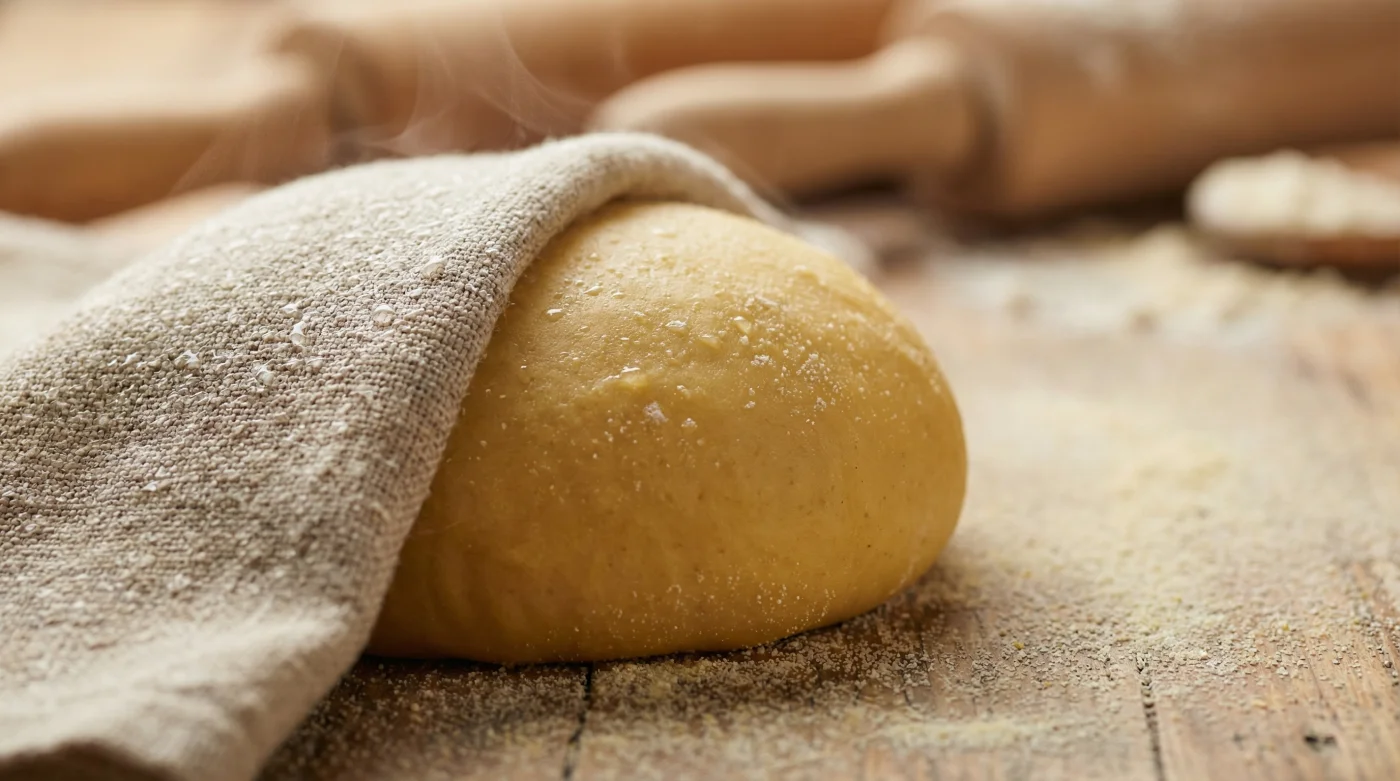
The reality is completely counterintuitive. Fresh pasta dough does not need to be locked away in a cold, suffocating seal. It requires a gentle, humid atmosphere to truly soften. By trading plastic for a warm, moistened cloth, you gain your greatest tactile advantage.
The Muscle Memory of Gluten
When you knead flour and water, you are building a microscopic scaffolding. The gluten strands stretch and weave, creating immense structural tension. Think of it like a knotted shoulder muscle after a strenuous run; applying ice only makes it seize further.
By introducing a warm, damp towel over your resting dough, you are effectively creating a soothing micro-sauna. The gentle, radiant warmth penetrates the surface, while the trapped humidity prevents the outermost layer from drying out and forming a restrictive crust.
This simple environmental shift changes how the proteins behave entirely. Instead of tearing under the mechanical pressure of the rolling machine, the internal structure relaxes completely. What once felt like wrestling a heavy rubber band suddenly feels like spreading soft butter across warm toast.
Consider the daily routine of Elias, a 48-year-old artisan pasta maker working out of a tiny, flour-coated workshop in Hackney. He abandoned cling film a decade ago. After working a large batch of rich egg dough, he immediately drapes it in thick, unbleached linen wrung out in warm water. He insists that dough breathes, and that suffocating it ruins the hydration process. For Elias, the damp cloth forces moisture to distribute evenly, ensuring the centre is just as supple as the exterior.
Tailoring the Microclimate
Not all pasta relies on the exact same environmental treatment. Recognising what sits on your kitchen counter dictates how heavily you soak your resting cloth.
Rich doughs made entirely of egg yolks and fine flour carry a notoriously low hydration level. They are stiff, proud, and incredibly quick to crack. Run your heavy cotton towel under hand-hot water, wringing it only until it stops dripping, to safely coax the stubborn fats into softening without making the exterior sticky.
- Fresh basil leaves turn entirely black enduring standard cold fridge shelf storage.
- Brown basmati rice cooks perfectly soft replacing prolonged boiling with this soak.
- Red wine vinegar instantly tenderises cheap roasting beef bypassing long slow cooking.
- Sourdough bread loaves achieve perfect oven spring using this hidden water tray.
- Cast iron skillets lose essential seasoning entirely boiling simple acidic tomato sauces.
A slightly cooler, lightly damp tea towel provides just enough surface protection without turning the coarse grains to mush. If you are preparing dough hours ahead of a dinner party, let it enjoy its warm rest on the counter for thirty minutes to establish elasticity, before moving the entire bundle to a cooler spot.
The Damp Towel Protocol
Applying this technique is wonderfully straightforward, yet it demands a certain physical mindfulness. You are removing the harshness of plastic and replacing it with a breathable, nurturing weight.
Here is the exact tactical toolkit you need to establish flawless stretching capabilities on your kitchen counter:
- Choose a heavy cotton or linen tea towel, completely avoiding anything with loose, fluffy synthetic fibres that might stick to the food.
- Run the cloth under tap water at roughly 35 degrees Celsius, feeling comfortably warm to the wrists.
- Wring the fabric forcefully; it should feel distinctly wet, but absolutely no water should pool when squeezed.
- Place your kneaded mass on a wooden board and drape the towel directly over it, tucking the edges under to seal out cold drafts.
- Leave undisturbed for a minimum of thirty minutes before attempting to cut or push through a machine.
Beyond the Metal Rollers
Treating your food with this level of tactile care shifts your entire relationship with cooking. You are no longer just following a rigid list of ingredients; you are responding to the environment, the temperature, and the texture beneath your fingers.
When that half-hour of resting concludes, the physical transformation is instantly palpable. The dough slumps slightly against the board, yielding to the slightest pressure of your palm. As you guide it through the machine, it stretches endlessly, holding its structural integrity without a single jagged edge.
This is the true joy of making something entirely from scratch. You take two of the most basic staples in your pantry, and through nothing more than a little warmth and patience, you coax out a texture that feels remarkably expensive. It is a quiet victory won before the water even comes to a rolling boil.
A well-rested dough never fights back; it simply remembers the shape you ask it to hold.
| Key Action | Technical Detail | Added Value |
|---|---|---|
| Ditching Plastic | Using breathable damp linen | Prevents dough from sweating and turning slimy. |
| Temperature Control | Applying 35C warmth | Relaxes tense gluten strands incredibly fast. |
| Draft Blocking | Tucking the towel edges | Stops dry, leathery skin forming on the surface. |
Frequent Curiosities
Why does my pasta tear when rolling? It usually means the gluten is overworked and under-rested, or the surface has dried out.
Can I leave the damp towel on for too long? Yes, after an hour at room temperature, the raw eggs pose a slight risk and the dough may become far too sticky.
Does the type of towel matter? Absolutely. Heavy linen or tight-weave cotton is ideal. Avoid terry cloth as it sheds fibres into your food.
Should I use warm or cold water on the cloth? Warm water is crucial. It acts as a micro-sauna, speeding up the relaxation of the protein structures.
What if my dough still feels hard after resting? It may simply lack initial hydration. Next time, add a teaspoon of water during the kneading phase before applying the towel.